Quick Answer
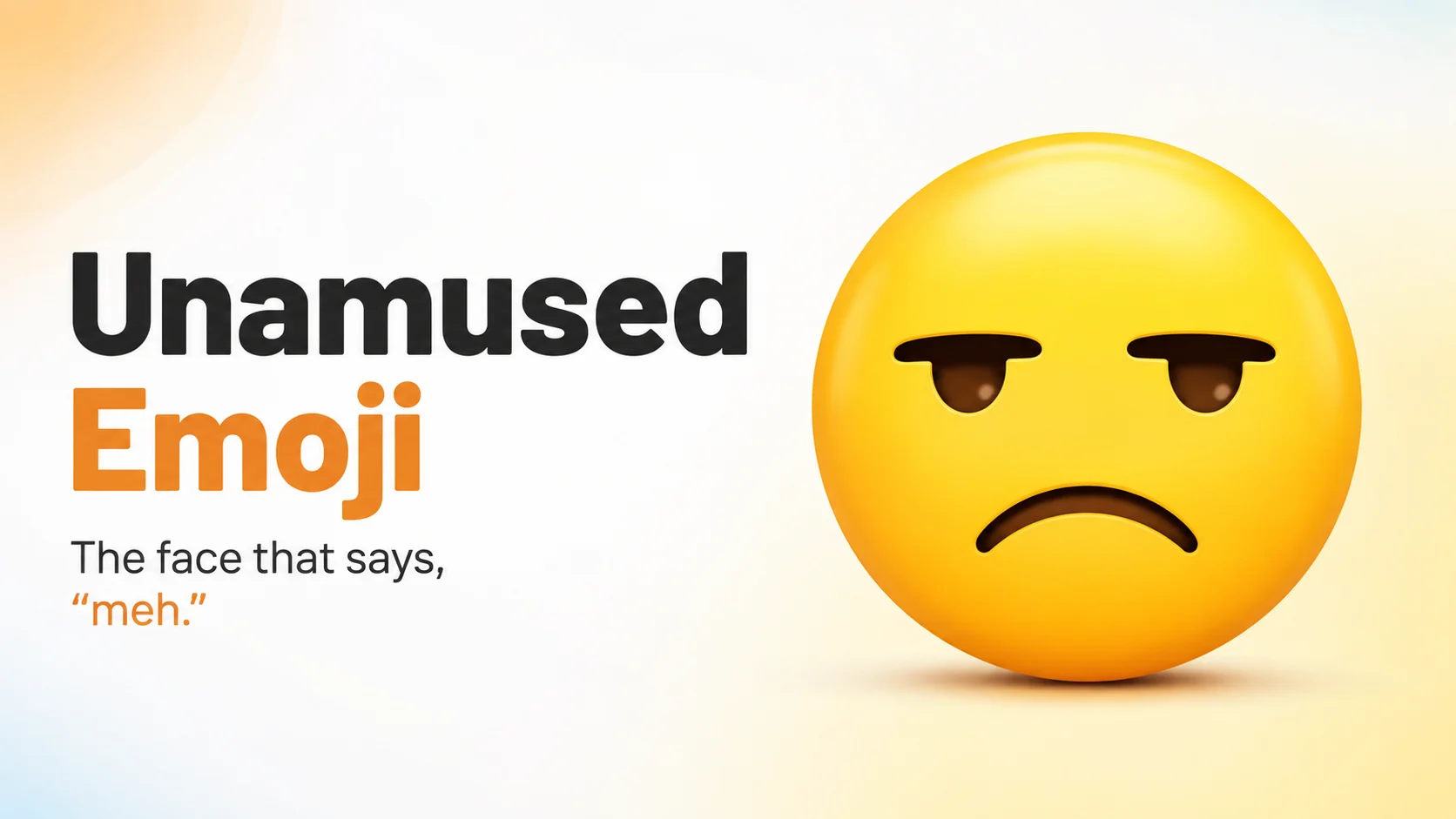
The unamused emoji 😒, officially called Unamused Face, usually expresses annoyance, displeasure, skepticism, dissatisfaction, or a lack of enthusiasm. Its sideways-looking eyes and flat, slightly frowning mouth can make a message feel unimpressed or irritated. In texts, 😒 may be used seriously or playfully, and its exact meaning depends on the words, relationship, and situation.
😒 is one of those emojis that can communicate a lot without saying much. The unamused emoji, officially known as Unamused Face, typically shows that someone is unimpressed, dissatisfied, annoyed, or not particularly interested in what is being said.
In everyday texting, someone might send 😒 after hearing an excuse they do not believe, receiving an unwanted suggestion, or reacting to something they find irritating. It can also be used playfully when a friend is teasing them.
The tone depends heavily on context. “You really ate my leftovers 😒” may sound mildly annoyed but playful, while “Fine, do whatever you want 😒” can feel much more serious or irritated. The emoji itself does not automatically prove anger, hostility, or sarcasm.
What Does the Unamused Emoji 😒 Mean?
The most common meaning of 😒 is unimpressed, annoyed, dissatisfied, or skeptical.
The expression combines narrowed sideways-looking eyes with a flat mouth, creating a feeling that the sender is not pleased with something.
People commonly use 😒 to communicate:
- “I’m not impressed.”
- “I don’t like that.”
- “Seriously?”
- “I’m annoyed.”
- “That’s disappointing.”
- “I’m skeptical.”
- “I’m not interested.”
- “I’m not buying that explanation.”
The exact interpretation depends on what happened in the conversation.
What Does 😒 Mean in Texting?
In texting, 😒 often acts as a quick emotional reaction to something irritating, disappointing, questionable, or boring.
For example:
“You forgot again 😒”
Likely meaning: The sender is disappointed or annoyed.
“You expect me to believe that? 😒”
Likely meaning: The sender is skeptical or unimpressed.
“Another meeting tomorrow 😒”
Likely meaning: The sender is unhappy about the situation.
“Okay, whatever 😒”
Likely meaning: The sender may be irritated or dismissive.
The emoji can make a short message feel more emotionally charged than the words alone.
What Tone Does 😒 Have?
😒 usually has a negative or mildly negative tone.
Depending on context, it can feel:
- Unimpressed
- Annoyed
- Skeptical
- Disappointed
- Bored
- Dismissive
- Irritated
- Sarcastic
- Playfully frustrated
It is generally stronger than 😐, which is more neutral, but it does not necessarily communicate intense anger.
A useful way to think about 😒 is: “I’m not happy about this, and I want you to know it.”
Can 😒 Be Sarcastic?
Yes. 😒 is frequently capable of taking on a sarcastic tone, especially when the words themselves are exaggerated or obviously playful.
For example:
“Wow, what a surprise 😒”
If the speaker expected the outcome, the emoji can reinforce the sarcasm.
But 😒 is not officially a “sarcasm emoji.” Sarcasm comes from the combination of wording, situation, and tone.
Is 😒 a Rude Emoji?
It can come across as rude in some conversations.
Sending only:
“😒”
may feel dismissive because the recipient has little information about what caused the reaction.
In a close friendship, however, the same emoji could be harmless teasing:
“You finished the whole pizza without me 😒”
The relationship and previous communication style can make a major difference.
If you want to avoid sounding harsh, adding words can make your intention clearer.
Is 😒 Flirty?
😒 is not normally a romantic or flirty emoji.
It can appear in playful flirting when someone is pretending to be annoyed, but the emoji itself usually communicates displeasure, skepticism, or unimpressed feelings rather than attraction.
For example:
“You’re really going to make me wait that long? 😒”
In a playful conversation, this could be teasing. In another situation, it might simply express genuine annoyance.
The surrounding conversation matters more than the emoji alone.
What Does 😒 Mean From Someone?
If someone sends you 😒, they may be saying that they are annoyed, unimpressed, disappointed, skeptical, or dissatisfied.
Look at the message around it.
“You seriously forgot? 😒”
Likely annoyance or disappointment.
“Yeah, sure 😒”
Could suggest skepticism or disbelief.
“You always do this 😒”
More likely genuine frustration.
“Look who finally showed up 😒”
Could be playful teasing or mild irritation.
Rather than assuming exactly what the sender feels, consider what happened immediately before the emoji.
What Does 😒 Mean in a Relationship?
In a relationship, 😒 can express irritation, disappointment, or playful frustration.
For example:
“You said you were going to call 😒”
This could indicate genuine disappointment.
But:
“You watched the next episode without me 😒”
could be playful annoyance between people who are comfortable teasing each other.
The emoji should not be treated as proof that someone is angry or upset with the relationship itself. It usually reacts to a specific situation.
Related Emojis and Their Meanings
| Emoji | Official Name | Common Meaning | Tone | Where or When It Is Used |
|---|---|---|---|---|
| 😒 | Unamused Face | Annoyance, displeasure, skepticism | Unimpressed, irritated | Complaints, reactions, disappointment |
| 😑 | Expressionless Face | Lack of emotion, boredom, resignation | Flat, neutral-negative | Awkward moments, dull situations, disbelief |
| 🙄 | Face with Rolling Eyes | Exasperation, disbelief, annoyance | Sarcastic, dismissive | Responding to excuses, clichés, or irritating comments |
| 😐 | Neutral Face | Little or no emotional reaction | Neutral, restrained | Awkward or uncertain situations |
| 😕 | Confused Face | Confusion or uncertainty | Confused, concerned | Unclear messages or unexpected situations |
| 😞 | Disappointed Face | Sadness or disappointment | Sad, subdued | Letdowns, failed expectations |
| 😤 | Face with Steam From Nose | Frustration, determination, or anger | Intense, forceful | Strong frustration or standing one’s ground |
| 😏 | Smirking Face | Smugness, mischief, or sly confidence | Cheeky, sly | Teasing or suggestive situations |
The biggest distinction is between 😒, 😑, and 🙄. 😒 usually communicates active displeasure or unimpressed feelings, while 😑 is more emotionally flat. 🙄 adds a stronger sense of exasperation or dismissive disbelief.
😐 is more neutral, so it is less likely to communicate clear annoyance. 😞 focuses more on disappointment or sadness, while 😤 is generally more intense and forceful.
😒 vs. 😑: What’s the Difference?
Both emojis can communicate a negative reaction, but they have different visual and emotional qualities.
😒 Unamused Face usually looks more actively unimpressed or irritated.
😑 Expressionless Face looks emotionally flat, as if the person has little left to say.
Compare:
“You forgot the tickets 😒”
This sounds annoyed.
“You forgot the tickets 😑”
This can sound more like resignation, disbelief, or “I don’t even know what to say.”
😒 vs. 🙄: What’s the Difference?
😒 generally communicates displeasure or being unimpressed.
🙄, officially Face with Rolling Eyes, more strongly suggests exasperation, disbelief, or dismissive frustration.
For example:
“You did it again 😒”
This can simply mean “I’m annoyed.”
“You did it again 🙄”
This more strongly suggests “Seriously? Not this again.”
They can overlap, but 🙄 often gives the reaction a more obvious dismissive or sarcastic edge.
😒 vs. 😐: What’s the Difference?
😐 is Neutral Face, so it usually communicates little emotional reaction.
😒 is more clearly negative.
Compare:
“Okay 😐”
Could mean the person is unsure, neutral, or not very expressive.
“Okay 😒”
More likely means they are unhappy, unimpressed, or irritated.
If you want to communicate that something is bothering you, 😒 is much clearer than 😐.
When Should You Use 😒?
😒 works well when you want to show mild annoyance, skepticism, or disappointment.
You might use it when:
- Someone gives an excuse you do not believe
- A friend teases you
- Something disappointing happens
- Someone repeats an annoying behavior
- You are unimpressed by a suggestion
- You want to express mild frustration
- A situation feels irritating or unfair
Examples:
“You ate my snacks again 😒”
Playful or genuine annoyance.
“That was your excuse? 😒”
Skepticism or disbelief.
“I have to wake up at 5 a.m. tomorrow 😒”
Displeasure about an unwanted situation.
When Could 😒 Be Misunderstood?
A single 😒 can be difficult to interpret because it provides no explanation.
For example:
“Okay 😒”
The recipient may wonder whether the sender is angry, disappointed, joking, or simply unimpressed.
The same emoji can also feel much harsher when sent after a serious message.
If the situation matters, use words to clarify:
“I’m a little annoyed about that 😒”
This leaves much less room for confusion.
How to Respond to 😒 in a Text
The best response depends on what caused the reaction.
If they seem genuinely annoyed
“Sorry, I didn’t mean to bother you.”
If you are unsure
“Are you actually annoyed or just teasing me?”
Avoid assuming that every 😒 means the person is angry with you. Sometimes it is just playful frustration.
Copy and Paste the Unamused Emoji
😒
You can copy and paste 😒 into texts, comments, captions, messages, and other supported apps.
Official Name and Unicode Details
The official Unicode name for 😒 is Unamused Face. Its Unicode code point is U+1F612. Unicode identifies the character as part of the emoji character set, while Emojipedia describes it as a face commonly associated with displeasure, dissatisfaction, and skepticism.
The artwork can vary slightly between operating systems and platforms, but the central expression remains recognizable: a yellow face with a flat mouth and eyes looking to the side.
FAQs
What does 😒 mean?
😒 usually means annoyance, displeasure, skepticism, dissatisfaction, or being unimpressed.
Is 😒 a negative emoji?
Generally, yes. It usually communicates some level of negative or dissatisfied emotion, although friends may use it playfully.
Does 😒 mean angry?
It can suggest irritation, but it does not necessarily mean intense anger. It is usually milder than emojis associated with strong anger.
Does 😒 mean annoyed?
Yes. Annoyance is one of the most common ways people interpret 😒.
Can 😒 mean sarcasm?
Yes. It can support a sarcastic message, but sarcasm depends on the complete context rather than the emoji alone.
Is 😒 rude?
It can feel rude or dismissive, particularly when sent by itself. In a close friendship, however, it may simply be playful teasing.
Conclusion
The unamused emoji 😒, officially called Unamused Face, usually communicates that someone is annoyed unimpressed, skeptical, or dissatisfied. Its meaning can range from mild frustration to playful teasing depending on the conversation.
The most useful distinction is between 😒 and similar faces. 😒 is generally more negative than 😐, flatter than an openly angry reaction, and less specifically dismissive than 🙄. When you see it in a text, consider the words around it and the relationship with the sender before deciding exactly what they mean.
Discover More Related Articles:
- Giggle Emoji | From Shy Laughs to Playful Moments In 2026
- Smug Emoji | Flirty, Playful, Confident & Sarcastic Meanings In 2026
