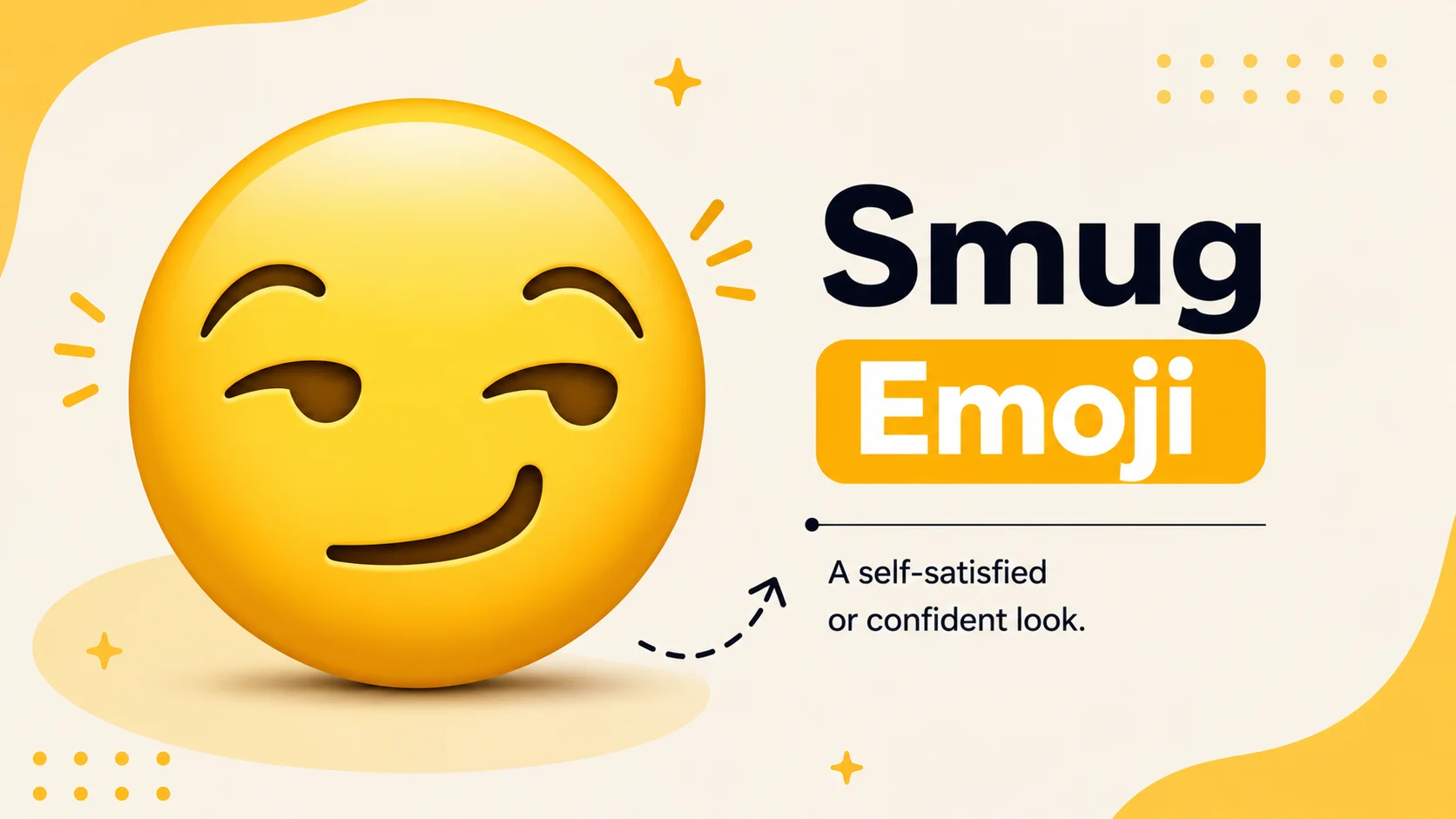
Quick Answer
The 😏 emoji is officially called Smirking Face and commonly expresses a smug, self-satisfied, sly, teasing, or suggestive attitude. In texting, it can mean something like “I know what I’m doing,” “I know something you don’t,” or “I’m teasing you.” Depending on the conversation, it can also feel flirty or sarcastic. The emoji does not have one fixed meaning, so the surrounding words and relationship between the people matter.
The 😏 emoji can be a surprisingly tricky one to interpret. Its half-smile, raised eyebrow, and sideways glance can make a message feel confident, smug, playful, teasing, sarcastic, or suggestive without saying much at all. That is why the same emoji can feel funny in one conversation and slightly uncomfortable in another.
When someone uses the smug emoji, they may be showing satisfaction with themselves, hinting that they know something, teasing another person, or acting deliberately confident. For example, “I told you I was right 😏” sounds self-satisfied, while “Guess who got the last cookie 😏” has a playful, mischievous tone.
The most important thing to remember is that 😏 does not automatically mean flirting. It can carry a flirty or suggestive tone, but context decides whether the sender is joking, teasing, bragging, being sarcastic, or actually flirting.
What Does the 😏 Smug Emoji Mean?
The official Unicode name for 😏 is Smirking Face. It commonly communicates a sideways, self-assured, or knowing expression.
Depending on context, it can suggest:
- Smugness
- Self-confidence
- Satisfaction
- Mischief
- Teasing
- Sarcasm
- A knowing attitude
- Playful confidence
- Suggestiveness
- Flirting in some conversations
The word “smug” describes one common interpretation, but it is not the official emoji name. The official name is Smirking Face.
A message such as:
“I knew that was going to happen 😏”
can sound confident and slightly smug.
By contrast:
“You looked really good today 😏”
could carry a more suggestive or flirty tone depending on the relationship and conversation.
😏 Meaning in Text Messages
In texting, 😏 often adds an attitude that plain words might not communicate.
Compare:
“I knew it.”
with:
“I knew it 😏”
The second version sounds more confident and self-satisfied.
It can also make a teasing statement feel playful:
“You really thought you could beat me? 😏”
Here, the sender may be playfully confident rather than genuinely arrogant.
The emoji can also imply that there is an unstated joke or hidden meaning:
“Oh, I have an idea 😏”
In that situation, the sender may be hinting that they have something planned without explaining it yet.
Is 😏 a Smug Emoji?
Yes, 😏 is commonly interpreted as a smug or self-satisfied emoji, although its official Unicode name is Smirking Face.
The expression often gives the impression that the sender feels pleased with themselves or believes they have an advantage.
For example:
“Told you I’d finish first 😏”
The emoji reinforces the feeling of “I told you so.”
However, smugness is only one possible interpretation. A person may also use 😏 simply to tease, joke, flirt, or make a statement sound knowingly confident.
Is 😏 a Flirty Emoji?
It can be flirty, but it is not automatically a flirting emoji.
For example:
“You really want me to come over? 😏”
In the right context, this could sound suggestive or flirtatious.
But:
“I finished my homework before you 😏”
is more likely playful competition or teasing.
This difference shows why it is risky to interpret 😏 by itself. Look at the words, the relationship, the conversation history, and the tone the sender normally uses.
A single 😏 is not proof that someone is romantically interested.
What Does 😏 Mean From Someone?
When someone sends 😏 directly to you, the meaning depends heavily on what came before it.
They may be:
- Teasing you
- Acting confident
- Bragging playfully
- Hinting at something
- Making a joke
- Being sarcastic
- Showing satisfaction
- Flirting, depending on the context
For example:
You: “I bet you can’t guess what I bought.”
Them: “I already know 😏”
This sounds like a knowing or confident response.
On the other hand:
You: “You look great today.”
Them: “Thanks 😏”
could simply sound confident or playful. It does not automatically establish romantic interest.
Can 😏 Be Sarcastic?
Yes. The smirking expression works well with sarcasm because it can signal that the sender does not mean the words completely literally.
For example:
“Yeah, that was definitely your best idea 😏”
Depending on the conversation, this could be playful sarcasm rather than genuine praise.
Another example:
“Great job arriving five minutes late 😏”
Here, the emoji can reinforce a teasing or sarcastic tone.
Because sarcasm depends on context, the emoji should not be treated as proof that a message is sarcastic.
Can 😏 Be Rude?
It can.
A message such as:
“I knew you would mess that up 😏”
could sound smug or condescending, especially if the sender and recipient are not close.
The same emoji between friends may be harmless teasing:
“I beat you again 😏”
The difference is not the emoji alone. The words, relationship, and situation determine how the message lands.
If you’re unsure, consider whether the statement would sound friendly without the emoji. If it already sounds insulting, 😏 may make the attitude feel even stronger.
😏 vs. 😉: What’s the Difference?
The two emojis are often confused because both can communicate playfulness or teasing.
😏 Smirking Face usually feels more self-assured, sly, smug, or knowing.
😉 Winking Face is generally more straightforwardly playful, joking, or suggestive.
Compare:
“I knew you’d say yes 😏”
This sounds confident or self-satisfied.
“I knew you’d say yes 😉”
This feels more playful and lighthearted.
Neither emoji has one guaranteed meaning, but the difference in facial expression can change the emotional tone.
Related Emojis and Their Meanings
| Emoji | Official Name | Common Meaning | Tone | Where or When It Is Used |
|---|---|---|---|---|
| 😏 | Smirking Face | Smugness, teasing, knowing confidence | Sly, confident | Teasing, playful boasts, hints |
| 😉 | Winking Face | Joking, teasing, playful implication | Light, playful | Jokes, friendly teasing, playful comments |
| 😎 | Smiling Face with Sunglasses | Confidence, coolness, relaxed satisfaction | Cool, confident | Achievements, jokes, casual confidence |
| 😌 | Relieved Face | Calmness, contentment, satisfaction | Peaceful, relaxed | Feeling pleased, relieved, or comfortable |
| 😈 | Smiling Face with Horns | Mischief or playful troublemaking | Mischievous, bold | Jokes, pranks, playful trouble |
| 🤭 | Face with Hand Over Mouth | Amusement, embarrassment, hiding a reaction | Playful, coy | Laughing, teasing, awkward moments |
| 😜 | Winking Face with Tongue | Silly teasing or joking | Goofy, playful | Jokes, playful banter |
| 😼 | Cat with Wry Smile | Slyness, mischief, smug humor | Mischievous | Playful or humorous reactions |
The closest match is usually 😉 Winking Face, but the emotional feel is different. 😏 tends to have a more knowing or self-satisfied edge, while 😉 often feels lighter and more openly playful.
😎 is better when the goal is confident or “cool” rather than sly. 😌 communicates calm satisfaction without the mischievous expression. 😈 can make a playful message feel more mischievous or deliberately naughty.
😏 vs. 😈: What’s the Difference?
Both emojis can appear mischievous, but they communicate different levels of attitude.
😏 Smirking Face is more subtle. It can suggest a knowing smile, confidence, teasing, or smug satisfaction.
😈 Smiling Face with Horns is more openly mischievous. It often suggests that the sender is intentionally being playful or causing trouble.
For example:
“I know something you don’t 😏”
sounds sly and knowing.
“I have a terrible idea 😈”
sounds more deliberately mischievous.
😏 vs. 😎: What’s the Difference?
😏 and 😎 can both communicate confidence, but they do it differently.
😎 usually communicates relaxed confidence, coolness, or satisfaction.
Compare:
“I knew I could do it 😏”
The speaker sounds self-satisfied.
“I finally passed the test 😎”
The speaker sounds pleased and confident.
If you want a friendly “I did it” feeling, 😎 is usually less provocative than 😏.
Text Message Examples
1. Playful Confidence
“I told you I’d win 😏”
Likely meaning: The sender is enjoying being right and teasing the other person.
2. Knowing Hint
“Oh, I know what you’re talking about 😏”
Likely meaning: The sender is suggesting they understand something without explaining it directly.
3. Friendly Teasing
“You thought I wouldn’t notice? 😏”
Likely meaning: Playful confidence or teasing.
4. Sarcastic Reaction
“Amazing timing 😏”
Likely meaning: Depending on the situation, the sender may be joking about poor timing.
5. Possible Flirty Context
“So you want to see me again? 😏”
Likely meaning: This can sound flirtatious or suggestive, but the surrounding conversation determines whether that is actually intended.
How to Respond to 😏
There is no single correct response because 😏 can have several meanings.
If they’re teasing you:
“Okay, okay 😂”
If they’re joking:
“I see what you’re doing 😏”
When the context is unclear, a simple question is often better than assuming the sender is flirting or being rude.
Common Misunderstandings About 😏
😏 does not always mean flirting
The emoji can be flirty, but it can also mean teasing, confidence, smugness, sarcasm, or a knowing attitude.
😏 does not automatically mean someone is being rude
Among friends, it may simply be playful. In a tense conversation, the same emoji can feel condescending.
😏 is not the same as 😉
Both can be playful, but 😏 tends to have a more sly or self-satisfied feel, while 😉 is generally more openly playful.
😏 does not prove romantic interest
An emoji cannot establish someone’s feelings on its own. Look at the full conversation rather than treating the emoji as a definite signal.
😏 does not always mean someone has a secret
The expression can suggest a knowing attitude, but the sender may simply be joking or teasing.
Official Emoji Details
The official Unicode name for 😏 is Smirking Face. Its Unicode code point is U+1F60F. Unicode identifies it as part of the facial-expression emoji set. (Unicode Consortium)
Emojipedia describes 😏 as Smirking Face and notes its association with a range of interpretations including smugness, flirtation, and self-satisfaction. (Emojipedia)
The artwork can vary slightly between Apple, Google, Samsung, and other platforms. The basic expression remains recognizable as a sideways-looking face with a raised, knowing smile.
FAQs
What is the official name of 😏?
The official Unicode name is Smirking Face.
What does the 😏 emoji mean in texting?
It commonly communicates smugness, confidence, teasing, a knowing attitude, or a sly reaction. In some contexts, it can also be flirty or suggestive.
Is 😏 the smug emoji?
Yes, 😏 is commonly called the smug emoji, although its official name is Smirking Face.
Does 😏 mean flirting?
It can. However, the emoji can also be used for teasing, sarcasm, confidence, or playful smugness, so context matters.
Is 😏 a sarcastic emoji?
It can be used sarcastically, particularly when the words already have a teasing or ironic tone.
Conclusion
The 😏 emoji is officially called Smirking Face, but it is commonly recognized as the smug emoji because of its self-satisfied, knowing expression. It can communicate confidence, teasing, sarcasm, mischief, or a sly attitude.
In some conversations, 😏 can also feel flirty or suggestive, but it should not automatically be interpreted that way. The words around the emoji, the relationship between the people, and the overall tone of the conversation provide much better clues.
If you want a lighter playful reaction, 😉 may work better. For relaxed confidence, 😎 is usually a better fit, while 😈 adds a stronger mischievous feeling. Choosing between them depends on the exact attitude you want to communicate.
Discover More Related Articles:
- Sweat Smile Emoji | Is It Nervous, Embarrassed or Happy In 2026
- Tired Face Emoji | Exhausted, Frustrated or Overwhelmed In 2026
