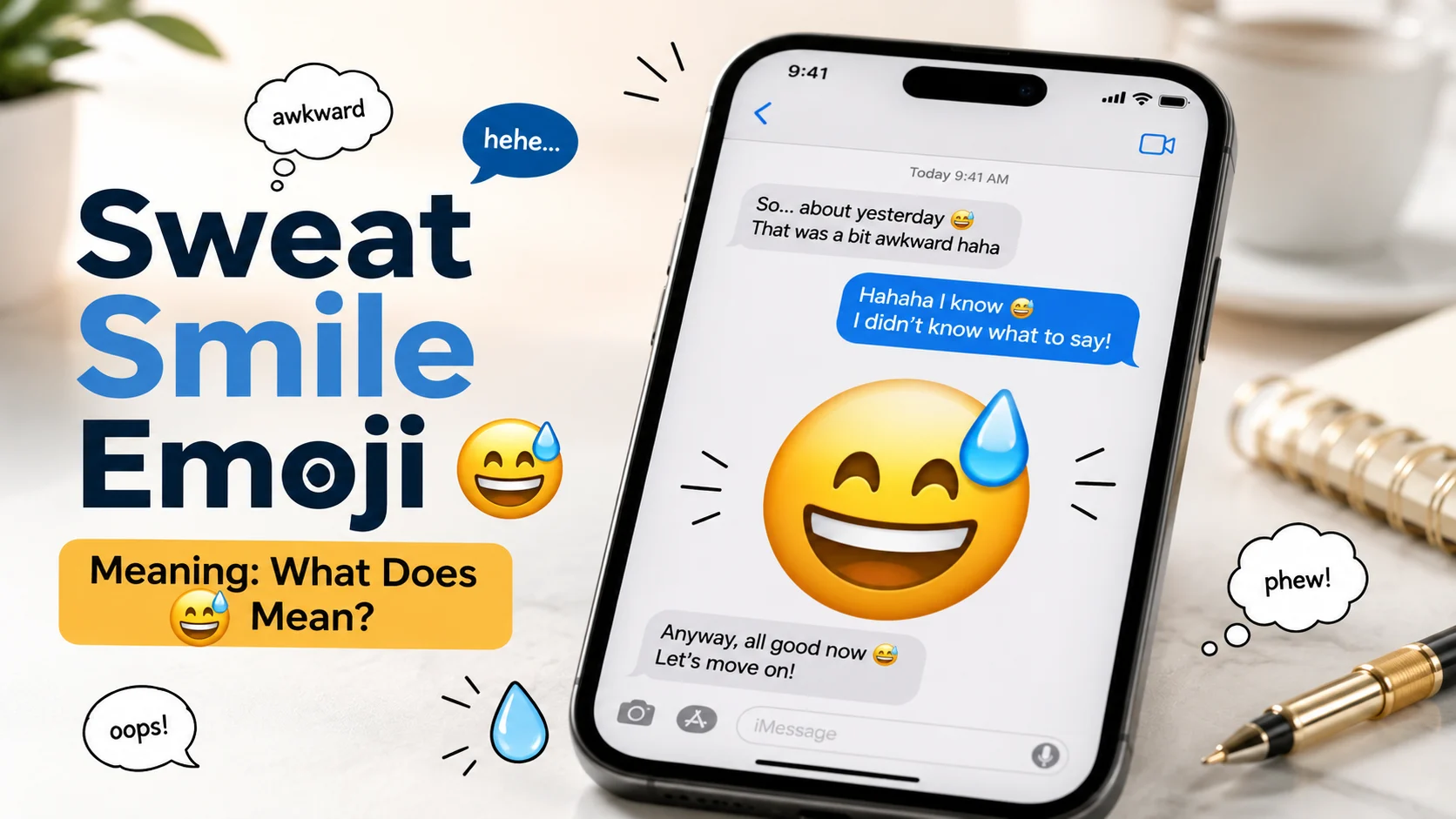
Quick Answer
The 😅 Grinning Face with Sweat emoji usually expresses nervous laughter, awkwardness, mild embarrassment, or relief after a stressful or close situation. It can feel like saying, “Whew,” “That was awkward,” or “I’m laughing, but I’m a little uncomfortable.” The exact tone depends on the message around it. It can be genuinely funny, slightly embarrassed, or a way to soften an awkward statement.
The 😅 emoji looks happy at first glance, but the single bead of sweat adds another layer. Unlike a simple smiling emoji, it can suggest that something is funny while also being awkward, stressful, embarrassing, or unexpectedly close. That combination is why people often use it when a plain smile would not fully capture the mood.
The sweat smile emoji is officially called Grinning Face with Sweat by Unicode. It shows a broad grin with a bead of sweat, and its common interpretations include nervous laughter, awkwardness, embarrassment, and relief. Emojipedia also notes its use for the feeling of getting through a close call and thinking, “Whew!”
Context matters most. 😅 can make a funny story feel more self-conscious, soften an embarrassing admission, or show relief after something almost went wrong. It does not automatically mean that the sender is nervous or embarrassed; sometimes the sweat simply adds playful exaggeration.
What Does the 😅 Sweat Smile Emoji Mean?
The 😅 emoji commonly combines happiness with a little tension.
Depending on the situation, it can mean:
- “That was awkward.”
- “I’m nervous, but I’m smiling.”
- “That was embarrassing.”
- “Whew, I got through that.”
- “That was almost a disaster.”
- “I’m laughing at myself.”
- “That situation was uncomfortable.”
- “I’m joking, but this is a little awkward.”
The key visual detail is the sweat drop. The grin suggests a positive or humorous reaction, while the sweat can introduce nervousness, stress, embarrassment, or relief.
Unicode’s current emoji data lists keywords associated with 😅 including nervous, stress, stressed, sweat, excited, cold, and dejected, showing why its interpretation can extend beyond simple happiness.
😅 Meaning in Text Messages
In texting, 😅 is often used when someone wants to acknowledge an awkward or uncomfortable situation without making the message sound too serious.
For example:
“I totally forgot the meeting was today 😅”
The emoji makes the admission feel lighter and slightly embarrassed.
Another example:
“That was a close one 😅”
Here, the emoji communicates relief.
And:
“I accidentally sent that message to the wrong person 😅”
The tone becomes embarrassed and self-aware rather than completely serious.
The words tell you what happened; 😅 helps show how the sender feels about it.
When 😅 Means Nervous Laughter
Sometimes 😅 is essentially a visual version of nervous laughter.
Someone may use it after saying something that feels uncomfortable, uncertain, or slightly embarrassing.
Example:
“I haven’t started the assignment yet 😅”
The sender is not necessarily laughing because the situation is genuinely funny. The emoji can communicate, “Yeah… this is not ideal.”
This makes 😅 useful for softening an admission or acknowledging an awkward situation.
😅 Meaning as Relief
One of the most common uses of 😅 is relief after something almost went wrong.
For example:
“I thought I lost my phone, but it was in my bag 😅”
Here, the emoji can be read as:
“Whew, that scared me.”
The situation has a happy ending, but the sweat drop shows that there was some tension before the relief.
This is different from 😂, which focuses much more directly on laughter.
😅 Meaning When Something Is Embarrassing
The sweat smile emoji can also communicate mild embarrassment.
For example:
“I called my teacher ‘Mom’ in class 😅”
The situation is embarrassing, but the sender is treating it lightly.
The emoji helps communicate self-conscious humor rather than serious distress.
😅 Meaning in a Funny Situation
😅 can absolutely be used when something is funny. However, it usually adds an extra feeling that a straightforward laughing emoji does not.
Compare:
“I just walked into the wrong classroom 😂”
This emphasizes humor.
“I just walked into the wrong classroom 😅”
This can feel more like, “That was embarrassing, but now I can laugh about it.”
That small difference is one of the most useful ways to understand 😅.
Is 😅 a Happy Emoji?
Yes, but it is not purely happy.
The grin makes 😅 positive or humorous on the surface, while the sweat drop adds nervousness, awkwardness, embarrassment, stress, or relief.
Think of it as a mixed-emotion smile.
It can communicate:
“I’m okay, but that was a little uncomfortable.”
or
“That was stressful, but everything worked out.”
That is why it often fits situations where 🙂 or 😄 would feel too simple.
Is 😅 Flirty?
😅 can appear in playful or flirty conversations, but it is not inherently a flirting emoji.
For example:
“You really think I’m cute? 😅”
Here, the emoji could make the response feel shy or embarrassed.
But:
“I forgot my keys again 😅”
has nothing to do with flirting.
The emoji itself does not prove romantic interest. The words and overall conversation provide the relevant context.
What Does 😅 Mean From Someone?
If someone sends you 😅, they may be trying to make a situation feel lighter.
Possible interpretations include:
- They are embarrassed about something.
- They are laughing nervously.
- They feel awkward.
- They are relieved.
- They are joking about their own mistake.
- They are softening an uncomfortable statement.
For example:
“I completely misunderstood what you meant 😅”
This probably communicates self-aware embarrassment.
But:
“We made it just before the doors closed 😅”
is more likely to communicate relief.
The same emoji can therefore have different meanings even within similar conversations.
Does 😅 Mean Sarcasm?
Sometimes, but not automatically.
😅 can make a sarcastic or ironic statement feel softer.
For example:
“Sure, I absolutely love doing homework at midnight 😅”
The words suggest irony, while the emoji reinforces the uncomfortable humor.
However, sarcasm usually comes from the wording and situation. 😅 alone does not mean “sarcasm.”
Related Emojis and Their Meanings
| Emoji | Official Name | Common Meaning | Tone | Where or When It Is Used |
|---|---|---|---|---|
| 😅 | Grinning Face with Sweat | Nervous laughter, awkwardness, relief | Awkward, relieved, playful | Embarrassing moments, close calls, uncomfortable jokes |
| 😂 | Face with Tears of Joy | Strong laughter or amusement | Very funny, joyful | Jokes, hilarious situations, funny reactions |
| 😄 | Grinning Face with Smiling Eyes | Genuine happiness and cheerful amusement | Happy, upbeat | Friendly conversations, positive reactions |
| 😬 | Grimacing Face | Awkwardness, tension, discomfort | Uncomfortable, nervous | Cringe moments, difficult situations, uncertainty |
| 😳 | Flushed Face | Embarrassment, surprise, shyness | Startled, embarrassed | Unexpected compliments, awkward moments, surprise |
| 😓 | Downcast Face with Sweat | Sadness, frustration, disappointment, stress | Worried, discouraged | Difficult situations, setbacks, emotional frustration |
| 😰 | Anxious Face with Sweat | Anxiety, worry, nervousness | More serious and tense | Worry, fear, stressful situations |
| 🫠 | Melting Face | Overwhelmed, embarrassed, exhausted, or ironic discomfort | Overwhelmed, humorous | Awkward moments, stressful situations, self-deprecating humor |
| 😉 | Winking Face | Playfulness, joking, teasing | Playful, suggestive, light | Jokes, teasing, playful messages |
The most important distinction is between 😅 and 😓. Both contain sweat, but 😅 has a grin and usually carries a lighter or more humorous tone. 😓 has a downcast expression and is more closely associated with sadness, frustration, pain, or disappointment.
😬 is another common point of confusion. It generally communicates tension or discomfort without the relieved or amused quality that 😅 can have.
😅 vs. 😂: What’s the Difference?
The simplest distinction is:
😅 = “That was awkward/stressful, but I’m okay.”
😂 = “That is really funny.”
For example:
“I forgot my own password again 😅”
This sounds self-conscious.
“That video was hilarious 😂”
This clearly emphasizes laughter.
Of course, people can use either emoji creatively, but their typical emotional tones are different.
😅 vs. 😬: What’s the Difference?
😅 usually combines a grin with nervousness, embarrassment, or relief.
😬 focuses more directly on discomfort, tension, or an awkward reaction.
Compare:
“I accidentally replied to the wrong group chat 😅”
This can sound like an embarrassed but humorous admission.
“I have to present this in front of everyone tomorrow 😬”
This sounds more genuinely uncomfortable or nervous.
😅 vs. 😓: What’s the Difference?
😅 has a smile and usually keeps the situation relatively light.
😓 has a frown or downcast expression and is more commonly associated with sadness, frustration, disappointment, or stress.
So:
😅 = awkward but laughing it off
😓 = stressed or discouraged
😅 vs. 🫠: What’s the Difference?
Both can be used for uncomfortable situations, but 🫠 often communicates a stronger sense of being overwhelmed, embarrassed, exhausted, or unable to deal with the situation.
😅 is generally lighter.
For example:
“I forgot the deadline was today 😅”
sounds mildly embarrassed.
“I forgot the deadline was today 🫠”
can sound much more overwhelmed.
Text Message Examples Using 😅
Example 1: Small Mistake
Message:
“I sent the email before attaching the file 😅”
Likely meaning:
The sender is embarrassed but treating the mistake lightly.
Example 2: Close Call
Message:
“I almost missed my flight 😅”
Likely meaning:
Relief after a stressful situation.
Example 3: Awkward Moment
Message:
“I waved back at someone who wasn’t waving at me 😅”
Likely meaning:
Self-conscious humor.
Example 4: Nervous Admission
Message:
“I haven’t studied nearly enough for this test 😅”
Likely meaning:
The sender recognizes the stressful situation and is softening the admission.
Example 5: Playful Situation
Message:
“Okay, maybe you were right 😅”
Likely meaning:
A slightly embarrassed or playful admission.
Can 😅 Be Used in a Serious Message?
Yes, but it can soften the seriousness.
For example:
“I completely forgot to call you back 😅”
The emoji can make the apology feel less formal and more self-aware.
However, if the situation is genuinely serious, adding 😅 can sometimes make the message seem dismissive or like the sender is not taking the issue seriously.
When the subject is sensitive, plain words may communicate your intentions more clearly.
How to Respond to 😅
Your response should depend on what caused the emoji.
If they are embarrassed:
“Haha, it happens!”
If they are relieved:
“Glad it worked out!”
If they made a funny mistake:
“😂 You’re good.”
If you’re unsure what they mean:
“Wait, what happened? 😅”
If they are admitting something awkward:
“No worries!”
You do not need to assign a deeper meaning to the emoji before responding. Answer the actual message first.
Common Misunderstandings About 😅
It does not always mean nervousness
The sweat drop can suggest nervousness, but the emoji is also commonly used for embarrassment, awkwardness, humor, and relief.
It does not always mean embarrassment
Someone might use 😅 after a close call even when they are not embarrassed.
It does not automatically mean flirting
A playful conversation may include 😅, but the emoji alone is not evidence of romantic interest.
It is not the same as 😂
Both can appear in funny messages, but 😅 usually adds awkwardness, tension, embarrassment, or relief.
It does not always mean the person is literally sweating
The sweat drop is part of the emoji’s visual expression. It often represents emotional tension rather than actual physical sweating.
Official Name and Technical Details
The official Unicode name for 😅 is Grinning Face with Sweat. Its Unicode code point is U+1F605. Unicode currently lists it under the Smileys & Emotion category, with keywords including nervousness, stress, sweat, smiling, and excitement.
The emoji was approved as part of Unicode 6.0 in 2010 and added to Emoji 1.0 in 2015. Earlier versions of its official name included “Smiling Face with Open Mouth and Cold Sweat.”
Its visual design can vary slightly across platforms. For example, the position of the sweat drop can differ, and some platform designs make the face look more anxious or relieved than others.
FAQs
What does 😅 mean in texting?
😅 usually means nervous laughter, awkwardness, embarrassment, or relief. The exact interpretation depends on the surrounding message.
What is the official name of 😅?
Its official Unicode name is Grinning Face with Sweat.
Does 😅 mean embarrassed?
It can. Embarrassment is one common interpretation, especially when someone is admitting a mistake or describing an awkward moment.
Does 😅 mean relief?
Yes. It is often used after a close call or stressful situation that ended well.
Is 😅 a laughing emoji?
It can communicate laughter, but its meaning is usually more specific than simple amusement. The sweat adds awkwardness, nervousness, embarrassment, or relief.
Is 😅 a nervous emoji?
It can be. The grin suggests the person is keeping things light while the sweat drop can signal nervousness or tension.
Conclusion
The 😅 Grinning Face with Sweat emoji is best understood as a smile mixed with a little tension. It can express nervous laughter, awkwardness, mild embarrassment, relief, or a humorous reaction to a stressful moment.
Its meaning depends heavily on context. “I forgot the deadline 😅” feels embarrassed, while “We made it just in time 😅” feels relieved. That flexibility is what makes 😅 useful in everyday texting.
If you are unsure what someone means by 😅, focus on the words around it rather than treating the emoji as a fixed code. The grin tells you the sender is keeping the mood relatively light, while the sweat suggests that something about the situation is awkward, stressful, embarrassing, or close.
Discover More Related Articles:
- Finger Heart Emoji | Cute, Friendly & Affectionate Uses In 2026
- Silly Face Emoji | Playful vs. Flirty Uses In 2026
