Quick Answer
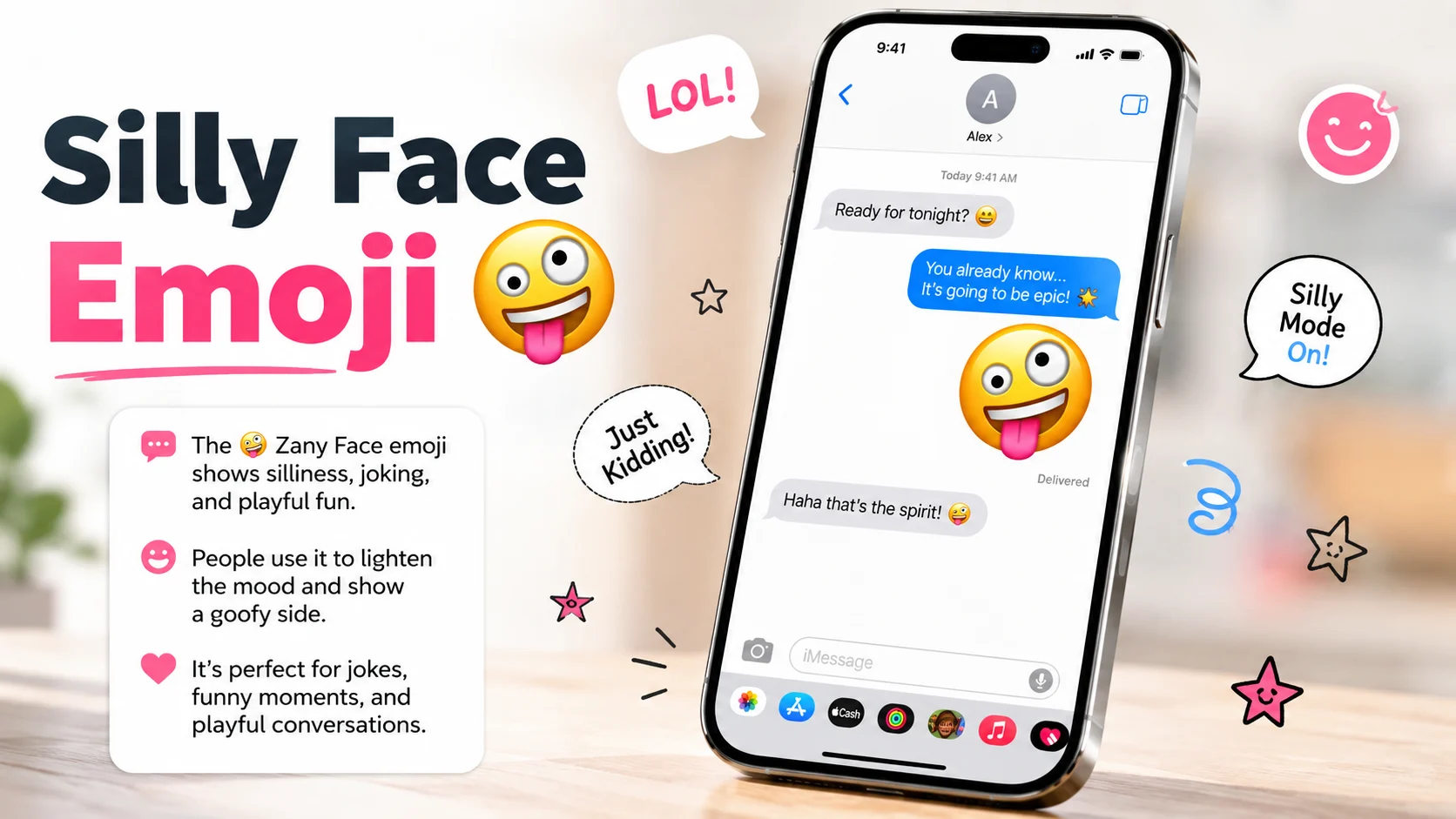
The 🤪 silly face emoji usually means being goofy, silly, playful, or joking around. Its official Unicode name is Zany Face, and it can make a message feel exaggerated, wild, or intentionally ridiculous.
Depending on the context, 🤪 may also suggest playful chaos, excitement, or a joking reaction. It is generally lighthearted, but the surrounding words and conversation determine exactly how it should be understood.
The 🤪 emoji is one of the easiest faces to recognize when someone is trying to be deliberately silly. With its tilted head, uneven eyes, wide grin, and tongue sticking out, it gives a message an exaggerated, goofy personality. If someone sends “I have no idea what I’m doing 🤪,” the emoji can make the statement feel playful rather than serious.
Although many people search for it as the silly face emoji, its official Unicode short name is Zany Face. Unicode lists it as U+1F92A, while its original Unicode name describes the visual design as “Grinning Face with One Large and One Small Eye.” It was approved in Unicode 10.0 in 2017 and added to Emoji 5.0 that same year.
The most important thing to remember is that 🤪 does not have one secret meaning. It can express silliness, joking, excitement, playful exaggeration, or something being a little off-the-wall. The words around it usually tell you which interpretation makes the most sense.
What Does the 🤪 Silly Face Emoji Mean?
The 🤪 Zany Face emoji commonly expresses:
- Silliness
- Goofiness
- Playfulness
- Joking around
- Wild or exaggerated behavior
- Fun and excitement
- Something being ridiculous or off-kilter
Emojipedia describes it as generally expressing silliness and notes that it is commonly associated with acting goofy, having fun, and partying. It is usually used positively.
For example:
“I just danced around my room for no reason 🤪”
The emoji tells the reader that the behavior is being presented in a silly, playful way.
It can also soften an exaggerated statement:
“I definitely did not eat the whole pizza 🤪”
Here, 🤪 makes the message feel joking and mischievous rather than like a serious statement.
🤪 Meaning in Texting
In texting, 🤪 often adds a goofy or unserious tone to a message.
Without the emoji:
“I forgot my homework again.”
With the emoji:
“I forgot my homework again 🤪”
The second version can sound more playful or self-mocking.
People may also use 🤪 after saying something intentionally ridiculous:
“I’m going to become a professional couch potato 🤪”
The emoji signals that the statement is meant to be silly rather than taken literally.
Is 🤪 a Happy Emoji?
Usually, yes, but it is more specific than a simple happy face.
😀 or 😄 generally communicate straightforward happiness or excitement. 🤪 adds goofiness and exaggeration.
Compare:
“That was fun 😄”
with:
“That was absolutely ridiculous 🤪”
The first sounds simply happy. The second sounds energetic, playful, and a little chaotic.
So 🤪 can communicate positive energy, but its main purpose is usually silliness rather than ordinary happiness.
Is the 🤪 Emoji Flirty?
It can appear in playful or flirtatious conversations, but 🤪 is not inherently a flirting emoji.
For example:
“You are seriously impossible 🤪”
Depending on the relationship and the rest of the conversation, this could be friendly teasing or playful flirting.
The emoji alone cannot establish romantic interest. If someone sends 🤪, look at the complete conversation and the person’s normal communication style rather than assuming a romantic meaning.
Can 🤪 Be Sarcastic?
Yes. 🤪 can sometimes support sarcasm, irony, or an exaggerated joke.
For example:
“Perfect. I absolutely love waking up at 5 a.m. 🤪”
The words and context suggest that the speaker does not literally mean they love waking up that early.
In this type of message, 🤪 adds a deliberately ridiculous or unserious tone.
However, 🤪 is more strongly associated with goofiness and joking than with sarcasm specifically. Emojis such as 🙃 or 😏 can sometimes communicate irony or a different kind of implied meaning more directly.
What Does 🤪 Mean From Someone?
When someone sends 🤪, they are often trying to make their message feel lighter, funnier, or more playful.
Consider:
“I stayed up until 3 a.m. watching movies 🤪”
The likely meaning is: “I know that was a little ridiculous, but I’m being playful about it.”
Another example:
“Guess who forgot where they parked again 🤪”
Here, the emoji can show self-directed humor.
If the message is directed at you:
“You’re such a troublemaker 🤪”
the emoji can make the statement sound teasing rather than genuinely critical.
🤪 in Friendship and Everyday Conversations
The silly face emoji works naturally in casual conversations between friends.
It can be used when:
- Making a joke
- Admitting something silly
- Teasing someone
- Describing an unusual situation
- Exaggerating for humor
- Celebrating a goofy moment
- Making a serious statement sound less serious
For example:
“I bought snacks for everyone and somehow ate half of them 🤪”
The emoji helps communicate that the speaker is laughing at their own behavior.
It can also make teasing feel softer:
“You really thought that was a good idea 🤪”
Without context, that sentence might sound critical. With 🤪, it is more likely to feel playful.
🤪 Compared With Similar Silly and Playful Emojis
| Emoji | Official Name | Common Meaning | Tone | Where or When It Is Used |
|---|---|---|---|---|
| 🤪 | Zany Face | Goofy, silly, wild, playful | Exaggerated, goofy | Jokes, teasing, ridiculous situations |
| 😜 | Winking Face with Tongue | Fun, joking, playful teasing | Playful, mischievous | Jokes, teasing, lighthearted messages |
| 😛 | Face with Tongue | Being silly or sticking out the tongue | Simple, playful | Casual jokes and playful reactions |
| 😝 | Squinting Face with Tongue | Stronger silliness or exaggerated play | Energetic, goofy | Jokes, playful reactions, exaggerated humor |
| 🤣 | Rolling on the Floor Laughing | Something is extremely funny | Highly amused | Funny messages, jokes, reactions |
| 😂 | Face with Tears of Joy | Laughing very hard | Amused, expressive | Funny comments and reactions |
| 🙃 | Upside-Down Face | Irony, sarcasm, humor, silliness | Playfully awkward | Ironic situations and jokes |
| 😜 | Winking Face with Tongue | Goofiness with a wink | Mischievous | Teasing and playful comments |
| 🤡 | Clown Face | Foolishness or acting like a clown | Humorous, sometimes critical | Jokes about foolish behavior |
The biggest difference is that 🤪 has a particularly wild and exaggerated look. 😛 is much simpler, while 😜 adds a wink and often feels more knowingly mischievous. 😝 pushes the tongue-out silliness further. Emojipedia describes 😜 as generally fun, exciting, wacky, or joking and notes that it is less “intense” than 🤪.
🤡 is different because it can be used critically to suggest foolishness, while 🤪 is more commonly a playful expression of being goofy.
🤪 vs. 😜: What’s the Difference?
These two emojis are easy to confuse because both feature a tongue and playful expression.
🤪 Zany Face usually feels more exaggerated, chaotic, or deliberately ridiculous.
😜 Winking Face with Tongue often feels more mischievous, teasing, or knowingly playful.
Compare:
“I wore two different socks today 🤪”
This sounds goofy and ridiculous.
“You know I was joking 😜”
This feels more like a playful wink.
Both can work in jokes, but 🤪 usually pushes the silliness further.
🤪 vs. 😛: What’s the Difference?
😛 Face with Tongue is a simpler tongue-out expression.
It can mean:
- “I’m being silly.”
- “Just kidding.”
- “I’m teasing.”
- “I’m being playful.”
🤪 adds much more visual exaggeration. Its uneven eyes and tilted expression make the message feel more chaotic or zany.
For a mild playful reaction, 😛 may fit better. For an obviously goofy or ridiculous moment, 🤪 can be a stronger choice.
🤪 vs. 🙃: What’s the Difference?
🙃 Upside-Down Face can express silliness, but it is especially useful for irony, awkward humor, or situations where things are not going as planned. Emojipedia describes 🙃 as commonly conveying sarcasm, irony, humor, and silliness.
For example:
“I forgot my umbrella again 🙃”
This may suggest ironic frustration.
Compare:
“I tried to cook without reading the recipe 🤪”
This sounds more openly goofy.
Examples of 🤪 in Text Messages
Example 1: Self-Mocking Humor
“I walked into the wrong classroom again 🤪”
Likely meaning: The sender is laughing at their own mistake.
Example 2: Playful Teasing
“You really thought you could beat me at this game 🤪”
Likely meaning: Friendly teasing rather than serious criticism.
Example 3: Exaggeration
“I have approximately one million things to do today 🤪”
Likely meaning: The number is exaggerated for humor.
Example 4: Being Goofy
“Guess who is wearing pajamas at noon 🤪”
Likely meaning: The sender is joking about doing something silly or unconventional.
Example 5: Making a Statement Less Serious
“Maybe I should quit everything and open a cookie shop 🤪”
Likely meaning: A playful fantasy rather than a serious announcement.
Can 🤪 Be Rude?
Usually, 🤪 is playful rather than rude, but context can change that.
For example:
“You actually believed that? 🤪”
Depending on the relationship, this could be friendly teasing or could feel like the sender is making fun of you.
If the surrounding words are insulting or dismissive, the emoji may make the message feel more sarcastic rather than friendly.
The safest approach is to interpret the whole message, not the emoji by itself.
Can 🤪 Mean “I’m Shocking”?
Not necessarily.
Because the emoji has uneven eyes, a tilted head, and a tongue sticking out, people sometimes describe it casually as looking “Shocking.” But its standard use is better understood as zany, goofy, silly, or playful rather than as a statement about mental health.
That distinction matters because an exaggerated facial expression does not automatically communicate a literal condition.
Is 🤪 a Good Emoji for Jokes?
Yes. 🤪 is especially useful when a joke involves exaggerated silliness or deliberately ridiculous behavior.
It works well after:
- A goofy confession
- A playful exaggeration
- A silly mistake
- A ridiculous idea
- Friendly teasing
- An intentionally absurd statement
If the joke is specifically about laughing, 😂 or 🤣 may be more direct. If the joke is about being goofy, 🤪 can be a better fit.
How to Respond to 🤪
Your response can match the playful tone without assuming anything beyond the message.
Playful:
“You’re ridiculous 😂”
Teasing:
“Okay, I’ll give you that one 😜”
Goofy:
“We’re both a little chaotic today 🤪”
Simple:
“LOL 😂”
Neutral:
“Haha, fair enough.”
If you are not sure whether someone is joking, respond to the actual words in the message rather than trying to decode the emoji alone.
Official Name and Technical Details
The emoji commonly called the silly face emoji is officially listed by Unicode as Zany Face with the short name “zany face.” Its code point is U+1F92A. Unicode’s current emoji list places it in the Smileys & Emotion group under the face-tongue subgroup.
Unicode documentation also records the older formal character name as GRINNING FACE WITH ONE LARGE AND ONE SMALL EYE. This technical name describes the character’s design rather than serving as its everyday meaning.
The emoji was approved as part of Unicode 10.0 in 2017 and added to Emoji 5.0 in 2017.
Different platforms may draw emoji characters somewhat differently. The basic idea of 🤪 remains recognizable, but details such as the shape of the mouth, eyes, or overall expression can vary.
What Does 🤪 Mean on Social Media?
On social media, 🤪 can add a playful or deliberately goofy tone to captions, comments, and reactions.
For example:
“Another completely normal day 🤪”
The emoji can signal that the caption is intentionally exaggerated.
It can also appear alongside photos or posts where the person wants to communicate that they are joking around or not taking the situation too seriously.
There is no single social-media-specific definition of 🤪. Its meaning still depends on the content surrounding it.
FAQs
What is the silly face emoji?
The emoji commonly called the silly face emoji is 🤪, officially named Zany Face by Unicode.
What does 🤪 mean in texting?
🤪 usually means someone is being silly, goofy, playful, exaggerated, or intentionally ridiculous.
Is 🤪 a laughing emoji?
Not exactly. 🤪 can accompany jokes and funny situations, but its main idea is silliness or goofiness. 😂 and 🤣 more directly express laughter.
Does 🤪 mean flirting?
It can appear in playful or flirty conversations, but 🤪 does not automatically mean flirting. Context matters.
What is the difference between 🤪 and 😜?
🤪 generally feels more exaggerated and zany, while 😜 often feels more mischievous or teasing because of the wink.
What is the difference between 🤪 and 😛?
😛 is a simpler tongue-out expression. 🤪 has a much more exaggerated, goofy appearance.
Conclusion
The 🤪 silly face emoji, officially called Zany Face, is mainly used to express silliness, goofiness, playful exaggeration, and joking around. Its unusual eyes, tilted expression, and tongue-out grin make it stronger and more exaggerated than simpler tongue-out emojis such as 😛.
The best way to understand 🤪 is to read it together with the message. It can make a joke more obvious, soften playful teasing, or show that someone is being intentionally ridiculous. It can appear in friendly or even flirtatious conversations, but the emoji alone does not prove romantic interest or any other specific feeling.
