Quick Answer
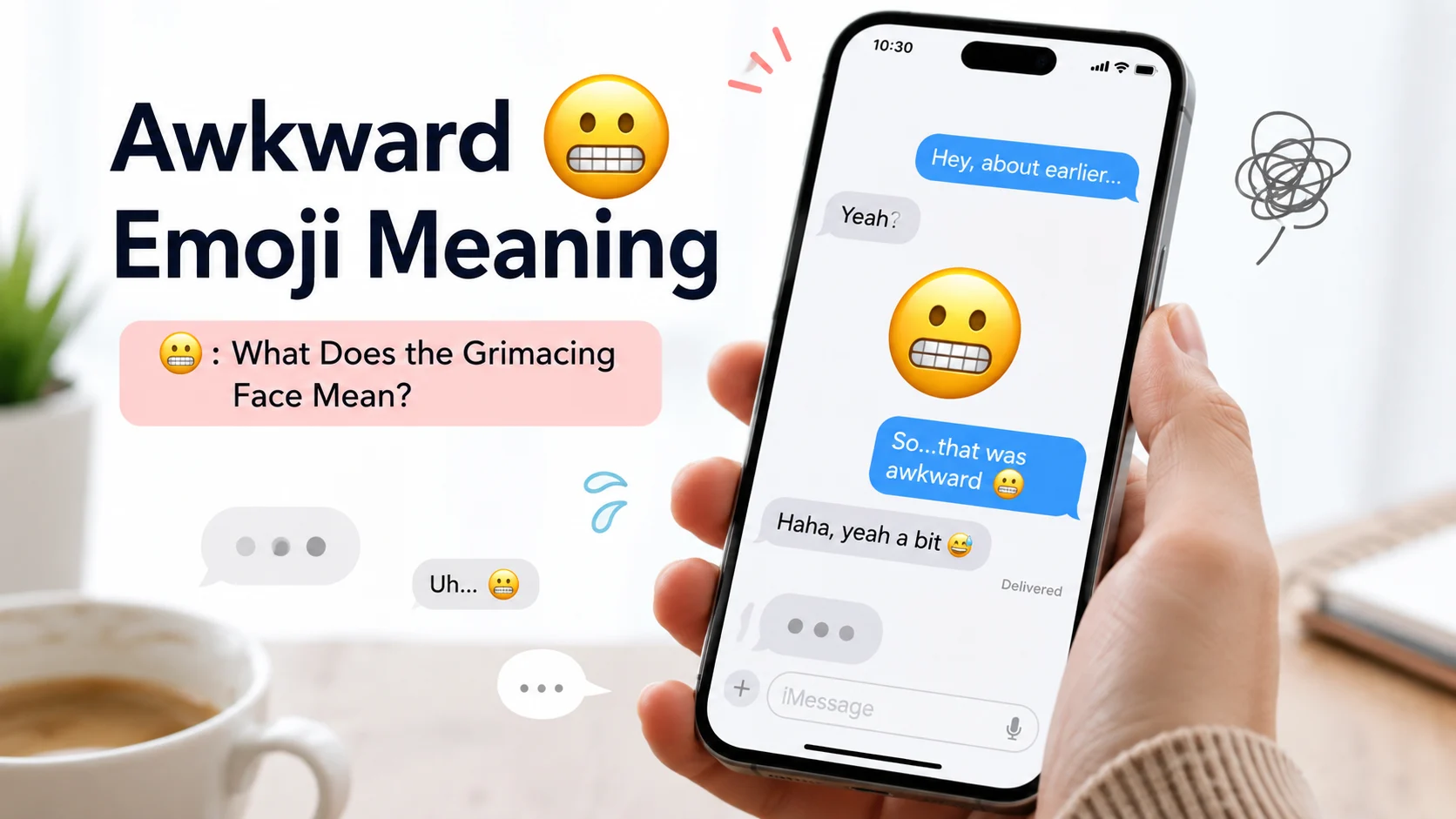
The 😬 Grimacing Face is often called the awkward emoji because it can express awkwardness, nervousness, embarrassment, discomfort, or an uneasy reaction. It can also soften an uncomfortable message or show that someone knows a situation is a little weird. The exact meaning depends on the words around it and the situation.
The 😬 emoji is one of those expressions that can say, “Well… that was awkward,” without using the words themselves. Its wide, toothy grin can make a message feel nervous, uncomfortable, embarrassed, or slightly tense. That is why many people refer to it as the awkward emoji even though its official Unicode name is Grimacing Face.
In texting, 😬 is often used when something did not go as planned, when someone feels uncomfortable, or when they want to acknowledge an embarrassing situation without making the conversation too serious. It can also add a nervous or uneasy tone to an otherwise ordinary sentence.
The context matters more than the emoji alone. A message such as “I forgot to send the email 😬” has a different feeling from “That was awkward 😬.” The same emoji can signal embarrassment, nervousness, discomfort, or a playful acknowledgment that something went wrong.
What Does the Awkward Emoji 😬 Mean?
The 😬 Grimacing Face commonly represents an awkward, uncomfortable, nervous, or embarrassed reaction.
People may use it when:
- Something feels awkward
- They made a mistake
- They feel embarrassed
- A situation is uncomfortable
- They are nervous about something
- They are unsure how someone will react
- Something went wrong
- They want to acknowledge an uncomfortable truth
- They are making a slightly cringe-worthy joke
- They want to soften an uncomfortable statement
For example:
“I accidentally replied to the wrong group chat 😬”
Here, 😬 communicates embarrassment and discomfort.
Another example:
“So… I may have eaten the last slice 😬”
This can make the confession feel playful and slightly guilty rather than completely serious.
Why Is 😬 Called the Awkward Emoji?
😬 is officially named Grimacing Face, but its facial expression naturally lends itself to awkward situations.
The emoji shows a face with a tense-looking expression and visible teeth. In everyday texting, that expression can resemble the reaction someone might have when they do not know what to say or when something feels uncomfortable.
“Awkward emoji” is therefore a common descriptive label, not the official Unicode name.
The distinction is useful:
- Official name: Grimacing Face
- Common nickname: Awkward emoji
- Typical feelings: Awkwardness, nervousness, embarrassment, discomfort, tension
- Contextual uses: Mistakes, uncomfortable moments, nervous reactions, awkward jokes, and uncertain situations
😬 Meaning in Texting
In texts, 😬 usually adds an uneasy emotional layer to the message.
Compare these two messages:
“I forgot your birthday.”
“I forgot your birthday 😬”
The second message acknowledges the uncomfortable situation and may make the confession sound more self-aware.
It can also soften a potentially uncomfortable statement:
“I think you sent that to the wrong person 😬”
Here, the emoji can make the correction feel less blunt.
However, 😬 does not automatically mean the sender is upset. It often communicates “This is uncomfortable, and I know it” rather than anger.
😬 Meaning From Someone
If someone sends you 😬, look at the rest of their message before deciding what they mean.
For example:
“I completely forgot we had plans 😬”
Likely meaning: They feel embarrassed or guilty about forgetting.
“My presentation starts in five minutes 😬”
Likely meaning: They think the situation was awkward or uncomfortable.
“I might have eaten your leftovers 😬”
Is 😬 a Nervous Emoji?
Yes. 😬 can communicate nervousness, especially when someone is uncertain about what is about to happen.
For example:
“I have to give a speech tomorrow 😬”
The emoji can suggest nervous anticipation.
It is different from a purely happy or excited reaction because the expression contains a sense of tension.
A nervous use of 😬 often has the feeling of:
“I’m not sure how this is going to go.”
Is 😬 an Embarrassed Emoji?
It can be. 😬 is commonly used after a mistake, embarrassing moment, or uncomfortable realization.
For example:
“I called my teacher ‘Mom’ today 😬”
The emoji reinforces the embarrassment without requiring a long explanation.
It can also be used after admitting something:
“Okay, I definitely misunderstood the assignment 😬”
The tone is self-aware and slightly embarrassed.
Is 😬 a Cringe Emoji?
Sometimes.
People may use 😬 when something feels cringe-worthy, uncomfortable, or difficult to watch.
For example:
“I just watched my old middle-school videos 😬”
Here, the emoji can communicate secondhand embarrassment or discomfort.
However, 😬 is not exclusively a “cringe” emoji. Depending on context, it can simply mean nervous, embarrassed, tense, or awkward.
Can 😬 Be Sarcastic?
Yes. The Grimacing Face can be used sarcastically or humorously.
For example:
“Sure, I totally understand the instructions 😬”
If the person clearly does not understand the instructions, 😬 can highlight the irony.
Another example:
“Everything is going perfectly 😬”
If the surrounding conversation describes a series of problems, the emoji can make the statement intentionally ironic.
The sarcasm comes from the words and situation, not from the emoji by itself.
Is 😬 a Bad Emoji?
Not necessarily.
😬 usually represents an uncomfortable or uneasy feeling, but using it does not mean something terrible happened.
It can be:
- Playful
- Nervous
- Embarrassed
- Self-deprecating
- Awkward
- Slightly worried
- Sarcastic
- Uncomfortable
For example:
“I may have bought another notebook even though I already have ten 😬”
This is more playful than serious.
Related Emojis Similar to 😬
| Emoji | Official Name | Common Meaning | Tone | Where or When It Is Used |
|---|---|---|---|---|
| 😬 | Grimacing Face | Awkwardness, nervousness, embarrassment | Tense, uneasy, awkward | Mistakes, uncomfortable moments, nervous situations |
| 😅 | Grinning Face with Sweat | Relief, nervous humor, embarrassment | Nervous, relieved, playful | Close calls, mistakes, uncomfortable jokes |
| 😳 | Flushed Face | Embarrassment, surprise, shock | Strong, startled, embarrassed | Unexpected moments, compliments, awkward situations |
| 🫣 | Face with Peeking Eye | Shyness, nervous curiosity, embarrassment | Shy, playful, uneasy | Awkward moments, things you are hesitant to look at |
| 😓 | Downcast Face with Sweat | Stress, worry, difficulty | Worried, tired, uncomfortable | Problems, pressure, difficult situations |
| 😟 | Worried Face | Concern or anxiety | Serious, concerned | Uncertain or troubling situations |
| 😖 | Confounded Face | Frustration, distress, discomfort | Strong, frustrated | Difficult situations or emotional reactions |
| 🙃 | Upside-Down Face | Irony, awkward humor, resignation | Playful, ironic, awkward | Sarcasm, absurd situations, uncomfortable humor |
The closest comparisons are 😅, 😳, 🫣, and 🙃.
😬 tends to focus on tension or awkwardness. 😅 often adds relief or nervous humor, while 😳 usually communicates stronger embarrassment or surprise. 🫣 can feel more shy and playful, and 🙃 often signals irony or “I guess this is happening” humor.
😬 vs. 😅
These two emojis are easy to confuse.
😬 Grimacing Face often emphasizes awkwardness, tension, or discomfort.
😅 Grinning Face with Sweat often suggests nervousness mixed with relief, embarrassment, or humor.
Compare:
“I accidentally sent the message to my boss 😬”
This focuses on the awkward situation.
“I accidentally sent it to my boss, but luckily they laughed 😅”
This emphasizes relief and nervous humor.
😬 vs. 😳
Both can appear in embarrassing situations, but they usually create different impressions.
😬 feels tense and awkward.
😳 often feels more visibly shocked, surprised, or intensely embarrassed.
For example:
“I forgot everyone’s name 😬”
This sounds awkward.
“They complimented me in front of everyone 😳”
This sounds more surprised and flustered.
😬 vs. 🫣
The 🫣 Face with Peeking Eye often suggests that someone is shy, nervous, embarrassed, or curious about something they are hesitant to look at.
😬 is more direct about discomfort or awkwardness.
Compare:
“That conversation was so awkward 😬”
with:
“I don’t want to see what they replied 🫣”
The first expresses awkwardness; the second suggests hesitant curiosity.
😬 vs. 🙃
The 🙃 Upside-Down Face often adds irony, sarcasm, or resigned humor.
😬 is more focused on tension or discomfort.
For example:
“I forgot my homework 😬”
This communicates nervousness or embarrassment.
“Forgot my homework again. Great. 🙃”
This communicates ironic frustration or resignation.
Awkward Emoji Text Examples
When You Made a Mistake
“Oops, I sent the draft before I finished it 😬”
Meaning: The sender feels embarrassed or uncomfortable about the mistake.
When You Feel Nervous
“I have to talk in front of everyone tomorrow 😬”
Meaning: The sender feels nervous about what is coming.
When Something Is Uncomfortable
“That conversation got really quiet 😬”
Meaning: The situation suddenly felt awkward.
When You Admit Something
“I didn’t actually read the instructions 😬”
Meaning: The sender is admitting something while acknowledging that it may not look good.
When Something Is Playfully Embarrassing
“I just waved back at someone who wasn’t waving at me 😬”
Meaning: The sender is laughing at their own awkward moment.
How to Respond to 😬
Your response should depend on what caused the awkwardness.
Supportive:
“It happens! Don’t worry.”
Reassuring:
“You’re fine 😂”
Playful:
“Okay, that was a little awkward 😅”
Understanding:
“I know exactly what you mean.”
If you need clarification:
“Wait, what happened? 😬”
You do not need to treat 😬 as a serious warning. Often, the sender is simply acknowledging an uncomfortable or funny situation.
Common Misunderstandings About 😬
It does not always mean embarrassment
😬 can also mean nervousness, tension, discomfort, or playful awkwardness.
It does not automatically mean anger
The expression may look tense, but anger is not its main meaning.
It does not prove anxiety
A person can use 😬 casually or humorously without describing a serious emotional state.
It does not always mean something went wrong
Someone may use it before an uncertain event:
“My interview starts in ten minutes 😬”
Nothing has gone wrong yet. The emoji communicates nervous anticipation.
It does not always mean the sender dislikes something
Context determines whether the expression represents discomfort, embarrassment, humor, or nervousness.
What Is the Official Name of 😬?
The official Unicode name of 😬 is Grimacing Face.
Its Unicode code point is U+1F62C. It was introduced as part of the original Unicode emoji set and is widely recognized as a facial expression showing a tense, toothy grimace.
“Awkward emoji” is an informal description based on common use. It is not the official Unicode name.
Different platforms may draw 😬 slightly differently, but the basic expression remains a face with a tense, toothy grin.
When Should You Use the Awkward Emoji?
Use 😬 when you want to communicate a feeling such as:
- “That was awkward.”
- “I’m nervous about this.”
- “Oops.”
- “I know this is uncomfortable.”
- “I made a mistake.”
- “This is a little embarrassing.”
- “I’m not sure how this will go.”
- “That was kind of cringe.”
- “I’m admitting something awkward.”
If you want to communicate genuine sadness, 😬 is usually not the best choice. Likewise, if you want to show simple happiness, a smiling emoji will usually be clearer.
FAQs
What does 😬 mean in texting?
😬 commonly means awkward, nervous, embarrassed, uncomfortable, or tense. The exact interpretation depends on the surrounding message.
Why is 😬 called the awkward emoji?
Its official name is Grimacing Face, but its tense, toothy expression is frequently used for awkward or uncomfortable situations.
Does 😬 mean nervous?
It can. 😬 often communicates nervous anticipation, especially when someone is unsure how something will turn out.
Does 😬 mean embarrassed?
It can express embarrassment, particularly after a mistake or uncomfortable moment.
Is 😬 a cringe emoji?
Sometimes. It can represent a cringe-worthy or uncomfortable situation, but it also has broader meanings such as nervousness and tension.
Is 😬 rude?
Not usually. It can soften an uncomfortable statement, although the exact tone depends on the words surrounding it.
Can 😬 be flirty?
It can appear in playful or flirty conversations, but the emoji itself does not prove romantic interest.
Conclusion
The 😬 Grimacing Face is commonly known as the awkward emoji because it works so well for uncomfortable, nervous, embarrassing, and tense moments. It can turn a simple statement into something more self-aware, playful, or uneasy.
The most important thing is context. 😬 can mean “That was awkward,” “Oops,” “I’m nervous,” or “I can’t believe I just did that.” Its meaning changes with the message, situation, and relationship between the people communicating. When in doubt, read the words around the emoji rather than treating 😬 as a fixed code.
