Quick Answer
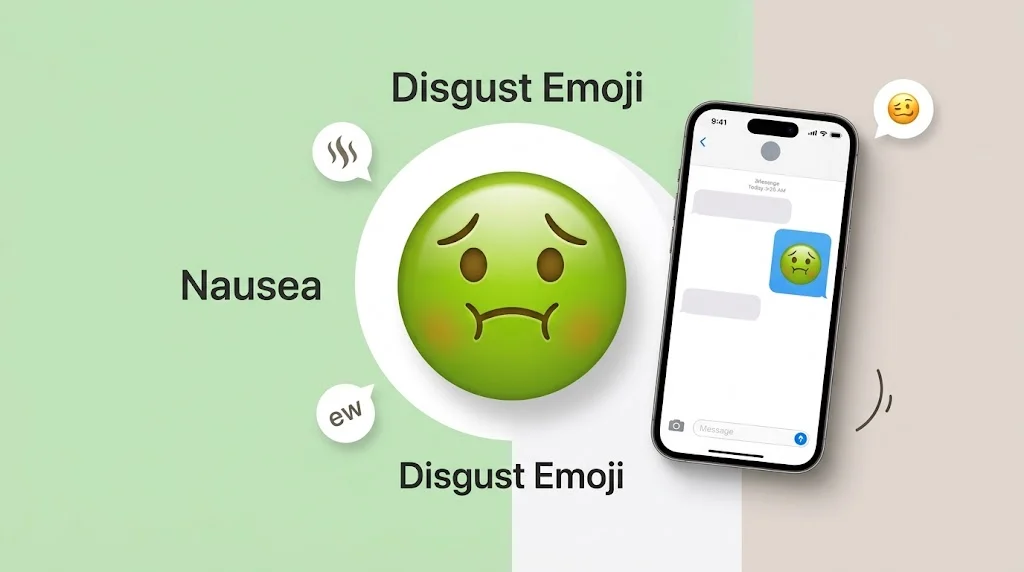
The 🤢 emoji is officially called Nauseated Face and commonly expresses disgust, nausea, sickness, or a strong negative reaction. It can be used literally when someone feels physically sick, but it is also frequently used informally to say something is gross, unpleasant, disturbing, or hard to tolerate. Unicode lists 🤢 as U+1F922, while Emojipedia notes that it can represent either physical illness or general disgust.
Seeing 🤢 in a text usually means that something feels gross, disgusting, nauseating, or unpleasant. The green face and uncomfortable expression make it a natural reaction to something a person strongly dislikes. Depending on the conversation, however, it does not always mean that the sender is actually sick.
The disgust emoji can describe a real physical feeling, such as feeling nauseated after eating something that did not agree with you. It can also be exaggerated for humor, such as reacting to an unpleasant smell, a strange food combination, an awkward situation, or something someone finds seriously unappealing.
Context matters most. A message such as “I feel so sick 🤢” points toward nausea, while “That smell 🤢” is more likely expressing disgust. The same emoji can therefore range from a literal health-related reaction to a playful or dramatic way of saying “ew.”
What Does the 🤢 Disgust Emoji Mean?
The 🤢 emoji is officially named Nauseated Face. Its most common informal meanings include:
- Disgust
- Nausea
- Feeling sick
- Something being gross
- Strong dislike
- An unpleasant reaction
- “Ew” or “That’s nasty”
Unicode’s current emoji data identifies 🤢 as Nauseated Face and associates it with terms such as “gross,” “nasty,” “nauseated,” “sick,” and “vomit.”
The exact meaning depends on what surrounds the emoji. If someone sends only 🤢, they may simply be reacting negatively to something. If they write “I don’t feel good 🤢,” the meaning is more likely physical nausea.
It is also worth remembering that an emoji does not have one guaranteed interpretation. A sender may use 🤢 seriously, jokingly, sarcastically, or as an exaggerated reaction.
🤢 Meaning in Text Messages
In texting, 🤢 often works as a quick emotional reaction. Instead of writing “That is disgusting,” someone may simply send 🤢.
For example:
“I just smelled something awful 🤢”
This likely means the person found the smell extremely unpleasant.
Another example:
“You actually put ketchup on that? 🤢”
Here, the emoji is probably playful exaggeration rather than a statement that the sender is physically sick.
When the message contains words about symptoms or feeling unwell, however, the interpretation can change:
“I haven’t felt well all morning 🤢”
In this case, 🤢 most likely communicates nausea or sickness.
Is 🤢 Always About Disgust?
No. Disgust is one of its common uses, but 🤢 can also represent physical nausea or illness. Emojipedia specifically describes the emoji as potentially representing physical illness as well as general disgust.
A useful way to interpret it is:
- Food or smell: probably disgust or nausea
- A medical or health-related conversation: probably feeling sick
- An unpleasant story: likely emotional disgust
- A joke: possibly exaggerated “ew”
- An opinion about something: often strong dislike
- A reaction to something surprising or disturbing: may communicate “that’s horrible”
The surrounding words are usually more reliable than the emoji by itself.
Can 🤢 Be Playful or Sarcastic?
Yes. The 🤢 emoji can be used dramatically without indicating genuine sickness.
For example:
“You two are being way too cute 🤢😂”
Here, the sender may be jokingly pretending to feel disgusted by excessive sweetness or affection. The laughing emoji changes the tone and makes the reaction feel more playful.
Another example:
“You eat pineapple with hot sauce? 🤢”
The sender may simply be teasing someone about their food choice.
This is why reading the entire message matters. 🤢 can sound harsh when used alone, but additional words or emojis can make the reaction clearly humorous.
What Does 🤢 Mean From Someone?
If someone sends 🤢 in response to your message, do not automatically assume they are angry or personally rejecting you.
They could be reacting to:
- Something you described
- A food or smell
- A joke
- A picture or story
- A situation they dislike
- Something they find unpleasant
- Something they are teasing you about
For example:
You: “I accidentally stepped in something gross.”
Them: “🤢”
That response is probably simply sympathy or shared disgust.
But if the emoji appears after a personal opinion or suggestion, it may indicate that they strongly dislike the idea. The surrounding conversation should determine the interpretation.
Is the 🤢 Emoji Rude?
It can feel rude, especially when it is directed at a person, appearance, idea, food, or personal choice.
For example:
“You actually like that? 🤢”
This could come across as judgmental.
However, 🤢 is not automatically rude. Friends may use it casually to exaggerate reactions or joke with each other.
If you want to avoid sounding harsh, pair the reaction with clearer words:
“Haha, that’s definitely not for me 🤢”
That communicates personal dislike without making the message unnecessarily hostile.
Is 🤢 a Flirty Emoji?
Usually, 🤢 is not a standard flirting emoji. Its primary meanings relate to nausea, disgust, sickness, or something unpleasant.
That said, people can use almost any emoji jokingly within a particular relationship or conversation. For example, someone might jokingly send 🤢 after a very sweet message.
That does not automatically mean flirting. Look at the words, the established tone between the people, and the wider conversation instead of treating one emoji as proof of romantic interest.
Related Emojis and How They Differ
| Emoji | Official Name | Common Meaning | Tone | Where or When It Is Used |
|---|---|---|---|---|
| 🤢 | Nauseated Face | Disgust, nausea, feeling sick | Negative, dramatic | Gross reactions, unpleasant smells, nausea |
| 🤮 | Face Vomiting | Strong sickness or disgust | Very intense | Extreme reactions or actual vomiting references |
| 🤧 | Sneezing Face | Sneezing or feeling unwell | Sick, mild | Colds, sneezing, illness-related messages |
| 🤒 | Face with Thermometer | Being sick or having a fever | Concerned, unwell | Health and illness conversations |
| 😷 | Face with Medical Mask | Illness, protection, avoiding germs | Serious, cautious | Health-related situations |
| 😖 | Confounded Face | Frustration, distress, discomfort | Negative, tense | Difficult or unpleasant situations |
| 😣 | Persevering Face | Struggling or enduring something | Strained, uncomfortable | Stress, difficulty, persistence |
| 😒 | Unamused Face | Annoyance, dissatisfaction, disapproval | Dry, negative | Reactions to irritating or disappointing situations |
The most important distinction is between 🤢 and 🤮. Both can communicate sickness or disgust, but 🤮 is specifically Face Vomiting and creates a much more explicit and intense reaction. Unicode lists the two as separate emoji characters: 🤢 is U+1F922 and 🤮 is U+1F92E.
Meanwhile, 🤒 and 🤧 are generally more focused on being unwell, while 😒 is better for annoyance or disapproval rather than physical nausea. Unicode’s emoji data separately identifies these faces and their associated concepts.
🤢 vs. 🤮: What’s the Difference?
The simplest distinction is:
🤢 = “This makes me feel sick or disgusted.”
🤮 = “This is so sickening that I’m vomiting.”
For example:
“That smell is awful 🤢”
This suggests disgust or nausea.
“That was the grossest thing I’ve ever seen 🤮”
This gives the reaction much more intensity.
If you want to express mild-to-moderate disgust, 🤢 is usually less explicit than 🤮.
Text Message Examples
1. Reacting to a Bad Smell
“The trash can has been sitting outside all day 🤢”
Meaning: The smell is extremely unpleasant.
2. Reacting to Strange Food
“Pickles and ice cream together? 🤢”
Meaning: The sender finds the combination unappealing, probably in a playful way.
3. Actual Nausea
“I woke up feeling really sick 🤢”
Meaning: The emoji describes a physical feeling of nausea.
4. Reacting to an Unpleasant Story
“That’s such a gross story 🤢”
Meaning: The sender feels disgusted by what they heard.
5. Playful Exaggeration
“You two are being so cheesy 🤢😂”
Meaning: The sender is jokingly pretending to be disgusted.
How to Respond to 🤢
Your response should depend on why the person sent it.
If they are actually sick:
“Are you feeling okay?”
If they are joking:
“😂 You’re so dramatic.”
A short clarification is often better than guessing, especially when the emoji could mean either physical nausea or emotional disgust.
Common Misunderstandings About 🤢
It does not always mean someone is sick
The emoji can simply mean “gross” or “ew.” Unicode’s related keywords include both sickness and disgust-related terms.
It does not automatically mean hatred
Someone using 🤢 may dislike a specific thing without expressing a serious personal opinion.
It does not automatically mean rejection
If someone sends 🤢 after a message, consider whether they are reacting to the topic rather than to you.
It does not prove sarcasm
The emoji can be sarcastic, but only the surrounding message and relationship context can establish that.
It is not the same as 🤮
🤢 communicates nausea or disgust, while 🤮 depicts vomiting and generally gives a more explicit reaction.
Official Emoji Details
The official Unicode name for 🤢 is Nauseated Face. Its Unicode code point is U+1F922. Unicode lists it among the face emojis associated with sickness and related reactions.
Nauseated Face was approved in Unicode 9.0 in 2016 and added to Emoji 3.0 in 2016, according to Emojipedia.
Different platforms may draw the emoji with slightly different facial details, colors, or shading. The basic concept remains recognizable: a green, uncomfortable face associated with nausea or disgust.
FAQs
What is the official name of 🤢?
The official Unicode name is Nauseated Face.
What does 🤢 mean in texting?
It usually means disgust, nausea, sickness, or “ew.” The exact interpretation depends on the surrounding conversation.
Is 🤢 the disgust emoji?
It is commonly called a disgust emoji because people frequently use it to express disgust. Its official name, however, is Nauseated Face.
What does 🤢 mean after a food message?
It usually means the sender finds the food, ingredient, smell, or combination unpleasant. Sometimes it is simply playful teasing.
Is 🤢 stronger than 😒?
Generally, yes in terms of disgust. 😒 is more closely associated with being unimpressed, annoyed, or dissatisfied, while 🤢 communicates a much more visceral reaction of nausea or disgust.
What is the difference between 🤢 and 🤮?
🤢 means nausea or disgust, while 🤮 is Face Vomiting and represents a more explicit vomiting reaction.
Conclusion
The 🤢 emoji, officially called Nauseated Face, is mainly used to express nausea, disgust, sickness, or a strong reaction to something unpleasant. It can be literal, such as when someone feels physically sick, or playful, such as reacting dramatically to strange food or an awkward situation.
The biggest clue is context. 🤢 after “I feel sick” has a different meaning from 🤢 after “That smell is awful.” And while it can sometimes sound rude or sarcastic, one emoji alone is not enough to prove someone’s attitude or feelings.
When choosing between similar emojis, think about intensity: 🤢 works well for disgust or nausea, while 🤮 gives a much stronger vomiting-related reaction. Using the emoji that matches the situation makes your message easier to understand.
Discover More Related Articles:
- Finger Heart Emoji | Cute, Friendly & Affectionate Uses In 2026
- Silly Face Emoji | Playful vs. Flirty Uses In 2026
