Quick Answer
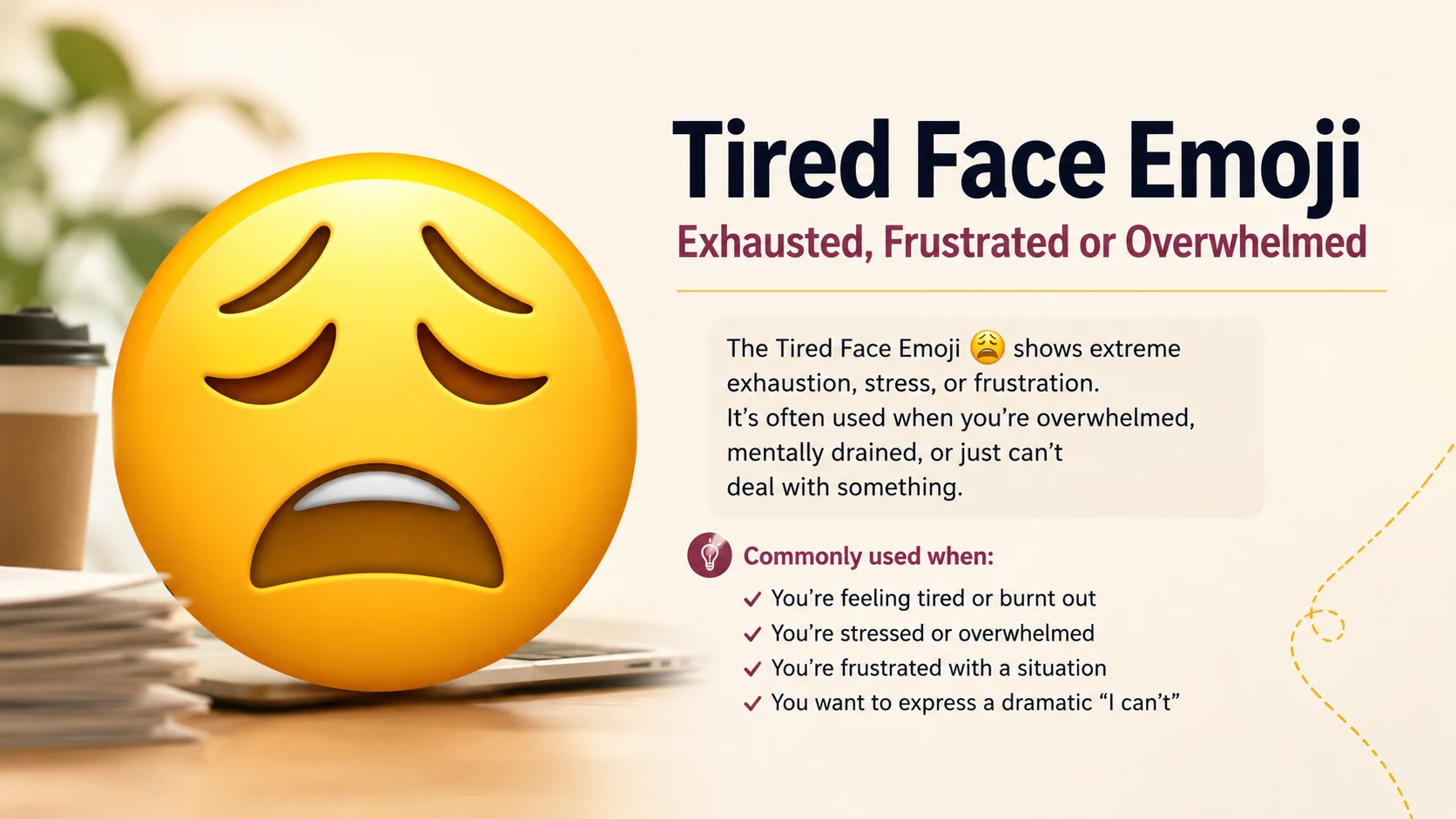
The 😫 Tired Face emoji usually expresses exhaustion, being worn out, frustration, or feeling overwhelmed. It can mean “I’m so tired,” “I can’t deal with this,” or “This is too much.” Depending on the message, it can also be used playfully to exaggerate a reaction or show that someone is emotionally overwhelmed by something they love or find exciting. The official Unicode name is Tired Face, and its code point is U+1F62B.
The 😫 Tired Face emoji is easy to recognize: scrunched eyes, furrowed brows, and a wide-open frown make it look like someone has reached their limit. In texting, it often communicates more than simple physical tiredness. A person may use it after a long day, a frustrating task, an exhausting conversation, or anything that feels like too much.
The tired face emoji meaning can change with context. “I worked all night 😫” most likely means genuine exhaustion, while “This homework is impossible 😫” may combine frustration with tiredness. It can even be playful when someone is dramatically reacting to something overwhelming, funny, exciting, or intensely cute.
That is why 😫 should not automatically be read as sadness or anger. The words around the emoji usually provide the strongest clue. A message, the relationship between the people texting, and the sender’s normal emoji habits can all affect how the reaction feels.
What Does 😫 Tired Face Mean?
The 😫 Tired Face emoji commonly represents:
- Physical exhaustion
- Mental fatigue
- Frustration
- Feeling overwhelmed
- Exasperation
- Emotional strain
- Being unable to deal with something
- Dramatic or playful exhaustion
Its facial expression makes it stronger than a simple “I’m a little tired” reaction.
For example:
“I have three exams this week 😫”
This likely means the person feels overwhelmed and exhausted by their workload.
Another example:
“I finally finished that project 😫”
Here, the emoji can emphasize how draining the experience was.
The emoji’s official name is Tired Face. Unicode lists it as U+1F62B, and it was included in Unicode 6.0 and Emoji 1.0.
😫 Meaning in Texting
In text messages, 😫 often works as an emotional reaction rather than a literal statement about sleep.
Someone might send:
“Why is this taking so long 😫”
The meaning is closer to “I’m frustrated and tired of dealing with this.”
Or:
“I cleaned the whole house today 😫”
This emphasizes exhaustion.
It can also stand alone:
“😫”
When used by itself, it may mean “I’m exhausted,” “I can’t handle this,” or “This is too much.” Without surrounding words, however, the exact reason is impossible to know.
Is 😫 More About Tiredness or Frustration?
It can be either.
The design clearly suggests tiredness, but the emoji is also commonly used for frustration and exasperation. Emojipedia describes it as expressing various degrees of tiredness while also noting frustration, sadness, excitement, and affection in different contexts.
Compare these messages:
“I barely slept last night 😫”
Likely meaning: Physical tiredness.
“This computer keeps crashing 😫”
Likely meaning: A mixture of mental fatigue and frustration.
So when you see 😫, think “I’m worn out or overwhelmed” rather than only “I’m sleepy.”
😫 Emotional Tone
The Tired Face emoji usually has a stronger emotional tone than 😪 Sleepy Face.
It can communicate:
Exhaustion:
“I’ve been working since 7 AM 😫”
Frustration:
“Why won’t this work 😫”
Overwhelm:
“I have way too much to do 😫”
Exasperation:
“You did it again 😫”
Dramatic reaction:
“This movie is too good 😫”
The last example shows why emojis cannot always be interpreted literally. A person can use 😫 to exaggerate an emotional reaction without actually being physically tired.
Does 😫 Mean Sadness?
Sometimes, but sadness is usually not its primary interpretation.
The expression can look distressed, so someone may use it when they feel emotionally drained or upset.
For example:
“I really miss my friends 😫”
Here, the emoji may reinforce emotional distress or longing.
But if someone wants to clearly communicate sadness, emojis such as 😢 Crying Face or 😭 Loudly Crying Face may communicate that emotion more directly.
Context remains important because 😫 can combine several feelings at once.
Can 😫 Mean “I Can’t Handle This”?
Yes. This is one of its useful conversational meanings.
Someone may use 😫 when something has become too difficult, frustrating, funny, exciting, or emotionally intense.
For example:
“This assignment is due tomorrow 😫”
The implied message could be:
“This is too much.”
Or:
“My favorite character just did that 😫”
Here, the emoji may be dramatic rather than negative. It can communicate an exaggerated “I can’t handle how good this is” reaction.
Can 😫 Be Playful?
Yes.
The emoji is often useful for dramatic reactions that are not meant to be taken completely literally.
For example:
“You really ate the last slice 😫”
Depending on the conversation, this could be playful disappointment rather than serious anger.
Another example:
“Stop being so funny 😫”
Here, the person is not necessarily complaining. The emoji can exaggerate the reaction for humor.
The surrounding words are what make the playful interpretation clear.
What Does 😫 Mean From Someone?
If someone sends you 😫, they may be saying:
- “I’m exhausted.”
- “I’m so frustrated.”
- “This is too much.”
- “I can’t deal with this.”
- “I’m emotionally overwhelmed.”
- “I’m being dramatic about this.”
For example:
“I have to wake up at 5 tomorrow 😫”
Likely meaning: They are unhappy about the early morning and expect to be tired.
“This problem makes no sense 😫”
Likely meaning: A playful or exaggerated emotional reaction.
The third example shows why it is risky to assign one fixed meaning to 😫. The words surrounding it can completely change the tone.
Is 😫 a Flirty Emoji?
It can appear in playful or affectionate conversations, but 😫 is not inherently a flirting emoji.
For example:
“You’re too cute 😫”
In this context, it can communicate playful emotional overwhelm or affection.
However, the emoji itself does not prove romantic interest. If you’re trying to understand someone’s intentions, consider the full conversation rather than treating one emoji as evidence of flirting.
😫 vs. 😩: What’s the Difference?
😫 Tired Face and 😩 Weary Face are closely related and are easy to confuse.
😩 has closed, crescent-shaped eyes and often feels more like being weary, distressed, or at the end of one’s patience.
Both can express frustration, exhaustion, or emotional overload. Emojipedia specifically describes them as similar in appearance and meaning.
A simple way to remember them:
- 😫 = “I’m exhausted / this is too much!”
- 😩 = “I’m worn out / I can’t take much more.”
The distinction is subtle, so users may choose either one for similar situations.
Emojis Similar to 😫
| Emoji | Official Name | Common Meaning | Tone | Where or When It Is Used |
|---|---|---|---|---|
| 😫 | Tired Face | Exhaustion, frustration, overwhelm | Drained, dramatic | Stressful tasks, long days, overwhelming reactions |
| 😩 | Weary Face | Weariness, frustration, distress | Worn out, exasperated | Complaints, difficult situations, emotional exhaustion |
| 😪 | Sleepy Face | Tiredness, sleepiness | Sleepy, low-energy | Feeling tired, ready for bed, lack of sleep |
| 😴 | Sleeping Face | Sleeping or strong sleepiness | Calm, sleepy | Going to bed, sleeping, feeling very tired |
| 🥱 | Yawning Face | Sleepiness, boredom, fatigue | Sleepy, bored | Late nights, boring situations, yawning |
| 😓 | Downcast Face with Sweat | Stress, difficulty, nervous effort | Worried, strained | Hard tasks, stressful moments, awkward situations |
| 😣 | Persevering Face | Struggle, difficulty, determination | Strained, frustrated | Trying to get through something difficult |
| 😖 | Confounded Face | Distress, frustration, confusion | Agitated, uncomfortable | Complicated or upsetting situations |
| 😞 | Disappointed Face | Disappointment, discouragement | Sad, subdued | Bad news, setbacks, unmet expectations |
The closest comparison is probably 😩 Weary Face, while 😪, 😴, and 🥱 are more directly associated with sleepiness. 😓 and 😣 can overlap with the stressed or strained feeling of 😫 but communicate different facial expressions and emotional shades. Unicode lists these emojis separately with their own official names.
😫 vs. 😪 Sleepy Face
The difference is especially useful when someone is trying to choose the right emoji.
😫 Tired Face usually communicates that something is draining, frustrating, or overwhelming.
😪 Sleepy Face more directly communicates sleepiness or tiredness.
Compare:
“I have been working all day 😫”
This sounds exhausted and overwhelmed.
“I’m falling asleep 😪”
This clearly communicates sleepiness.
Emojipedia notes that 😪 can represent tiredness or sleeping and should not be confused with other tired-looking faces.
😫 vs. 😴 Sleeping Face
😴 Sleeping Face is much more literal. It is generally used to indicate sleep, going to bed, or being very sleepy.
😫 is better when the emphasis is on struggle, exhaustion, or frustration.
“I need to go to bed 😴”
versus:
“I’ve been studying for six hours 😫”
The first focuses on sleep. The second focuses on how exhausting the situation feels.
😫 in Everyday Text Examples
Physical exhaustion
“I walked around the city all day 😫”
Meaning: The person is physically worn out.
Work stress
“I still have four hours left at work 😫”
Meaning: They feel drained or overwhelmed.
Frustration
“Why does this keep happening 😫”
Meaning: The emoji emphasizes exasperation.
Too much homework
“I have three assignments due tomorrow 😫”
Meaning: Mental fatigue and overwhelm.
Playful exaggeration
“You can’t just leave me on a cliffhanger like that 😫”
Meaning: Dramatic, playful frustration.
Affectionate reaction
“That puppy is so cute 😫”
Meaning: The person is playfully overwhelmed by how cute the puppy is.
How to Respond to 😫
Your response should depend on why the person used it.
If they’re exhausted:
“You definitely need a break 😭”
They’re frustrated:
“I know, that sounds so annoying.”
If you’re not sure:
“What happened? 😫”
A simple question can be better than guessing what the sender meant.
Can 😫 Be Used Sarcastically?
Yes. Like many expressive emojis, 😫 can be used to exaggerate a situation for humor.
For example:
“My favorite show ended on a cliffhanger 😫”
The person may not literally be exhausted. They are using the face to dramatize their reaction.
Another example:
“You finished the snacks without me 😫”
The tone could be joking rather than genuinely upset.
The key is the mismatch between the words and the situation. If the message is obviously playful, 😫 may simply amplify the joke.
What Does 😫 Mean on Social Media?
On social media, 😫 can be used as a quick reaction to posts, comments, photos, jokes, entertainment, or frustrating situations.
Its meaning still depends on context.
Someone might use it to react to:
- A frustrating situation
- An exhausting task
- A dramatic plot twist
- Something extremely cute
- An amusing complaint
- A stressful experience
- A playful exaggeration
There is no single platform-specific meaning that overrides its general use.
Common Misunderstandings About 😫
It does not always mean physical tiredness
A person may be emotionally exhausted or simply frustrated.
It does not automatically mean sadness
The expression can communicate distress, but sadness is only one possible interpretation.
It does not automatically mean anger
Frustration and exasperation can look similar to anger in a short text, but the emoji itself does not establish anger.
It does not prove flirting
A playful 😫 in an affectionate message may feel flirty, but the emoji alone cannot establish romantic intent.
It is not the same as 😪 or 😴
Those emojis are more closely associated with sleepiness or sleeping, while 😫 often adds frustration or emotional strain.
What Is the Official Name of 😫?
The official Unicode name of 😫 is Tired Face.
Its code point is U+1F62B. Unicode lists it among the face-negative emoji and separately identifies nearby characters such as 😩 Weary Face and 🥱 Yawning Face.
Tired Face was approved as part of Unicode 6.0 in 2010 and added to Emoji 1.0 in 2015, according to Emojipedia.
The official name identifies the character, but everyday interpretation is broader. People use 😫 for tiredness, frustration, emotional overload, and exaggerated reactions.
When Should You Use 😫?
Use 😫 when you want to communicate that something feels exhausting, frustrating, overwhelming, or dramatically difficult.
It works naturally after messages such as:
“I have been doing this for hours 😫”
“This assignment is impossible 😫”
“I can’t believe that just happened 😫”
“I’m so done with today 😫”
If you simply mean that you’re getting sleepy, 😪, 🥱, or 😴 may communicate that idea more clearly.
FAQs
What does 😫 mean in texting?
😫 usually means exhaustion, frustration, feeling overwhelmed, or being unable to deal with something. It can also be used for playful exaggeration.
Is 😫 the tired emoji?
Yes. Its official Unicode name is Tired Face, and it is commonly used to express tiredness or exhaustion.
What is the difference between 😫 and 😩?
Both can communicate exhaustion and frustration. 😫 has scrunched, X-shaped eyes, while 😩 has closed, crescent-shaped eyes and can feel more weary or distressed.
Does 😫 mean “I can’t handle this”?
It can. In many conversations, 😫 communicates that something feels overwhelming, frustrating, or emotionally too much.
Is 😫 a sad emoji?
It can express sadness or emotional distress in some contexts, but its main associations are tiredness, frustration, and exhaustion.
Does 😫 mean flirting?
Not by itself. It can appear in playful or affectionate messages, but the surrounding conversation is needed to determine whether a message is actually romantic or flirty.
Conclusion
The 😫 Tired Face emoji usually communicates more than simply being sleepy. It can express exhaustion, frustration, overwhelm, exasperation, or a dramatic reaction to something that feels like too much. Its exact meaning depends on the words around it and the situation.
When choosing between 😫, 😩, 😪, 🥱, and 😴, think about the feeling you want to emphasize. Use 😫 for a strained or overwhelmed reaction, while the other tired-looking emojis can communicate weariness, sleepiness, yawning, or actual sleep more directly.
Discover More Related Articles:
