Quick Answer
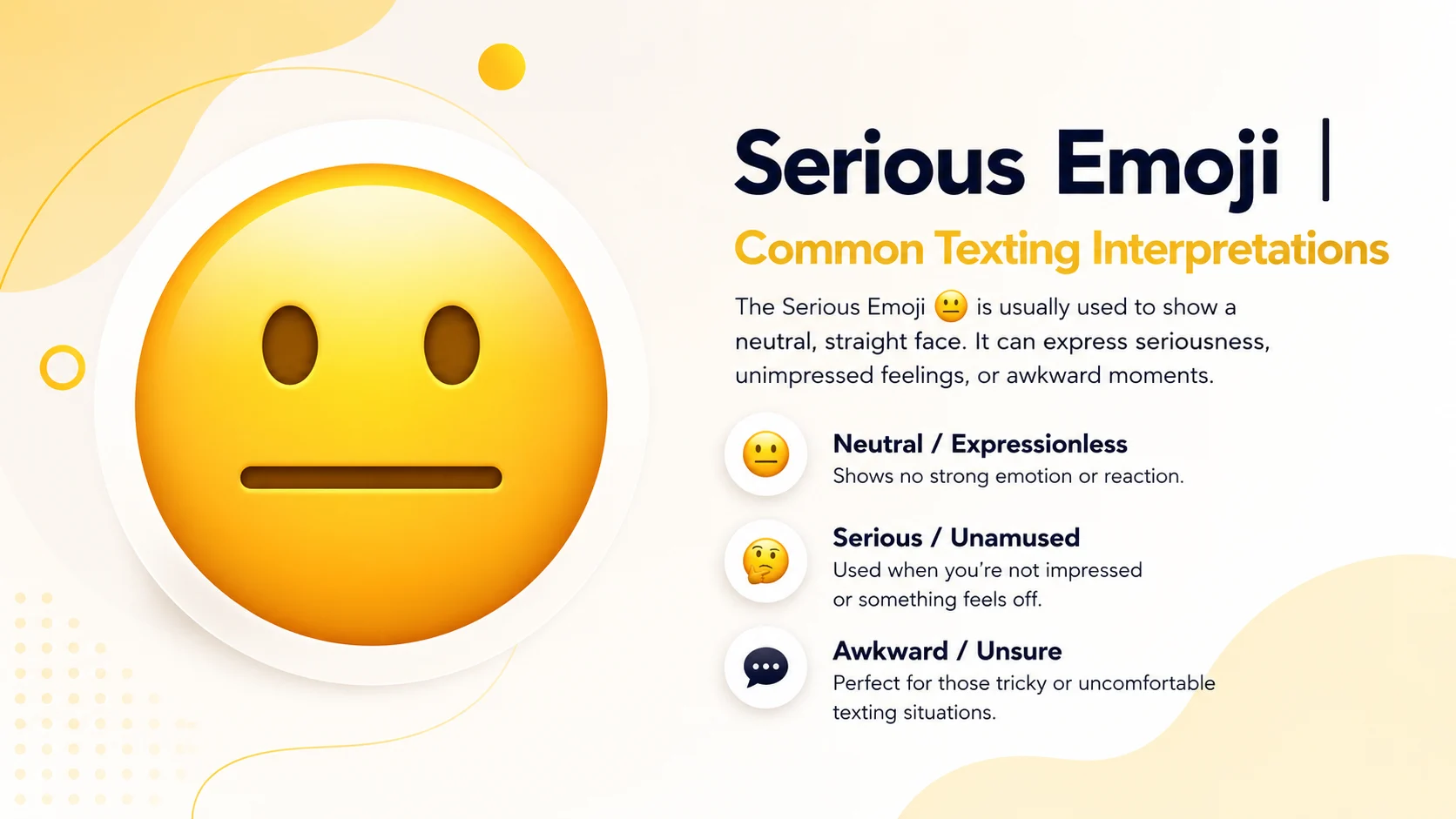
The 😐 Neutral Face emoji is often used when someone wants to show a neutral, serious, unimpressed, awkward, or emotionally restrained reaction. In texting, it can mean “I have no reaction,” “I’m not amused,” “I’m unsure what to say,” or simply “Okay.” Its exact meaning depends heavily on the surrounding words and conversation. A serious-looking emoji does not automatically mean someone is angry or upset.
When a text feels serious, awkward, or difficult to react to, 😐 can say a lot without adding many words. The Neutral Face emoji usually presents a straight, expressionless reaction, making it useful when someone wants to sound calm, unimpressed, uncertain, or emotionally reserved.
The serious emoji meaning can change depending on the situation. A message such as “Okay 😐” may sound hesitant or unimpressed, while “He really said that 😐” can suggest disbelief or a lack of amusement. The same emoji can even be used jokingly when someone wants to exaggerate an awkward reaction.
That is why 😐 should not be treated as a fixed signal for anger or seriousness. The sender’s words, relationship with you, usual texting style, and the situation all help determine what the emoji means. In many cases, it is less about being genuinely serious and more about communicating a flat or restrained reaction.
What Does 😐 Mean?
The 😐 Neutral Face emoji commonly represents a neutral or expressionless reaction.
Depending on context, it can communicate:
- Neutrality
- Uncertainty
- Awkwardness
- Mild annoyance
- Unimpressed feelings
- Emotional restraint
- Lack of enthusiasm
- “I don’t know what to say”
- “Okay…”
- A deliberately flat reaction
The emoji is especially useful when words alone do not capture the sender’s reaction.
For example:
“You forgot again 😐”
This could sound mildly annoyed or disappointed.
Compare that with:
“Okay 😐”
The second message may suggest hesitation, awkwardness, or that the sender is not fully satisfied.
Neither example proves the sender is angry. Context matters.
What Does 😐 Mean in Texting?
In texting, 😐 often works as a flat reaction.
Someone may use it when:
- They do not find something funny.
- They are unsure how to respond.
- A situation feels awkward.
- They are mildly annoyed.
- They want to show little emotion.
- They are deliberately keeping their response neutral.
- They are reacting to something unexpected.
For example:
“I accidentally sent that message to my teacher 😐”
Here, 😐 can communicate an awkward, speechless reaction.
Another example:
“So you’re telling me you knew the answer the whole time 😐”
This can sound unimpressed or mildly irritated.
Is 😐 a Serious Emoji?
It can be, but 😐 is not officially named “Serious Face.” Its official Unicode name is Neutral Face.
The emoji can create a serious tone because its expression is intentionally restrained. However, “serious” is only one possible interpretation.
Depending on the message, 😐 can feel:
- Calm
- Flat
- Awkward
- Unimpressed
- Dry
- Slightly annoyed
- Emotionally distant
- Deadpan
If someone sends 😐 after a joke, they may be communicating that they did not find it funny. If they send it after a serious statement, they may simply be acknowledging the message without showing much emotion.
😐 Meaning From Someone
If someone sends you 😐, avoid immediately assuming they are angry.
Consider the complete message.
Example:
“I don’t really know what to say 😐”
Likely meaning: The person feels uncertain or speechless.
Example:
“You did what? 😐”
Likely meaning: Surprise, disbelief, or concern.
Example:
“Sure 😐”
Likely meaning: The person may be hesitant, unimpressed, or not completely enthusiastic.
The same emoji can produce different impressions depending on the words around it.
Is 😐 Rude?
Sometimes it can feel rude, but the emoji itself is not inherently rude.
A short response such as:
“Cool 😐”
could feel dismissive if the conversation is already tense.
But:
“I honestly don’t know what to say 😐”
is more likely to communicate uncertainty.
The difference comes from the entire message rather than the emoji alone.
If you’re unsure how someone intended 😐, look at whether their words are friendly, short, sarcastic, frustrated, or supportive.
Can 😐 Mean Someone Is Annoyed?
Yes. 😐 can sometimes communicate mild annoyance or dissatisfaction.
For example:
“You changed the plan again 😐”
The emoji can make the message feel restrained rather than openly angry.
It may communicate something like:
“I’m not happy about this, but I’m not going to make a big deal out of it.”
However, if someone is genuinely angry, they may use words that make their feelings clearer. Do not assume that 😐 alone means anger.
Can 😐 Be Sarcastic?
Yes. 😐 works especially well with dry or deadpan humor.
For example:
“Great, another meeting at 7 a.m. 😐”
The emoji can emphasize that the speaker is not actually excited.
Another example:
“Love when my Wi-Fi stops working during a test 😐”
Here, the expression can reinforce sarcasm by deliberately looking emotionally flat.
The surrounding words create the sarcasm; the emoji simply strengthens the reaction.
Does 😐 Mean “I’m Not Impressed”?
It can.
If someone replies:
“I finished the whole project in ten minutes 😐”
the neutral expression may suggest disbelief or a lack of enthusiasm.
Likewise:
“You call that an apology? 😐”
can sound unimpressed.
This interpretation becomes stronger when the message itself suggests doubt, disappointment, or criticism.
Serious vs. Neutral: What Is the Difference?
A serious message communicates that the topic matters or that the speaker is not joking. A neutral emoji such as 😐 communicates a restrained facial reaction.
That means 😐 can appear in a serious conversation without necessarily meaning “this is serious.”
For example:
“We need to talk about what happened 😐”
Here, the words create the serious tone.
By contrast:
“That was a joke? 😐”
The emoji may communicate confusion or a lack of amusement.
So, 😐 is better understood as neutral or emotionally flat than as a dedicated serious emoji.
Related Emojis and Their Meanings
| Emoji | Official Name | Common Meaning | Tone | Where or When It Is Used |
|---|---|---|---|---|
| 😐 | Neutral Face | Neutral, flat, unsure, unimpressed | Neutral, restrained | Awkward reactions, uncertainty, dry responses |
| 😑 | Expressionless Face | Annoyance, boredom, frustration | Flat, irritated | When something feels repetitive or frustrating |
| 🙄 | Face with Rolling Eyes | Disbelief, annoyance, sarcasm | Sarcastic, dismissive | Reacting to something irritating or ridiculous |
| 😶 | Face Without Mouth | Speechless, quiet, no response | Silent, restrained | When someone does not know what to say |
| 😒 | Unamused Face | Displeasure, skepticism, annoyance | Unimpressed, negative | Responding to something irritating or unconvincing |
| 🫤 | Face with Diagonal Mouth | Mixed feelings, uncertainty, discomfort | Uneasy, uncertain | When a situation feels complicated or awkward |
| 🤨 | Face with Raised Eyebrow | Doubt, suspicion, questioning | Skeptical, questioning | When someone is unsure or does not believe something |
| 😬 | Grimacing Face | Awkwardness, discomfort, nervousness | Tense, awkward | Embarrassing or uncomfortable moments |
| 🤔 | Thinking Face | Thinking, questioning, uncertainty | Curious, thoughtful | Considering an idea or questioning information |
The most common confusion is between 😐, 😑, and 😒. 😐 is generally more neutral, while 😑 often feels more emotionally drained or irritated and 😒 more clearly communicates displeasure.
🙄 is usually more openly dismissive or sarcastic. 🤨 focuses more on suspicion or questioning, while 🤔 suggests active thought rather than emotional flatness.
😐 vs. 😑
These two emojis look similar but often create different impressions.
😐 Neutral Face tends to communicate a blank, neutral, or restrained reaction.
😑 Expressionless Face often feels more tired, irritated, bored, or emotionally drained.
Compare:
“Okay 😐”
This can simply sound neutral or uncertain.
“Okay 😑”
This is more likely to sound annoyed or frustrated.
😐 vs. 😒
😐 usually leaves more room for interpretation.
😒 Unamused Face has a more clearly negative expression and commonly suggests displeasure, skepticism, or annoyance.
For example:
“Really? 😐”
could be neutral disbelief.
“Really? 😒”
sounds more openly unimpressed.
😐 vs. 🙄
The 🙄 Face with Rolling Eyes is usually more expressive.
It can communicate:
- “Seriously?”
- “Here we go again.”
- “That’s ridiculous.”
- “I’m not impressed.”
😐 is much more restrained.
If you want a subtle flat reaction, 😐 may fit better. If you want obvious sarcasm or exasperation, 🙄 is stronger.
Text Examples of the Serious Emoji
1. A flat reaction
“Oh, okay 😐”
Likely meaning: The person is acknowledging something without much enthusiasm.
2. Mild annoyance
“You canceled again 😐”
Likely meaning: The sender may be disappointed or mildly irritated.
3. Awkwardness
“Everyone heard me say that 😐”
Likely meaning: The sender feels embarrassed or awkward.
4. Disbelief
“You actually believed that? 😐”
Likely meaning: The sender may be questioning the other person’s judgment.
5. Dry humor
“Perfect. My laptop crashed again 😐”
Likely meaning: The sender is using a deliberately flat expression to make the situation sound humorously frustrating.
How to Respond to 😐
Your response should depend on what the sender actually said.
If they seem confused:
“Haha, let me explain.”
They seem annoyed:
“Sorry, I didn’t mean to make things difficult.”
If they seem disappointed:
“Yeah, I understand why you’d be frustrated.”
A simple clarification is often better than trying to decode the emoji by itself.
Common Misunderstandings About 😐
One common mistake is calling 😐 an “angry emoji.” It is not officially an angry face. Its Unicode name is Neutral Face, and its expression is intentionally more restrained.
Another mistake is assuming that 😐 always means someone is upset. It can also express uncertainty, awkwardness, boredom, lack of enthusiasm, or simply a neutral response.
It is also possible to mistake a dry joke for genuine irritation. For example:
“Amazing. Another password reset 😐”
The sender might genuinely be annoyed, or they might simply be making a small joke about an everyday inconvenience.
Look at the surrounding words before deciding what the emoji means.
What Is the Official Name of 😐?
The official Unicode name of 😐 is Neutral Face.
Its Unicode code point is U+1F610.
The emoji was included in Unicode 6.1 and is part of the standard set of facial-expression emojis.
The official name identifies the character, while meanings such as “serious,” “unimpressed,” or “awkward” describe ways people may use it in conversation.
When Should You Use 😐?
😐 works well when you want to show a restrained reaction.
You might use it for:
- An awkward moment
- Mild disbelief
- A dry joke
- A neutral response
- Uncertainty
- Lack of enthusiasm
- A situation that leaves you speechless
- Mild frustration
If you want to communicate strong anger, sadness, excitement, or affection, another emoji may express that emotion more clearly.
FAQs
What is the serious emoji?
There is no official emoji named “Serious Face.” 😐 Neutral Face is one emoji that people may use to create a serious, flat, or restrained tone.
What does 😐 mean from a girl or guy?
The emoji does not have a different fixed meaning based on the sender’s gender. The conversation, relationship, and wording matter more.
Does 😐 mean angry?
Not necessarily. It can suggest mild annoyance, but it can also mean neutral, awkward, uncertain, unimpressed, or speechless.
Is 😐 a bad emoji?
No. 😐 is not inherently negative. Its tone can range from neutral to mildly negative depending on context.
Does 😐 mean “okay”?
Sometimes. In a short message such as “Okay 😐,” it can make “okay” sound hesitant, flat, or less enthusiastic.
Conclusion
The 😐 Neutral Face emoji is best understood as a restrained reaction rather than a dedicated “serious emoji.” It can communicate neutrality, awkwardness, uncertainty, mild annoyance, disbelief, or a lack of enthusiasm.
Its meaning becomes clearer when you read it together with the words around it. 😐 can be serious, but it can also be dry, sarcastic, playful, or simply neutral. If you are trying to understand what someone meant, focus on the complete conversation instead of treating one emoji as a guaranteed emotional signal.
