Quick Answer
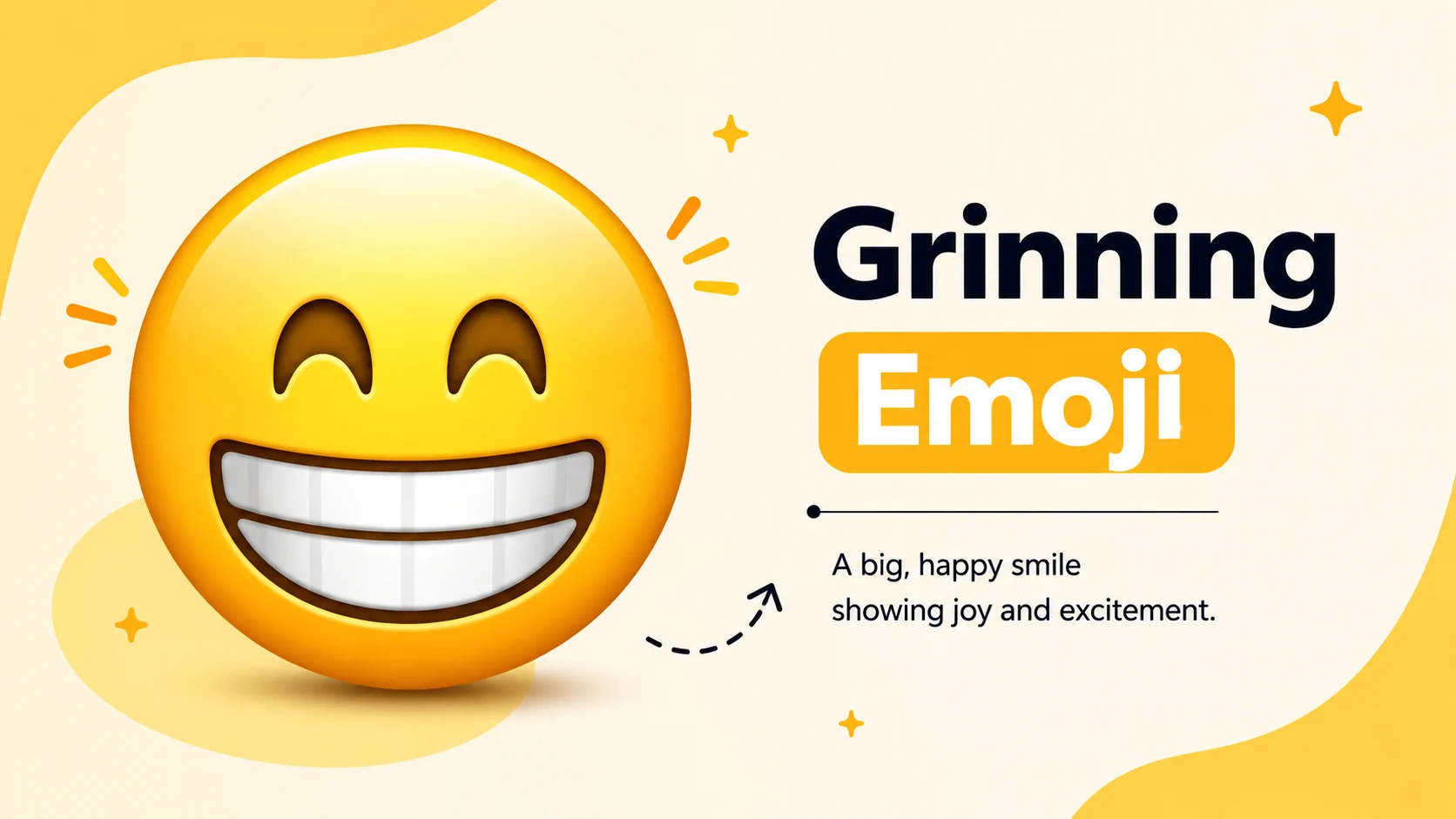
The grinning emoji 😀, officially called Grinning Face, usually expresses happiness, cheerfulness, amusement, or a friendly positive reaction. It has a simple open-eyed expression and a broad open smile. In texts, it can make a message feel upbeat or playful, although the exact tone depends on the words around it and the relationship between the people chatting. Unicode identifies 😀 as U+1F600.
😀 is one of the clearest smiley emojis, but its meaning can be slightly different depending on the conversation. The grinning emoji officially called Grinning Face, shows a broad open smile and is generally associated with happiness, good cheer, amusement, or a positive reaction.
In a text message, someone might use 😀 simply to show that they are happy about something, enjoying a joke, or keeping their response friendly. It can also soften a short message that might otherwise sound too serious or blunt.
Context still matters. “That sounds great 😀” is clearly upbeat, while “Okay, I guess 😀” could feel more playful, awkward, or slightly ironic depending on the conversation. The emoji itself does not prove a particular emotion or relationship intention.
What Does the Grinning Emoji 😀 Mean?
The most common meaning of 😀 is happiness or cheerful amusement. Its wide smile makes it useful when someone wants to show a positive reaction without adding a more specific emotion such as laughter, affection, embarrassment, or excitement.
People may use 😀 when they are:
- Happy about good news
- Responding positively to a message
- Making a friendly joke
- Showing general amusement
- Celebrating a small win
- Making a message sound warmer
- Reacting to something pleasantly surprising
The expression is relatively straightforward, so it usually has a positive tone.
Is 😀 Always a Sign of Happiness?
Not necessarily.
The emoji normally looks cheerful, but the surrounding message can change how it comes across. For example:
“I finally finished my homework 😀”
This most naturally suggests relief or happiness.
But:
“You remembered my birthday 😀”
could be genuinely appreciative, playful, or lightly teasing depending on the conversation.
This is why it is better to interpret the complete message rather than treating one emoji as a fixed emotional code.
What Does 😀 Mean in Texting?
In texting, 😀 often works as a simple “I’m happy,” “That’s good,” or “I’m enjoying this” reaction.
It can be especially useful when a sender wants to keep a conversation positive without using a stronger emoji such as 😂 or 🤩.
For example:
“We got tickets 😀”
Likely meaning: The sender is excited or happy about getting tickets.
“That was actually pretty funny 😀”
Likely meaning: The sender found something amusing.
“Thanks for helping me 😀”
Likely meaning: The sender is expressing friendly appreciation.
The emoji does not automatically mean laughter. If the person is specifically laughing hard, 😂 or 🤣 may communicate that more clearly.
What Tone Does the Grinning Face Have?
😀 generally has a bright, friendly, and cheerful tone.
Its emotional intensity is usually moderate. It is more expressive than a plain text “okay,” but it does not necessarily communicate the strong excitement of 🤩 or the affection of 🥰.
Depending on context, 😀 can feel:
- Cheerful
- Friendly
- Playful
- Amused
- Positive
- Lighthearted
- Occasionally awkward or ironic
The words surrounding it are often more important than the emoji itself when deciding between these interpretations.
Can 😀 Be Sarcastic?
Yes, but sarcasm comes from context, not from the official meaning of the emoji.
For example:
“Another three-hour meeting 😀”
If the conversation makes it clear that the person dislikes long meetings, the emoji could be intentionally ironic.
By contrast:
“No meeting today 😀”
would normally be read as genuine happiness.
So 😀 can participate in a sarcastic message, but it is not inherently a sarcastic emoji.
Is 😀 Flirty?
Usually, 😀 is simply friendly or cheerful rather than specifically romantic.
Someone could use it in a flirty conversation, but the emoji alone is not enough evidence of romantic interest. Other parts of the conversation, such as the wording, established relationship, and overall tone, matter much more.
For example:
“You’re really funny 😀”
could be friendly.
In another conversation, the same emoji might accompany playful flirting. The emoji does not determine that meaning by itself.
If someone wants a more affectionate or romantic tone, emojis such as 😊, 🥰, 😍, or a heart may communicate that more directly.
What Does 😀 Mean From Someone?
If someone sends you 😀, the safest interpretation is usually that they are trying to communicate a positive, cheerful, or friendly reaction.
Consider the complete message:
“That sounds fun 😀”
Likely positive enthusiasm.
“Haha, you actually did it 😀”
Likely playful amusement.
“Sure, no problem 😀”
Likely a friendly way of keeping the response warm.
You do not need to assume that the sender is flirting, being sarcastic, or expressing a deeper emotion unless the surrounding conversation supports that interpretation.
Related Emojis and Their Meanings
| Emoji | Official Name | Common Meaning | Tone | Where or When It Is Used |
|---|---|---|---|---|
| 😀 | Grinning Face | General happiness, cheer, amusement | Cheerful, friendly | Positive reactions, everyday texts, jokes |
| 😃 | Grinning Face with Big Eyes | Happiness, excitement, good-natured amusement | Bright, energetic | Good news, enthusiastic reactions |
| 😄 | Grinning Face with Smiling Eyes | Warm happiness and amusement | Warm, upbeat | Friendly conversations, genuine enjoyment |
| 😁 | Beaming Face with Smiling Eyes | Strong happiness or a broad grin | Energetic, delighted | Celebrations, proud or very happy reactions |
| 😆 | Grinning Squinting Face | Strong amusement or laughter | Playful, excited | Funny messages and humorous reactions |
| 😂 | Face with Tears of Joy | Something is extremely funny | Laughing, highly amused | Jokes, funny stories, humorous reactions |
| 😅 | Grinning Face with Sweat | Nervous laughter, relief, or awkward humor | Awkward, relieved, playful | Close calls, uncomfortable jokes, stressful-but-funny moments |
| 😊 | Smiling Face with Smiling Eyes | Warm happiness, friendliness, appreciation | Gentle, warm | Gratitude, kindness, affectionate messages |
| 😏 | Smirking Face | Slyness, smugness, mischief, or suggestiveness | Sly, cheeky | Teasing or suggestive contexts |
The most common confusion is between 😀, 😃, and 😄. All three are positive smiling faces, but their eye shapes give them different visual personalities. 😀 is the straightforward Grinning Face, 😃 has larger, more excited-looking eyes, and 😄 uses smiling eyes that give it a warmer expression.
😁 can look even more intensely cheerful because its smiling eyes and full-toothed grin create a stronger expression. 😂 shifts the meaning toward laughter, while 😊 has a softer and warmer feeling.
😏 is particularly different. Its half-smile and sideways-looking eyes can suggest smugness, mischief, or flirtation, so it should not normally be treated as another version of the straightforward 😀 smile.
😀 vs. 😃: What’s the Difference?
😀 Grinning Face has simple open eyes and a broad open smile.
😃 Grinning Face with Big Eyes has larger, more excited-looking eyes while keeping a broad smile. Emojipedia describes both as expressions of general happiness and good-natured amusement, with 😃 tending to look more excited because of its eyes.
A simple way to choose:
- 😀 = straightforward cheerful grin
- 😃 = brighter or more energetic grin
Neither one has a guaranteed emotional intensity. Personal style and context still matter.
😀 vs. 😄: What’s the Difference?
😀 has simple open eyes, while 😄 has crescent-shaped smiling eyes.
That eye difference can make 😄 feel warmer or more openly delighted. Emojipedia describes 😄 as conveying general happiness and good-natured amusement.
For example:
“We passed the test 😀”
A straightforward happy reaction.
“We passed the test 😄”
A warmer, more visibly delighted reaction.
These are subtle differences rather than strict rules.
When Should You Use 😀?
😀 works well when you want a message to sound clearly positive without making the emotion too specific.
Good situations include:
- Responding to good news
- Showing friendly enthusiasm
- Reacting to a joke
- Celebrating a small success
- Saying thanks in a cheerful way
- Keeping casual conversation upbeat
Examples:
“I got the job 😀”
Shows happiness about the result.
“That sounds awesome 😀”
Shows a positive reaction.
“We finished everything 😀”
Shows satisfaction or relief.
When Could 😀 Be Misunderstood?
Because 😀 is such a broad smile, it can sometimes feel different from what the sender intended.
For example:
“I have to work all weekend 😀”
Without more context, the emoji could be genuine enthusiasm, forced positivity, or sarcasm.
Another example:
“You forgot again 😀”
That could be playful teasing, but it might also be read as passive-aggressive depending on the relationship and previous messages.
If the subject is serious, adding a cheerful emoji can sometimes make the message feel confusing. When clarity matters, use words to explain your actual reaction instead of relying on the emoji alone.
How to Respond to 😀 in a Text
Your response should match the message rather than the emoji alone.
If the message is happy
“That’s great! 😀”
If they are joking
“Haha, seriously 😂”
If you are unsure what they mean
“Wait, are you joking? 😄”
If they are sharing good news
“Congrats! That’s awesome!”
If the tone seems sarcastic
“Okay… should I be concerned? 😅”
You do not need to copy the exact same emoji. A natural response usually works better.
Copy and Paste the Grinning Emoji
😀
You can copy 😀 and use it in texts, captions, comments, messages, or other places that support emoji.
Official Name and Unicode Details
The official Unicode name for 😀 is Grinning Face. Its Unicode code point is U+1F600. Unicode’s current character chart identifies U+1F600 as Grinning Face, while Emojipedia notes that the emoji was approved as part of Unicode 6.1 in 2012 and added to Emoji 1.0 in 2015.
The emoji’s exact artwork can vary between platforms and operating systems. The basic concept remains the same: a yellow face with simple open eyes and a broad open smile.
FAQs
What does 😀 mean?
😀 means Grinning Face and commonly expresses happiness, cheerfulness, amusement, or a friendly positive reaction.
Is 😀 a happy emoji?
Yes. Happiness and good cheer are among its most common interpretations.
Does 😀 mean laughing?
Not necessarily. It can show amusement, but 😂 and 🤣 communicate stronger laughter more directly.
Is 😀 a friendly emoji?
Generally, yes. Its broad smile usually gives a message a friendly and positive tone.
Conclusion
The grinning emoji 😀, officially Grinning Face, is a simple way to communicate happiness, cheer, amusement, or a friendly positive reaction. Its meaning is usually straightforward, but the surrounding words can make it playful, teasing, ironic, or occasionally awkward.
When interpreting 😀 in a text, look at the whole conversation instead of treating the emoji as a fixed signal. Compared with 😃, 😄, 😁, and 😂, it is best thought of as a general-purpose cheerful grin rather than a specific expression of intense excitement, warmth, or laughter.
Discover More Related Articles:
- Sweat Smile Emoji | Is It Nervous, Embarrassed or Happy In 2026
- Tired Face Emoji | Exhausted, Frustrated or Overwhelmed In 2026
