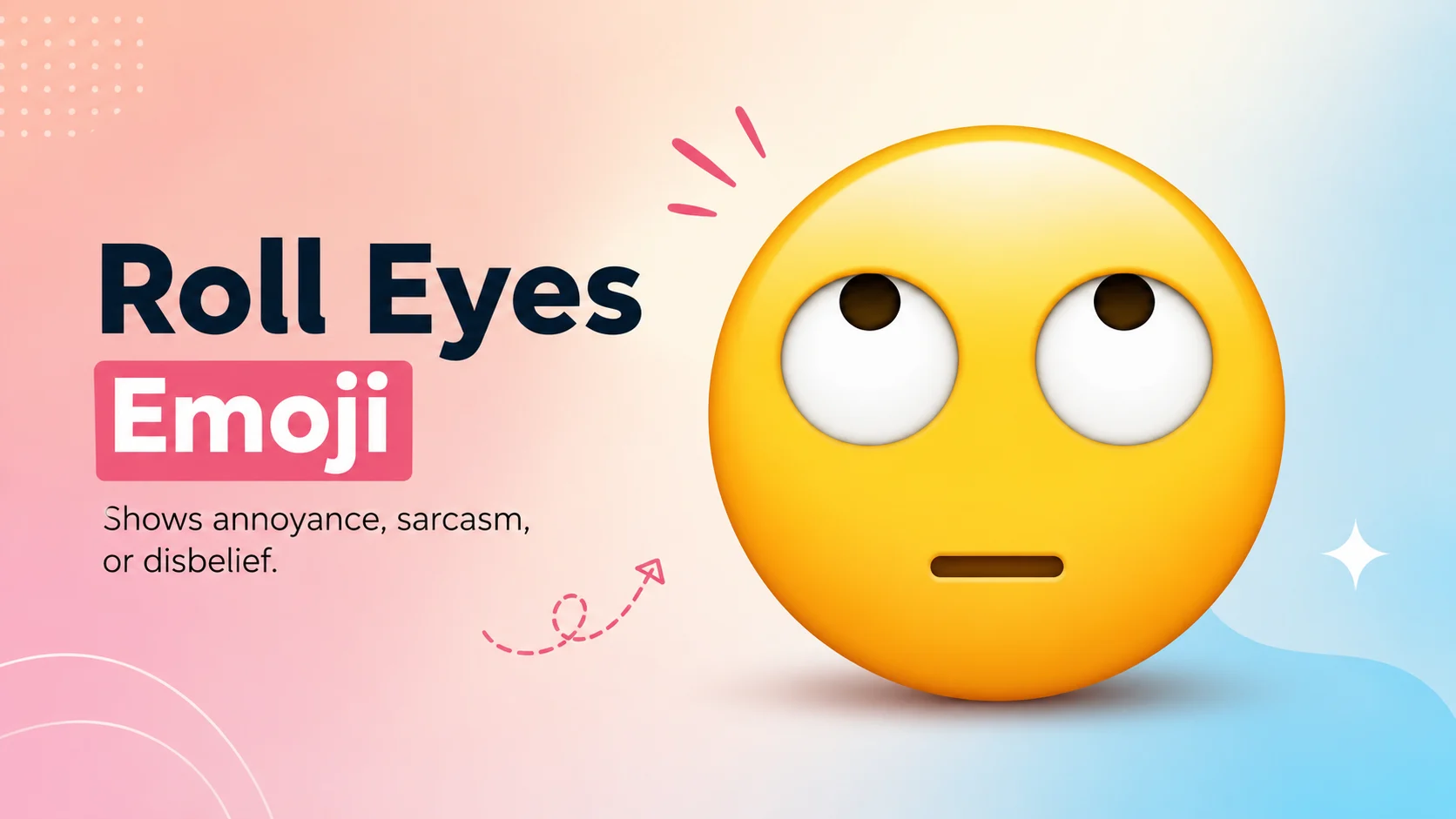
Quick Answer
The 🙄 emoji is officially called Face with Rolling Eyes. It usually expresses annoyance, disbelief, disapproval, boredom, sarcasm, or a “seriously?” reaction. The tone can be playful or genuinely irritated depending on the conversation. Emojipedia describes it as commonly conveying moderate disdain, disapproval, frustration, or boredom, while Unicode lists its official name as Face with Rolling Eyes.
The 🙄 roll eyes emoji is one of the easiest emojis to recognize because it mimics a familiar facial gesture: rolling your eyes upward. In texts, it often communicates a reaction such as “Oh, please,” “Seriously?” or “Whatever.” It can be used when someone finds a comment annoying, predictable, silly, or hard to believe.
The emoji does not always indicate serious anger. Friends may use 🙄 playfully when teasing each other or reacting dramatically to an exaggerated statement. In other situations, especially when the message is short or blunt, it can sound dismissive or irritated.
Context makes a big difference. “You forgot your keys again 🙄” may be light teasing, while “Fine, do whatever you want 🙄” can sound much more frustrated. The words around the emoji, the relationship between the people, and the normal tone of the conversation all help reveal what the sender means.
What Does the 🙄 Roll Eyes Emoji Mean?
The official Unicode name for 🙄 is Face with Rolling Eyes. Its common meanings include:
- Annoyance
- Disbelief
- Disapproval
- Frustration
- Boredom
- Sarcasm
- Impatience
- Mild disdain
- “Seriously?”
- “Whatever”
Unicode identifies 🙄 with the code point U+1F644 and places it among the face emojis associated with neutral or skeptical expressions.
Emojipedia describes its typical use as an eye-roll that can communicate moderate disdain, disapproval, frustration, or boredom. It can also have playful, sassy, resentful, or sarcastic tones.
The emoji is therefore usually negative or dismissive, but the strength of that negativity depends heavily on context.
🙄 Meaning in Text Messages
In texting, 🙄 is often used as a quick reaction to something the sender finds irritating, obvious, exaggerated, or ridiculous.
For example:
“He said he was going to be five minutes late again 🙄”
This suggests the sender is annoyed or unsurprised by the situation.
Another example:
“You seriously forgot my birthday? 🙄”
Here, the emoji reinforces disappointment and frustration.
But it can also be playful:
“You know you love my terrible jokes 🙄😂”
The laughing emoji changes the overall tone and makes the eye-roll feel more teasing than hostile.
Is 🙄 a Negative Emoji?
Usually, yes. The 🙄 emoji generally carries a negative, skeptical, or dismissive tone.
However, “negative” does not always mean angry. It can express anything from mild irritation to playful sarcasm.
Think of the emotional range like this:
Mild: “Oh, come on 🙄”
Playful: “You’re so dramatic 🙄😂”
Skeptical: “You expect me to believe that? 🙄”
Frustrated: “We already talked about this 🙄”
Dismissive: “Whatever you say 🙄”
The surrounding words determine where the message falls on that range.
Can 🙄 Be Sarcastic?
Yes. Sarcasm is one of the common ways people use the roll eyes emoji.
For example:
“Wow, what an amazing idea 🙄”
The words sound positive on their own, but 🙄 suggests the sender does not genuinely mean them. The emoji signals that the statement may be sarcastic.
Another example:
“Sure, because that worked so well last time 🙄”
Here, the emoji strengthens the sarcastic tone.
Still, 🙄 does not automatically make every message sarcastic. If the sender is genuinely frustrated, the emoji may simply emphasize their annoyance.
What Does 🙄 Mean From Someone?
If someone sends 🙄 to you, the meaning depends on what they are reacting to.
They might be:
- Teasing you
- Showing mild annoyance
- Questioning what you said
- Expressing disbelief
- Disagreeing with you
- Reacting sarcastically
- Saying “seriously?”
- Showing that they are tired of a topic
For example:
You: “I might be late again.”
Them: “🙄”
That could mean they are annoyed because this has happened before.
But:
You: “I ate the whole pizza.”
Them: “🙄😂”
This is more likely playful teasing.
One emoji is not enough to determine someone’s exact feelings. Read it together with the message and the conversation history.
Is 🙄 Rude?
It can be.
An eye roll is generally associated with dismissal or irritation, so sending 🙄 in a serious conversation can make your response sound disrespectful or impatient.
For example:
“I was trying to explain why I was upset.”
“🙄”
That response could feel dismissive.
On the other hand, friends may use it casually:
“You always steal the last slice 🙄😂”
Here, the emoji is likely playful.
If you are talking to someone you do not know well, using 🙄 can sometimes create a harsher impression than you intended.
Is the Roll Eyes Emoji Flirty?
The 🙄 emoji is not normally a flirting emoji. Its basic meaning is related to annoyance, disbelief, sarcasm, boredom, or disapproval.
In a playful conversation, someone might use it while teasing another person, but that does not automatically make the message romantic or flirty.
For example:
“You really think you’re funny 🙄😂”
This could simply be friendly teasing.
The surrounding words and relationship matter more than the emoji itself. Do not treat 🙄 alone as evidence of attraction or romantic interest.
🙄 Meaning in Relationships and Friendships
Between friends, the roll eyes emoji can be a casual way to show playful frustration.
For example:
“You changed the movie again 🙄”
Depending on the relationship, this may mean “You’re impossible” in a joking way rather than genuine anger.
In a more serious relationship conversation, however, 🙄 may communicate impatience or dismissal:
“Can we please talk about this later? 🙄”
That may signal that the person is frustrated with the conversation.
The same emoji can therefore feel completely different depending on the people involved.
Related Emojis and Their Meanings
| Emoji | Official Name | Common Meaning | Tone | Where or When It Is Used |
|---|---|---|---|---|
| 🙄 | Face with Rolling Eyes | Annoyance, disbelief, sarcasm, boredom | Dismissive, sarcastic, playful | Reactions to irritating or ridiculous comments |
| 😒 | Unamused Face | Dissatisfaction, annoyance, lack of enthusiasm | Dry, negative | When something is disappointing or irritating |
| 😑 | Expressionless Face | No reaction, boredom, emotional flatness | Deadpan, neutral | When someone has little to say or feels unimpressed |
| 😏 | Smirking Face | Self-satisfaction, slyness, knowing attitude | Sly, playful | Teasing, confidence, or suggestive jokes |
| 🤨 | Face with Raised Eyebrow | Doubt, skepticism, disbelief | Questioning, skeptical | When something sounds suspicious or questionable |
| 😐 | Neutral Face | Neutral or uncertain reaction | Flat, reserved | When someone does not have a strong reaction |
| 😬 | Grimacing Face | Awkwardness, discomfort, tension | Nervous, uncomfortable | Awkward moments or uncomfortable situations |
| 🤦 | Person Facepalming | Frustration, embarrassment, disbelief | Exasperated, humorous | Reacting to a mistake or obviously bad decision |
The closest comparisons are 🙄, 😒, and 🤨. 🙄 is especially useful when you want to show an actual eye-roll or sarcastic “seriously?” reaction. 😒 is more generally unamused or dissatisfied, while 🤨 focuses more on doubt or suspicion.
😑 is flatter and less expressive. It can communicate “I have no words” without the obvious dismissive gesture found in 🙄.
🙄 vs. 😒: What’s the Difference?
Both emojis can express annoyance, but they communicate it differently.
🙄 = “Seriously? Come on.”
😒 = “I’m not impressed.”
For example:
“You forgot to bring the tickets again 🙄”
This sounds like an eye-roll at someone’s mistake.
“That movie was disappointing 😒”
This communicates dissatisfaction without the stronger eye-roll gesture.
They can overlap, but 🙄 tends to feel more reactive and sarcastic.
🙄 vs. 🤨: What’s the Difference?
These two are sometimes confused because both can express skepticism.
🙄 usually communicates an eye-roll, irritation, or dismissive disbelief.
🤨 usually communicates doubt, suspicion, or questioning.
Compare:
“You said you finished it yesterday 🙄”
This suggests frustration or disbelief.
“You said you finished it yesterday? 🤨”
This sounds more like questioning whether the statement is true.
🙄 vs. 😑: What’s the Difference?
The difference is mostly emotional expression.
🙄 has an active reaction: the sender is visibly rolling their eyes.
😑 has a flat, expressionless reaction: the sender may be bored, unimpressed, or simply out of words.
If someone sends:
“Here we go again 🙄”
They are actively showing annoyance.
If they send:
“Here we go again 😑”
The reaction feels quieter and more deadpan.
Text Message Examples
Playful Eye Roll
“You really bought another pair of sneakers? 🙄😂”
Likely meaning: Friendly teasing rather than serious anger.
Mild Annoyance
“You forgot to text me when you got home 🙄”
Likely meaning: The sender is irritated or disappointed.
Sarcasm
“Yes, because that sounds like a fantastic plan 🙄”
Likely meaning: The sender probably does not genuinely approve of the plan.
Disbelief
“You seriously believe that story? 🙄”
Likely meaning: The sender doubts what they heard.
Boredom
“Another meeting about the same thing 🙄”
Likely meaning: The sender is tired or bored with the repeated topic.
How to Respond to 🙄
The best response depends on the tone.
If it is playful:
“😂 What? I didn’t do anything!”
If they seem annoyed:
“Okay, I get it. What bothered you?”
A simple clarification can prevent a small emoji from turning into a bigger misunderstanding.
Common Misunderstandings About 🙄
It does not always mean anger
The sender may be mildly annoyed, bored, sarcastic, or simply joking.
It does not automatically mean disrespect
Friends often use eye-roll emojis as playful reactions. The surrounding message matters.
It does not prove someone dislikes you
A person can be annoyed by a particular situation without being annoyed with you personally.
It is not automatically flirting
Playful teasing can happen in many kinds of relationships. 🙄 by itself does not establish romantic interest.
It does not always mean sarcasm
Sarcasm is common, but the emoji can also express straightforward frustration or disbelief.
Official Emoji Details
The official Unicode name for 🙄 is Face with Rolling Eyes. Its Unicode code point is U+1F644. Unicode’s emoji charts list it alongside other neutral and skeptical facial expressions such as 😒 Unamused Face, 😑 Expressionless Face, and 🤨 Face with Raised Eyebrow.
Face with Rolling Eyes was approved in Unicode 8.0 in 2015 and added to Emoji 1.0 in 2015, according to Emojipedia.
The artwork can vary between platforms. For example, different operating systems and vendors may use slightly different facial details or positioning while keeping the same basic eye-rolling concept.
FAQs
What is the official name of 🙄?
The official Unicode name is Face with Rolling Eyes. Its code point is U+1F644.
What does 🙄 mean in texting?
It commonly means annoyance, disbelief, sarcasm, boredom, frustration, or disapproval.
Is 🙄 a rude emoji?
It can sound rude or dismissive in a serious conversation, but friends may use it playfully.
What does 🙄 mean from a girl or guy?
The meaning does not depend on the sender’s gender. The conversation, wording, relationship, and tone provide much more useful context.
Does 🙄 mean sarcasm?
It can signal sarcasm, especially when the words sound overly positive or exaggerated. But it can also simply express irritation or disbelief.
Is 🙄 a flirting emoji?
Not usually. It is primarily associated with eye-rolling, annoyance, disbelief, and sarcasm. A playful conversation can give it a different tone, but the emoji alone does not prove flirting.
Conclusion
The 🙄 Face with Rolling Eyes emoji usually communicates annoyance, disbelief, sarcasm, boredom, or disapproval. It can be serious when someone is genuinely frustrated, but it can also be a playful way for friends to tease each other.
The best way to understand a roll eyes emoji is to look at the entire message rather than the emoji alone. Words, conversation history, and tone can turn 🙄 from a lighthearted joke into a genuinely dismissive response.
If you want a stronger eye-roll reaction, 🙄 works well. For simple dissatisfaction, 😒 may fit better; for skepticism, 🤨 is usually clearer; and for a flat, unimpressed response, 😑 may be a better choice.
Discover More Related Articles:
- Giggle Emoji | From Shy Laughs to Playful Moments In 2026
- Smug Emoji | Flirty, Playful, Confident & Sarcastic Meanings In 2026
