Quick Answer
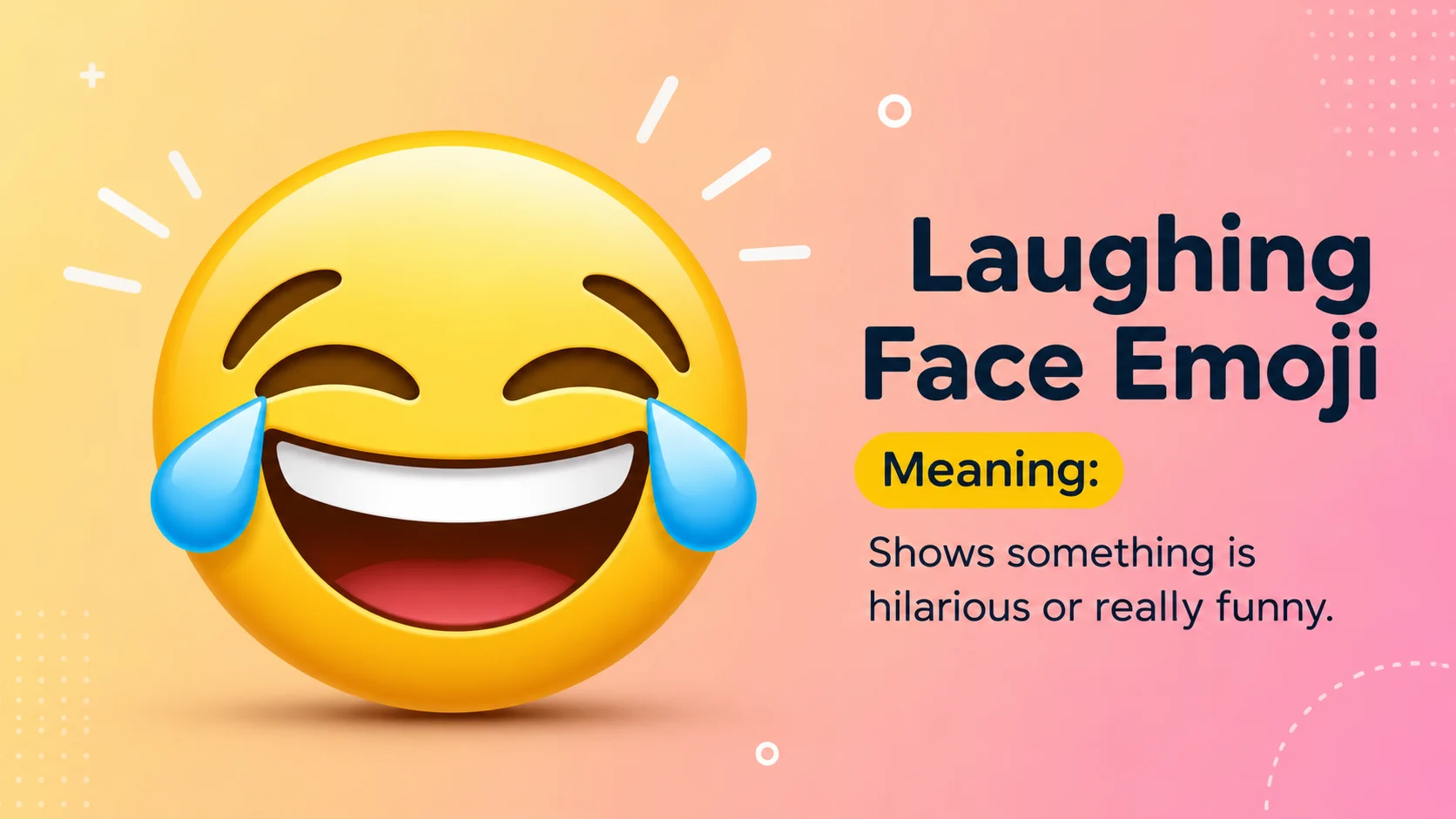
The laughing face emoji 😂 is officially called Face with Tears of Joy. It usually means that something is very funny, amusing, or making the sender laugh so much that they are represented with tears of joy. It can be used for jokes, funny stories, playful reactions, and humorous comments. The exact tone can still depend on the surrounding message and conversation. Unicode identifies 😂 as U+1F602.
😂 is one of the most recognizable emojis for expressing laughter. Although people often call it the laughing face emoji, its official Unicode name is Face with Tears of Joy. The expression combines a wide smile with tears coming from the eyes, visually suggesting laughter so strong that it brings tears.
In texts, 😂 is commonly used when something is genuinely funny, when someone is reacting to a joke, or when a situation feels amusing enough to deserve a stronger response than a simple smile. It can make a message feel more energetic and playful.
Context still matters. A message such as “That was hilarious 😂” is clearly humorous, while “You really forgot again 😂” could be playful teasing. The emoji does not automatically tell you whether someone is laughing with you, teasing you, or reacting ironically, so the surrounding words are important.
What Does the Laughing Face Emoji 😂 Mean?
The most common meaning of 😂 is strong amusement or laughter.
People often use it when something makes them laugh, especially when a simple “haha” does not seem expressive enough.
It can communicate:
- “That is so funny.”
- “I’m laughing.”
- “That made me laugh.”
- “I can’t believe how funny that was.”
- “That situation is hilarious.”
- “I’m reacting playfully to this.”
The tears are not normally meant to express sadness. They represent tears of joy, which is why the official name is Face with Tears of Joy.
What Does 😂 Mean in Texting?
In texting, 😂 is usually a direct reaction to something funny or entertaining.
For example:
“I just walked into the wrong classroom 😂”
The emoji suggests that the sender finds the situation funny.
Another example:
“You actually said that out loud 😂”
Here, 😂 can show amusement and playful disbelief.
A short response such as:
“😂”
can also stand alone as a reaction. In that case, the sender is essentially saying that they found the previous message funny.
Why Do People Use 😂 Instead of “LOL”?
😂 can communicate laughter visually and immediately. It can also make a response feel more expressive than a plain “lol.”
Compare:
“That was funny.”
with:
“That was funny 😂”
The emoji adds a clear visual cue that the person is amused.
However, not every use of 😂 means the sender is literally laughing at that exact moment. Like other emojis, it can be used as an expressive reaction to show that something is very funny or entertaining.
What Tone Does 😂 Have?
😂 usually has a playful, humorous, and energetic tone.
Depending on the conversation, it can feel:
- Genuinely amused
- Playful
- Lighthearted
- Excited
- Teasing
- Dramatic
- Occasionally ironic
It is generally stronger than a basic smiling emoji because it specifically highlights laughter or amusement.
The tone can also depend on repetition. A single 😂 may be a simple laugh, while several emojis such as 😂😂😂 can make the reaction look much more exaggerated.
Can 😂 Be Sarcastic?
Yes, 😂 can appear in sarcastic messages, but sarcasm comes from the context and wording, not from the official meaning of the emoji.
For example:
“Awesome, my internet stopped working again 😂”
If the sender clearly does not consider the situation awesome, the emoji can reinforce an ironic or sarcastic tone.
By contrast:
“That joke was actually hilarious 😂”
is much more straightforward.
If you are unsure whether someone is being sarcastic, look at the full message and the conversation that came before it rather than interpreting 😂 alone.
Is 😂 a Friendly Emoji?
Generally, yes. 😂 is often used between friends, family members, classmates, coworkers, and other people having a casual conversation.
It can help show that a comment is meant humorously rather than seriously.
For example:
“You really thought I was going to forget? 😂”
This may sound playful rather than angry when the surrounding conversation supports that reading.
Still, humor can be interpreted differently by different people. If the subject is sensitive or serious, using 😂 may make a message seem dismissive.
Is 😂 Flirty?
😂 is not specifically a flirting emoji.
Someone may use it during a playful or flirty conversation, but the emoji itself primarily communicates laughter or amusement. It should not be treated as proof of romantic interest.
For example:
“You’re actually hilarious 😂”
could simply be a friendly compliment.
The meaning becomes more personal only when the broader conversation provides that context. The emoji by itself does not establish romantic intent.
What Does 😂 Mean From Someone?
If someone sends you 😂, the safest interpretation is usually that they found something funny or are reacting playfully.
Consider these examples:
“I can’t believe you did that 😂”
Likely meaning: They find the situation amusing.
“Stop 😂”
Likely meaning: They are playfully saying that something is making them laugh or that the joke has gone far enough.
“You’re too funny 😂”
Likely meaning: They are expressing amusement and possibly giving you a friendly compliment.
The relationship between the people, the message itself, and the previous conversation can all affect the tone.
When Does 😂 Mean “I’m Laughing”?
When someone responds to a funny story, joke, meme, or unexpected situation with 😂, it commonly means “I’m laughing” or “That’s really funny.”
For example:
“My dog stole my sandwich and then looked completely innocent 😂”
A reply of:
“😂”
would normally mean that the reader found the story funny.
It does not necessarily mean that the person is literally crying or experiencing sadness. The tears are part of the exaggerated visual expression of joyful laughter.
Related Laughing Emojis and Their Meanings
| Emoji | Official Name | Common Meaning | Tone | Where or When It Is Used |
|---|---|---|---|---|
| 😂 | Face with Tears of Joy | Strong laughter or amusement | Playful, humorous | Funny texts, jokes, stories, reactions |
| 🤣 | Rolling on the Floor Laughing | Extremely strong laughter | Exaggerated, energetic | Very funny jokes, dramatic reactions |
| 😆 | Grinning Squinting Face | Big laugh or intense amusement | Playful, energetic | Jokes, silly moments, excited reactions |
| 😅 | Grinning Face with Sweat | Nervous laughter, relief, or awkward humor | Awkward, relieved | Close calls, uncomfortable moments, stressful humor |
| 😀 | Grinning Face | General happiness and cheerful amusement | Friendly, upbeat | Positive reactions and everyday messages |
| 😄 | Grinning Face with Smiling Eyes | Warm happiness and amusement | Warm, cheerful | Friendly reactions and enjoyable moments |
| 😁 | Beaming Face with Smiling Eyes | Strong happiness or a broad grin | Bright, energetic | Celebrations, excitement, proud reactions |
| 🤭 | Face with Hand Over Mouth | Coy laughter, embarrassment, or an “oops” reaction | Playful, shy | Teasing, amusing mistakes, awkward humor |
The biggest difference is emotional focus. 😂 is specifically built around tears of joy, while 🤣 takes the idea of laughter even further with its exaggerated rolling-on-the-floor expression. Unicode identifies 😂 as U+1F602 and 🤣 as U+1F923.
😆 is another close match because its tightly closed eyes and broad smile suggest strong amusement. 😅 adds sweat, which can change the meaning toward nervousness, awkwardness, or relief rather than pure laughter.
😀, 😄, and 😁 are primarily smiling or grinning faces. They can express amusement, but they do not communicate laughter as directly as 😂. 🤭 is different again because the hand covering the mouth can suggest coy laughter, embarrassment, or an “oops” feeling.
😂 vs. 🤣: What’s the Difference?
😂 is Face with Tears of Joy, while 🤣 is Rolling on the Floor Laughing.
Both can express strong laughter, but 🤣 generally gives the reaction a more exaggerated visual intensity.
A simple distinction is:
- 😂 = “That is so funny.”
- 🤣 = “That is unbelievably hilarious.”
These are not strict rules. People often use the two interchangeably depending on their personal texting style.
😂 vs. 😆: What’s the Difference?
😂 emphasizes tears of joy, while 😆 emphasizes a broad grin and tightly closed eyes.
For example:
“That story was hilarious 😂”
focuses directly on laughter.
“You actually did that 😆”
can feel more like an energetic, amused reaction.
Both are strongly associated with humor, but their facial designs give them slightly different visual personalities. Unicode identifies 😆 as U+1F606 and describes its expression as a smiling face with an open mouth and tightly closed eyes.
😂 vs. 😅: What’s the Difference?
😂 usually communicates straightforward amusement.
😅 can communicate laughter too, but the sweat adds another possible layer: nervousness, awkwardness, relief, or an uncomfortable situation.
Compare:
“That movie was hilarious 😂”
with:
“I almost missed the deadline 😅”
The first clearly signals amusement. The second is more likely to communicate relief or nervous humor.
When Should You Use 😂?
😂 works especially well when the main purpose of your reaction is humor.
You might use it when:
- Someone tells a funny story
- You are reacting to a joke
- A friend sends a funny picture
- Something unexpectedly amusing happens
- You are playfully teasing someone
- You want to show that a comment made you laugh
Examples:
“That ending was wild 😂”
“You really said that? 😂”
“I’m still laughing about this 😂”
The best choice depends on how strong you want the reaction to feel.
When Could 😂 Be Misunderstood?
😂 can sometimes create confusion when the subject is serious.
For example:
“I lost my phone today 😂”
could mean the person is joking about the situation, trying to stay positive, or laughing at their own bad luck.
But if someone is discussing a serious problem, responding with 😂 could appear dismissive or insensitive even if that was not the intention.
When the topic matters, make the words clear enough that the emoji does not carry the entire meaning.
How to Respond to 😂 in a Text
Your response can depend on what the person is laughing at.
If you agree that it is funny
“Right? 😂”
If they are telling a funny story
“No way 😂”
If they are teasing you
“Okay, okay 😂”
If you want clarification
“Wait, what’s so funny? 😂”
If you want to keep it playful
“You’re making it worse 😂”
A natural response does not have to use another laughing emoji. You can simply continue the conversation.
Copy and Paste the Laughing Face Emoji
😂
You can copy 😂 and use it in texts, comments, captions, messages, or other places that support emoji.
Official Name and Unicode Details
The official Unicode name for 😂 is Face with Tears of Joy. Its Unicode code point is U+1F602. Unicode lists it among the facial emojis in the U+1F600–U+1F64F range.
The common phrase “laughing face emoji” is a descriptive name people use because the emoji is strongly associated with laughter. Its official name focuses on the visual idea of tears caused by joy.
Different platforms may draw the emoji somewhat differently, but the core expression remains a laughing face with tears of joy.
FAQs
What does 😂 mean?
😂 usually means strong laughter, amusement, or finding something very funny. Its official name is Face with Tears of Joy.
Is 😂 a laughing emoji?
Yes. It is commonly used as a laughing or humor emoji, although its official Unicode name is Face with Tears of Joy.
Does 😂 mean “LOL”?
It can serve a similar purpose to “LOL” by showing that someone finds something funny, but it does not have to literally mean “LOL.”
Is 😂 positive or negative?
It is generally positive and humorous. However, context can make it sarcastic, teasing, or inappropriate for a serious subject.
What is the difference between 😂 and 🤣?
😂 is Face with Tears of Joy, while 🤣 is Rolling on the Floor Laughing. Both express laughter, with 🤣 generally giving a more exaggerated impression.
Conclusion
The laughing face emoji 😂, officially called Face with Tears of Joy, is mainly used to show strong amusement, laughter, and humorous reactions. It works naturally in jokes, funny stories, playful teasing, and casual conversations.
Its meaning can shift slightly with context. 😂 may be a genuine laugh, an exaggerated reaction, or part of a sarcastic joke. When comparing it with other smiling emojis, remember that 😂 focuses most clearly on laughter, while 😆, 🤣, 😅, and the regular grinning faces communicate related but slightly different emotions.
Discover More Related Articles:
- Giggle Emoji | From Shy Laughs to Playful Moments In 2026
- Smug Emoji | Flirty, Playful, Confident & Sarcastic Meanings In 2026
