Quick Answer
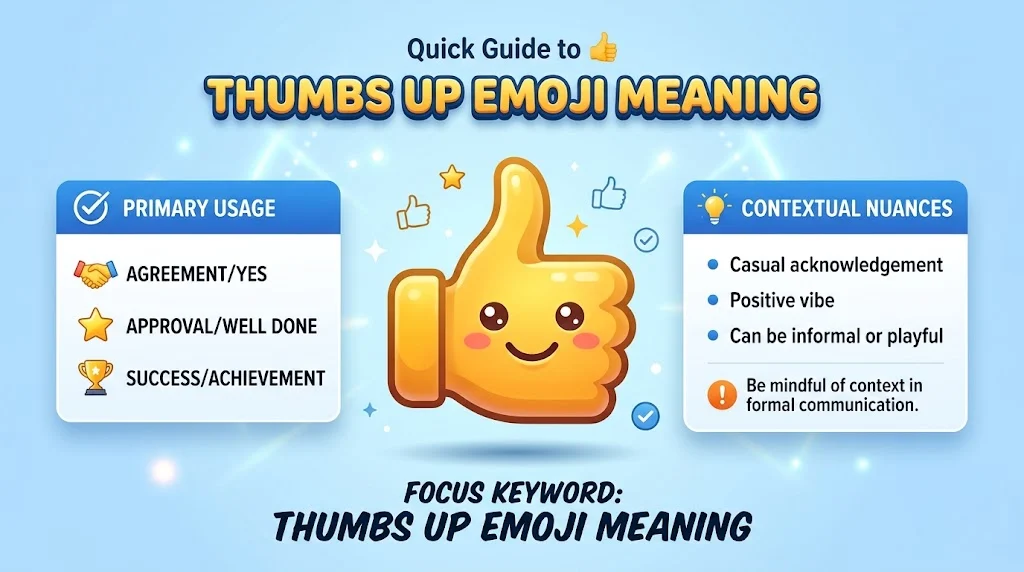
The thumbs up emoji 👍 usually means “okay,” “good,” “yes,” “I agree,” or “sounds good.” It is commonly used as a quick way to show approval, acknowledgment, agreement, or a positive reaction. The tone can range from friendly and enthusiastic to simple and neutral depending on the conversation. In some situations, especially very short replies, 👍 can feel a little blunt or dismissive, so the surrounding message matters.
The emoji’s official Unicode name is Thumbs Up, and its code point is U+1F44D. Unicode associates it with approval, hand, thumb, and thumbs up.
The thumbs up emoji 👍 is one of the easiest emojis to recognize. It visually represents a raised thumb and is commonly used to communicate approval, agreement, acknowledgment, or a simple “got it.”
In texting, someone may send 👍 instead of writing a full response. For example, if you ask, “Are we still meeting at 5?” and receive “👍,” the most likely meaning is “Yes” or “That works.”
However, the emoji’s tone is not always exactly the same. A thumbs up can sound warm and friendly in one conversation but short or slightly dismissive in another. The words surrounding it, the relationship between the people, and the type of message all help determine what the sender intended.
What Does the Thumbs Up Emoji 👍 Mean?
The most common meaning of 👍 is approval or agreement.
Someone may use it to communicate:
- “Yes.”
- “Okay.”
- “Sounds good.”
- “I agree.”
- “Got it.”
- “Nice.”
- “Good job.”
- “That works.”
- “I approve.”
For example:
“I’ll send you the details tonight 👍”
Here, the emoji adds a positive acknowledgment to the message.
If someone simply replies:
“👍”
it may mean “Okay, understood” without needing a longer response.
👍 Meaning in Text Messages
In texting, 👍 is often used as a quick acknowledgment.
Consider this exchange:
Person A: “Don’t forget to bring your notebook tomorrow.”
Person B: “👍”
The natural interpretation is:
“Got it.”
Another example:
Person A: “Pizza at 7?”
Person B: “👍”
This generally means:
“Sure” or “That works for me.”
Because 👍 can communicate an entire response by itself, it is especially useful when the sender does not need to add much explanation.
Is the Thumbs Up Emoji Positive?
Usually, yes.
The thumbs up emoji generally communicates a positive or approving reaction. It can show that someone likes an idea, agrees with a plan, understands information, or thinks something is acceptable.
But “positive” does not always mean enthusiastic.
Compare:
- “That sounds amazing! 😄” → enthusiastic
- “Sounds good 👍” → positive and straightforward
- “Okay 👍” → could be neutral, brief, or slightly cold depending on context
The emoji itself is generally positive, but the rest of the message can change how strongly that positivity comes across.
What Does 👍 Mean From Someone?
When someone sends 👍 to you, they are usually acknowledging what you said or showing agreement.
For example:
“I finished the homework 👍”
If they respond:
“👍”
they may simply be saying:
“Nice” or “Okay, got it.”
If you make a suggestion:
“Let’s meet after school.”
and receive:
“👍”
the likely meaning is:
“Sure.”
There is no universal hidden message behind the emoji. It is better to interpret it according to the conversation rather than assuming it represents a particular emotion.
Does 👍 Mean “Okay”?
Yes. “Okay” is one of the most common interpretations of 👍 in casual texting.
Depending on context, it can mean:
- Okay
- Got it
- Sure
- Agreed
- Understood
- That works
For example:
“I’ll call you later 👍”
can naturally mean:
“Okay, sounds good.”
This is why 👍 often appears as a complete one-emoji response.
Does 👍 Mean “Yes”?
It can.
If someone asks a question that can be answered with agreement, 👍 may function like “yes.”
Question:
“Are you coming with us?”
Reply:
“👍”
This can reasonably be understood as “Yes.”
Still, it is not literally the word “yes.” It is a visual signal of approval or agreement, so the exact interpretation depends on the question.
Is 👍 Friendly or Formal?
The thumbs up emoji can work in both casual and some work-related conversations, but it is generally more natural in informal or conversational communication.
With friends:
“See you tomorrow 👍”
sounds casual and friendly.
In a school or group conversation:
“I uploaded the file 👍”
can simply acknowledge that the task is done.
In a formal email or serious professional message, plain words may be clearer than an emoji. The appropriate choice depends on the relationship and communication setting.
Can 👍 Sound Rude?
Sometimes, yes.
The thumbs up emoji is normally not rude, but a one-word or one-emoji response can feel abrupt when the conversation is emotional or when someone expected a thoughtful answer.
For example:
Person A: “I worked really hard on this project. What do you think?”
Person B: “👍”
The response could feel too brief because the situation calls for more explanation.
Similarly:
“Okay 👍”
might sound completely normal in one conversation but slightly passive-aggressive in another.
This does not mean 👍 automatically means anger or sarcasm. The interpretation depends heavily on context.
Can 👍 Be Sarcastic?
Yes, although sarcasm is not the emoji’s default meaning.
For example:
“Awesome, another two hours of homework 👍”
The thumbs up may be intentionally ironic because the person is clearly not excited about the homework.
Another example:
“Forgot my umbrella and it’s pouring outside 👍”
Here, 👍 could highlight the absurdity of the situation rather than genuine approval.
Words such as “great,” “awesome,” or “perfect” can become sarcastic when paired with a situation that is obviously unpleasant.
Is 👍 Flirty?
The thumbs up emoji is not specifically a flirting emoji.
It can appear in a conversation between people who like each other, but the emoji itself generally communicates approval, acknowledgment, or agreement.
For example:
“That sounds fun 👍”
does not automatically indicate romantic interest.
If someone is flirting, the meaning usually comes from the broader conversation rather than from 👍 alone. Avoid treating a single emoji as proof of attraction.
Thumbs Up Emoji in Different Situations
When agreeing with a plan
“Let’s meet at 4.”
“👍”
Meaning: “Sounds good.”
When acknowledging information
“The assignment is due Friday.”
“👍”
Meaning: “Got it.”
When approving an idea
“How about we order pizza?”
“👍”
Meaning: “I’m good with that.”
When congratulating someone
“I finally finished my project!”
“👍”
Meaning: “Nice!” or “Good job!”
A longer response may be better if you want to show stronger excitement.
Related Hand and Approval Emojis
| Emoji | Official Name | Common Meaning | Tone | Where or When It Is Used |
|---|---|---|---|---|
| 👍 | Thumbs Up | Approval, agreement, acknowledgment | Positive, neutral | Quick replies, agreement, confirmation |
| 👎 | Thumbs Down | Disapproval or disagreement | Negative, direct | Rejecting an idea or showing dislike |
| 👌 | OK Hand | “Okay,” approval, or that something is fine | Casual, positive | Confirmation, reassurance, agreement |
| 🙌 | Raising Hands | Celebration, excitement, or praise | Joyful, energetic | Good news, achievements, celebrations |
| 👏 | Clapping Hands | Applause, praise, or appreciation | Supportive, positive | Congratulations, compliments, achievements |
| 🤝 | Handshake | Agreement, cooperation, or partnership | Friendly, professional | Deals, teamwork, mutual agreement |
| ✌️ | Victory Hand | Peace, victory, or a cheerful sign-off | Friendly, upbeat | Casual messages, celebrations, goodbyes |
| 🫶 | Heart Hands | Love, appreciation, or support | Warm, affectionate | Gratitude, encouragement, caring messages |
The closest alternatives depend on what you want to communicate. 👎 is the direct opposite of 👍, while 👌 can also mean “okay.” 👏 is better when you want to praise someone, and 🤝 is more specific to agreement, cooperation, or partnership.
🙌 usually carries more excitement than 👍, while 🫶 adds a warmer emotional or affectionate feeling. Choosing between them depends on whether you want simple acknowledgment, celebration, praise, cooperation, or affection.
👍 vs. 👌: What’s the Difference?
Both can communicate that something is okay, but they are not identical.
👍 usually emphasizes:
- Agreement
- Approval
- Acknowledgment
- “Got it”
- “Sounds good”
👌 often emphasizes:
- “Okay”
- “All good”
- “That’s fine”
- “Perfect”
For example:
“I’ll send it tonight 👍”
sounds like an acknowledgment or agreement.
“Everything is ready 👌”
can emphasize that everything is fine or satisfactory.
👍 vs. 👏: Which One Shows More Praise?
👍 is usually a simple sign of approval.
👏 is more clearly associated with applause, praise, or celebration.
Compare:
“Nice work 👍”
with:
“You did an amazing job! 👏”
The first is a straightforward positive reaction. The second feels more like actively applauding someone’s achievement.
👍 vs. ❤️: Approval or Affection?
These emojis can sometimes appear in similar conversations, but they communicate different emotional signals.
👍 usually says:
“Okay,” “Agreed,” or “Good.”
❤️ can express:
Love, affection, care, or strong appreciation.
If someone reacts to your message with 👍, it is usually safer to interpret it as acknowledgment or approval rather than affection.
How to Respond to 👍
Most of the time, you do not need a complicated response.
If someone sends:
“👍”
you can simply continue the conversation.
Depending on the situation, natural replies include:
- “Sounds good!”
- “Perfect.”
- “Thanks!”
- “Got it.”
- “See you then.”
- “Awesome.”
If you are unsure whether they are being brief or genuinely enthusiastic, you can ask a simple follow-up question rather than guessing.
Common Misunderstandings About 👍
It does not always mean excitement
A thumbs up can show approval without showing strong enthusiasm. “Okay 👍” is usually less energetic than “YES! 🎉”
It does not automatically mean sarcasm
Some people use 👍 very literally as a quick acknowledgment. Sarcasm depends on the surrounding message.
It does not prove friendliness or flirting
The emoji can appear in friendly conversations, but it does not automatically signal affection or romantic interest.
A single 👍 is not necessarily cold
Some people naturally use short responses. Their normal texting style matters when interpreting a brief emoji-only reply.
Official Name and Unicode Details
The official Unicode name of 👍 is Thumbs Up. Its Unicode code point is U+1F44D. Unicode lists related keywords including approval, hand, and thumb.
Emojipedia identifies the character as Thumbs Up and describes its common use for approval, agreement, or a positive response.
The design can look slightly different across platforms and operating systems, but the basic raised-thumb gesture remains recognizable.
FAQs
What does the 👍 emoji mean in texting?
It usually means “okay,” “yes,” “sounds good,” “I agree,” or “got it.” The exact meaning depends on what was said before it.
What does 👍 mean from a friend?
From a friend, it commonly means acknowledgment, agreement, approval, or a simple positive reaction.
Is the thumbs up emoji positive?
Yes. Its usual meaning is positive or approving, although it may sometimes feel neutral or brief.
Can 👍 mean “I understand”?
Yes. When someone gives you information or instructions, 👍 can mean “Got it” or “I understand.”
Can 👍 be passive-aggressive?
It can be interpreted that way in some contexts, especially when paired with wording that sounds sarcastic or annoyed. But the emoji itself does not automatically carry that meaning.
Is 👍 a flirting emoji?
Not specifically. It can be used in a flirty conversation, but by itself it usually means approval or acknowledgment rather than romantic interest.
Conclusion
The thumbs up emoji 👍 usually communicates approval, agreement, acknowledgment, or “okay.” It is especially useful when you want to give a quick response without typing a full sentence.
Its tone can range from friendly and positive to simple and neutral. In some situations, a one-emoji reply may feel abrupt or sarcastic, but that interpretation comes from the surrounding conversation not from a guaranteed hidden meaning in 👍.
When choosing between similar emojis, use 👍 for straightforward approval, 👌 for “okay,” 👏 for praise, 🙌 for celebration, and ❤️ when you want to express affection or care.
Discover More Related Articles:
- Fist Bump Emoji | Friendship, Support & Respect In 2026
- Raised Hands Emoji | Happy, Excited or Celebrating In 2026
