Quick Answer
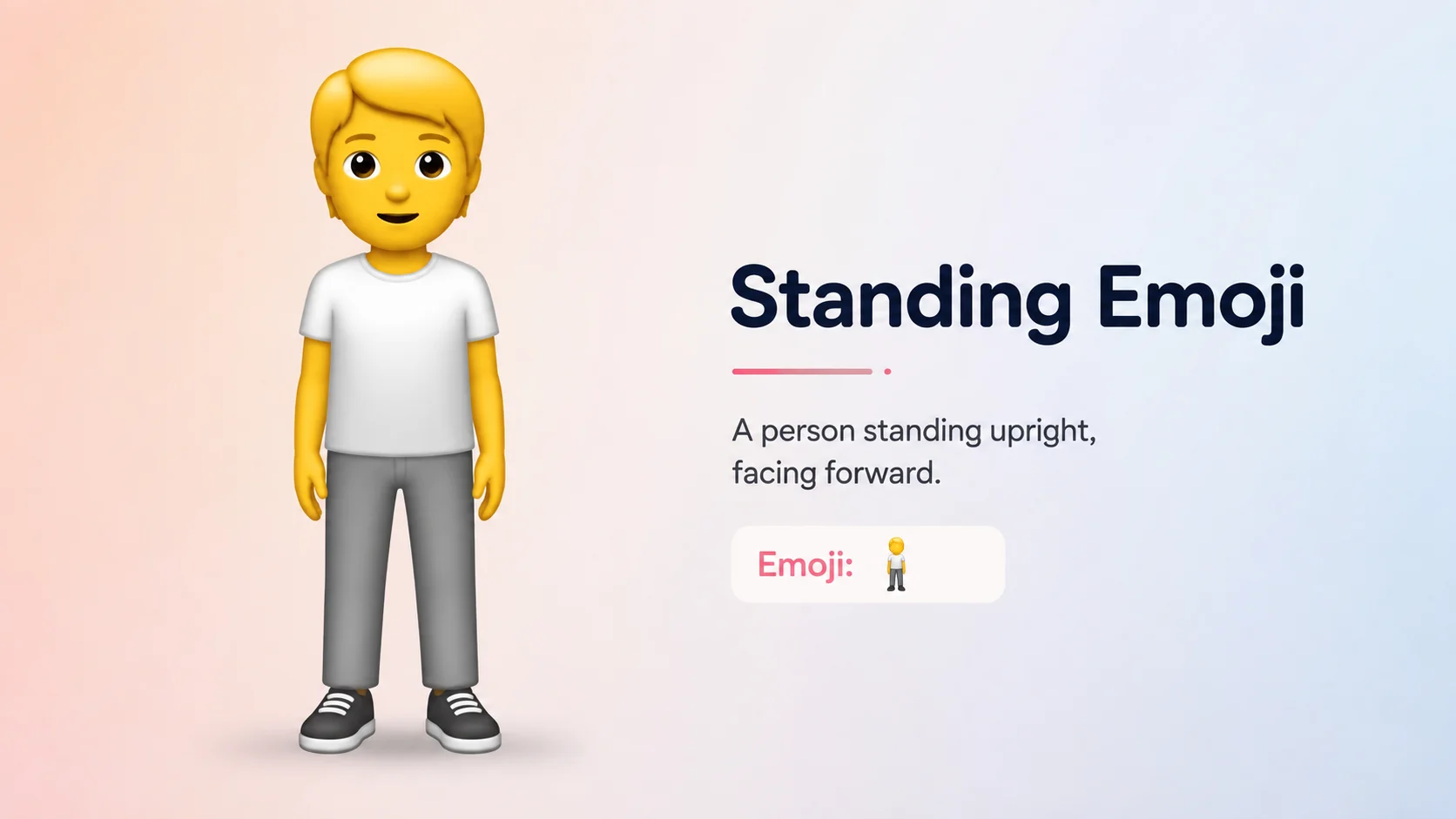
The standing emoji 🧍, officially called Person Standing, shows a person standing upright and facing forward. Its literal meaning is simply standing or a person who is standing, but in casual online conversations it can also suggest awkwardness, uncertainty, waiting around, or not knowing what to do. Emojipedia notes that it is sometimes used to convey awkwardness, while Unicode lists its core keywords as “person,” “stand,” and “standing.”
The meaning depends heavily on context. Someone might use 🧍 literally when talking about a person standing somewhere, or use it as a humorous reaction when a situation suddenly becomes uncomfortable. It is also different from 🚶, because the standing emoji shows no movement.
The standing emoji 🧍 is a full-body person standing upright and facing forward. Its official Unicode name is Person Standing, and its code point is U+1F9CD. Unicode includes “person,” “stand,” and “standing” among its keywords.
At first glance, 🧍 seems like a very simple emoji. Unlike 😂 or 😭, it does not show a strong facial emotion. That is exactly what makes it useful in certain conversations. The person can look like they are simply standing there, waiting, observing, or awkwardly existing in the situation.
Online, the emoji can take on a more humorous meaning. Emojipedia specifically notes that Person Standing can be used to convey awkwardness, particularly in some social-media contexts.
What Does the Standing Emoji 🧍 Mean?
The most basic meaning of 🧍 is a person standing upright.
It can represent:
- Standing somewhere
- Waiting
- A person being present
- Pausing
- Watching something happen
- Feeling awkward
- Not knowing what to say
- A funny “just standing here” reaction
The emoji does not automatically mean that someone is embarrassed or uncomfortable. Those meanings come from context and informal usage.
For example:
“I’m outside 🧍”
Here, 🧍 can simply reinforce the idea that the person is standing outside.
But:
“Everyone started arguing and I was just there 🧍”
Now the emoji adds a humorous feeling of “I had no idea what to do.”
🧍 Meaning in Text Messages
In texting, 🧍 is often more about the situation than a specific emotion.
It can work as a visual reaction to something strange or unexpected.
For example:
“They really canceled the event after we got there 🧍”
The emoji can communicate:
“So… what am I supposed to do now?”
Another example:
“He asked me that in front of everyone 🧍”
Here, 🧍 can suggest awkwardness or being caught off guard.
It can also be completely literal:
“I’m standing at the bus stop 🧍”
So the surrounding words are essential.
Why Does 🧍 Sometimes Mean Awkwardness?
The standing emoji has a very neutral body position. The person is simply there, facing forward without an obvious action.
That makes it useful for situations where someone feels like they are stuck, speechless, uncomfortable, or unsure how to react.
For example:
“My teacher walked in while we were laughing about the homework 🧍”
The emoji creates the feeling of:
“Well… this is awkward.”
It can also be used as deadpan humor. Instead of explaining “I have absolutely no idea what to say,” someone may simply send:
🧍
The lack of an obvious reaction is part of the joke.
Does 🧍 Mean Someone Is Waiting?
It can mean waiting, but waiting is not its only meaning.
For example:
“Been waiting here for 20 minutes 🧍”
The emoji visually reinforces the idea of standing around.
However:
“They told me the meeting was tomorrow 🧍”
Here, the emoji is more likely to express awkwardness, disbelief, or an uncomfortable reaction.
The words around 🧍 determine whether it is literal or humorous.
Is the Standing Emoji Rude?
Usually, no.
🧍 is generally neutral or playful. However, like almost any reaction emoji, it can feel dismissive if it is sent in response to something serious.
For example:
“I spent all night working on this project.”
Reply:
“🧍”
That response might come across as strange, cold, or uninterested because the emoji does not acknowledge the person’s effort.
In a funny conversation, however, the exact same emoji may be perfectly harmless.
Can 🧍 Be Used as a Meme Reaction?
Yes. The standing emoji works particularly well as a deadpan reaction.
Someone might use it after an unexpected statement:
“She said she had never seen a pizza before 🧍”
Or after an awkward moment:
“I accidentally called my boss ‘Mom’ 🧍”
In these situations, 🧍 can communicate a reaction like:
- “I have no words.”
- “Well, this is awkward.”
- “I’m just standing here.”
- “What am I supposed to do?”
- “Okay…”
- “That just happened.”
These are informal interpretations rather than official definitions.
What Does 🧍 Mean From Someone?
If someone sends you 🧍, don’t automatically assume they are annoyed or uncomfortable.
It could mean:
- They are literally standing somewhere.
- They are waiting.
- They feel awkward.
- They don’t know how to respond.
- They are joking about a strange situation.
- They are using a deadpan reaction.
For example:
You: “I just realized I sent that message to the wrong group chat.”
Them: “🧍”
This probably means something like:
“Oh no…” or “I don’t even know what to say.”
The emoji alone does not prove what the sender is feeling.
🧍 Meaning in Friendship and Social Conversations
Among friends, 🧍 can be an easy way to react to an awkward or ridiculous situation without writing a full sentence.
For example:
“You really showed up an hour early? 🧍”
The emoji could add playful disbelief.
Or:
“Everyone left and somehow I’m still here 🧍”
Here, it creates a humorous “I’m just standing here” feeling.
The emoji is especially useful when a long explanation would make the joke less funny.
Is 🧍 a Flirty Emoji?
Not specifically.
The standing emoji is not inherently romantic or flirty. It is more commonly connected with standing, awkwardness, waiting, or a deadpan reaction.
If it appears in a playful conversation, the surrounding messages might make the conversation feel flirtatious, but 🧍 itself does not prove romantic interest.
It is better to interpret the entire conversation instead of assigning a romantic meaning to one emoji.
Related Emojis and Their Meanings
| Emoji | Official Name | Common Meaning | Tone | Where or When It Is Used |
|---|---|---|---|---|
| 🧍 | Person Standing | Standing, waiting, being present, or awkwardly reacting | Neutral, awkward, deadpan | Texts, reactions, jokes, waiting situations |
| 🚶 | Person Walking | Walking or moving somewhere | Neutral, active | Talking about walking, travel, or movement |
| 🧎 | Person Kneeling | Kneeling or being down on the knees | Serious, physical, contextual | Describing kneeling or certain reactions |
| 🧘 | Person in Lotus Position | Meditation, calmness, or mindfulness | Peaceful, relaxed | Meditation, relaxation, calm reactions |
| 🏃 | Person Running | Running, rushing, or moving quickly | Energetic, urgent | Exercise, rushing, leaving quickly |
| 🧑 | Person | A generic person | Neutral | Referring to a person without specifying an action |
| 🫥 | Dotted Line Face | Feeling invisible, awkward, absent, or withdrawn | Awkward, uncertain | Uncomfortable or socially strange moments |
| 😐 | Neutral Face | Little or no emotional reaction | Flat, neutral, deadpan | Awkward, unimpressed, or ordinary situations |
The closest visual comparison is 🧍 versus 🚶. 🧍 shows a person standing upright without movement, while 🚶 represents walking. Unicode lists them separately as person standing and person walking.
Another useful comparison is 🧍 versus 🫥. The standing emoji shows an actual person in a neutral physical pose, while 🫥 is a facial expression that can communicate feeling invisible, uncomfortable, or withdrawn.
🧍 vs. 🚶: Standing or Walking?
The distinction is simple:
🧍 = standing
🚶 = walking
If you want to show that someone has stopped somewhere, 🧍 makes more sense.
“Waiting outside 🧍”
If you want to show movement:
“Heading home 🚶”
The standing emoji has no motion implied. Emojipedia specifically distinguishes it from 🚶 because Person Standing faces forward and does not indicate movement.
🧍 vs. 🫥: Which One Shows Awkwardness?
These emojis can overlap in awkward situations, but they communicate it differently.
🧍 often creates a visual joke:
“I have no idea what to do, so I’m just standing here.”
🫥 is more about feeling invisible, uncomfortable, or wanting to disappear from the situation.
For example:
“Everyone started talking about something I knew nothing about 🧍”
The standing emoji works well as a deadpan reaction.
“I said something embarrassing and wanted to disappear 🫥”
The dotted-line face fits the emotional feeling more directly.
Text Examples Using 🧍
Awkward moment
Message:
“I walked into the wrong meeting and nobody said anything 🧍”
Likely meaning:
The sender is making fun of an awkward situation.
Waiting
Message:
“Still waiting for the bus 🧍”
Likely meaning:
Literal standing or waiting.
Speechless reaction
Message:
“You said WHAT to your teacher? 🧍”
Likely meaning:
The sender is playfully stunned and doesn’t know how to react.
Deadpan humor
Message:
“I studied for the wrong test 🧍”
Likely meaning:
A humorous “well, I’m doomed” type of reaction.
Observing chaos
Message:
“Everyone started arguing and I just sat there watching 🧍”
Likely meaning:
The sender is emphasizing their passive, awkward presence.
How to Respond to 🧍
Your response depends on why the person sent it.
If they are being awkward
“Why are you just standing there? 😂”
If they are joking
“Don’t just stand there 😭”
If they are waiting
“I’m coming!”
If you don’t understand the reaction
“Wait, what does that mean? 😂”
If the situation is genuinely awkward
You can acknowledge the moment directly:
“Yeah… that got awkward fast.”
There is no single required response to 🧍. Matching the tone of the conversation is usually the easiest approach.
Does 🧍 Have Different Gender Versions?
Yes. Unicode includes Person Standing 🧍, along with Man Standing 🧍♂️ and Woman Standing 🧍♀️.
The gendered versions are constructed from the person-standing emoji with gender components. Emojipedia notes that 🧍♂️ and 🧍♀️ are ZWJ sequences based on Person Standing.
There are also skin-tone variations for the person-standing emoji and its gendered versions. Unicode lists these as modifier sequences.
Official Name and Unicode Details
The official Unicode name of 🧍 is Person Standing.
Its code point is U+1F9CD. Unicode’s current emoji list gives the related keywords as person, stand, and standing.
Person Standing was introduced with Emoji 12.0 in 2019.
The emoji is intentionally a generic person rather than a specific gender. Gender-specific versions include 🧍♂️ and 🧍♀️.
FAQs
What does 🧍 mean in texting?
🧍 usually represents a person standing, but in casual texting it can also suggest awkwardness, waiting, uncertainty, or a deadpan reaction.
What is the official name of 🧍?
The official Unicode name is Person Standing. Its Unicode code point is U+1F9CD.
Why does 🧍 mean awkward?
The person is simply standing there with no obvious action, which can visually represent someone being stuck, speechless, or unsure how to react. Emojipedia specifically notes its use for awkwardness.
Is 🧍 a bad emoji?
No. 🧍 is generally neutral or playful. Its tone depends on the conversation and what it is reacting to.
Does 🧍 mean waiting?
It can. When someone is talking about waiting somewhere, 🧍 may literally reinforce the idea of standing and waiting.
Is 🧍 a flirting emoji?
No. 🧍 is not specifically a flirting emoji. A playful conversation can give it a different context, but the emoji itself does not indicate romantic interest.
Conclusion
The standing emoji 🧍 officially represents a person standing upright, but its casual meaning can go beyond the literal action. In texts and online conversations, it may suggest awkwardness, waiting, uncertainty, speechlessness, or a deadpan reaction.
The key is context. 🧍 can simply mean “I’m standing here,” or it can humorously communicate “Well, this is awkward.” Unlike 🚶, it does not imply movement, while emojis such as 🫥 and 😐 express different kinds of emotional reactions.
Discover More Related Articles:
- Fist Bump Emoji | Friendship, Support & Respect In 2026
- Raised Hands Emoji | Happy, Excited or Celebrating In 2026
