Quick Answer
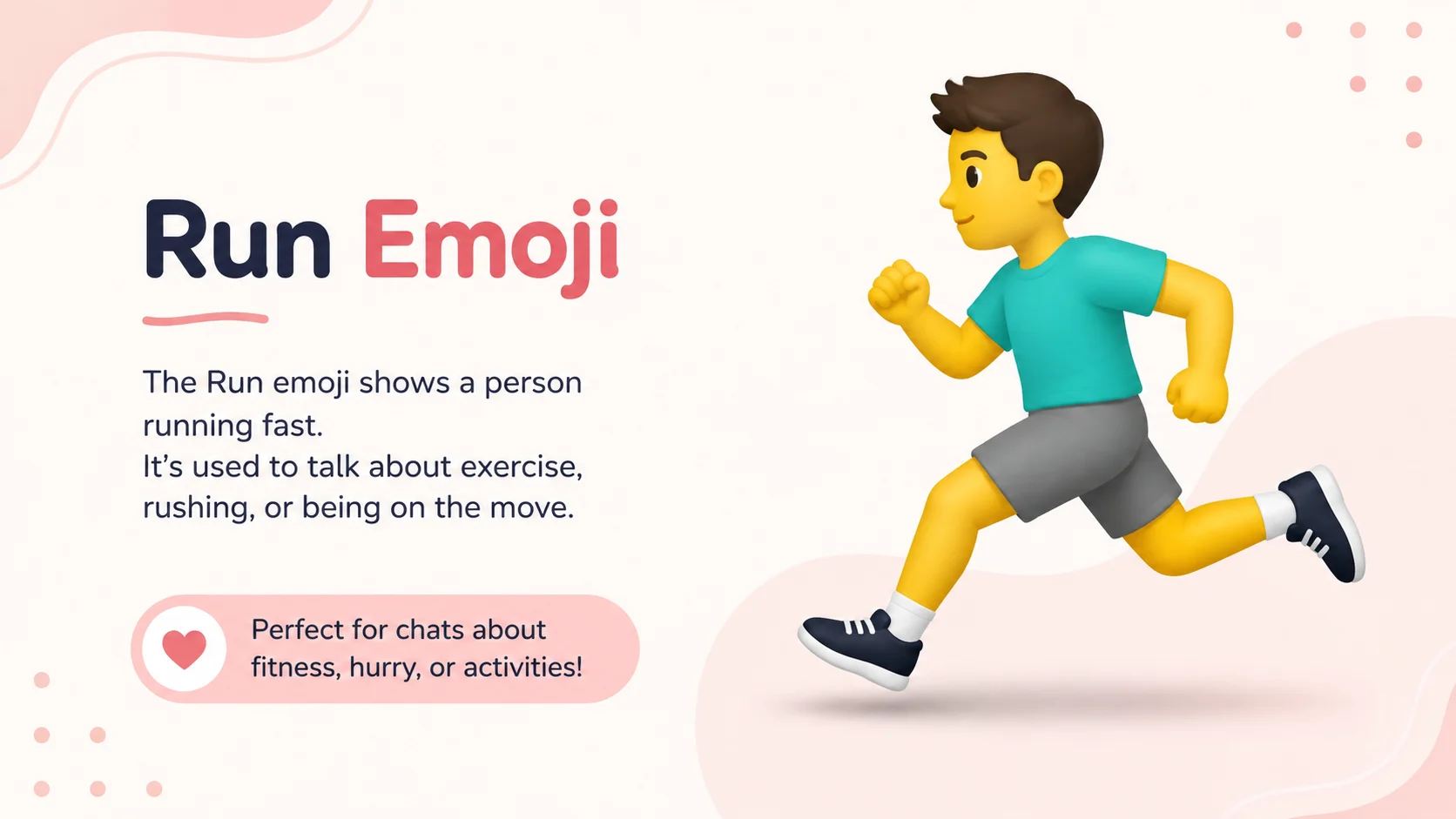
The 🏃 emoji is officially called Person Running and commonly represents running, exercise, speed, movement, rushing, or quickly leaving a situation. In texts, it can be literal such as talking about a workout or race or playful, such as joking that you are “running away” from an awkward situation. Unicode lists 🏃 as U+1F3C3, with related keywords including fast, hurry, marathon, race, run, rush, and speed.
The 🏃 emoji shows a person taking a large running stride, making it an easy way to communicate movement, speed, exercise, or urgency. If someone sends it after saying “I’m late,” they may literally mean they are hurrying. If it appears after a joke, however, it can have a much more playful meaning, such as “I’m out of here.”
The run emoji can also express the idea of escaping from a situation. Someone might use 🏃 after seeing an awkward message, hearing a terrible joke, or joking about avoiding responsibility. In these cases, the emoji is not describing actual physical running; it is acting like a visual punchline.
Context makes the difference. “Going for a run 🏃” clearly refers to exercise, while “Me when they say there’s a pop quiz 🏃” uses the same emoji as a humorous reaction. The emoji itself stays the same, but the words around it tell you what kind of running the sender has in mind.
What Does the 🏃 Run Emoji Mean?
The 🏃 emoji is officially named Person Running. It commonly represents:
- Running or jogging
- Exercise
- Racing
- Speed
- Moving quickly
- Hurrying
- Leaving
- Escaping
- Chasing something
- Playful “I’m out of here” reactions
Unicode’s emoji data associates 🏃 with terms such as fast, hurry, marathon, move, quick, race, racing, run, rush, and speed.
The most straightforward interpretation is physical running. For example:
“I’m heading out for my morning run 🏃”
Here, the emoji reinforces the literal activity.
But texting gives the emoji plenty of figurative uses. A person might write:
“They said we have homework due tomorrow 🏃”
The emoji can jokingly communicate, “I’m getting out of here.”
🏃 Meaning in Text Messages
In text messages, 🏃 is often used as a visual reaction to movement or urgency.
For example:
“Running late, be there soon 🏃”
Meaning: The person is hurrying.
Another example:
“Me leaving the group chat after that argument 🏃”
Meaning: A humorous way of saying the person wants to leave the situation.
It can also simply mean that someone is exercising:
“5K this weekend! 🏃”
Meaning: Running or participating in a race.
Because the emoji has both literal and figurative uses, the surrounding message matters more than the emoji alone.
Does 🏃 Mean “I’m Leaving”?
Sometimes. In casual conversations, 🏃 can act like “I’m leaving,” “I’m out,” or “I’m getting away from this.”
For example:
“You want me to present first? 🏃”
The sender is probably joking that they want to escape the situation.
Likewise:
“When someone says ‘we need to talk’ 🏃”
Here, 🏃 creates a humorous “run away” reaction.
This does not necessarily mean the person is genuinely upset or planning to leave. It can simply exaggerate a reaction for humor.
🏃 as a Funny or Playful Reaction
The running emoji works especially well when the sender wants to make a reaction feel dramatic.
For example:
“The teacher said we have a surprise test tomorrow 🏃💨”
The combination makes the joke more obvious: the person is pretending to run away.
Another example:
“Me after accidentally sending the message to the wrong person 🏃”
The emoji represents the urge to escape an awkward moment.
The humor comes from treating an ordinary situation as though it requires an immediate getaway.
Does 🏃 Mean Someone Is in a Hurry?
It can. Unicode specifically associates the emoji with concepts such as fast, hurry, quick, rush, and speed.
For example:
“I have five minutes to get there 🏃”
Here, 🏃 naturally reinforces urgency.
But urgency is not guaranteed. If someone sends:
“Going for a run after school 🏃”
the emoji is simply describing exercise.
The words around 🏃 usually tell you whether the focus is speed, exercise, urgency, or humor.
Is 🏃 a Flirty Emoji?
The 🏃 emoji is not inherently romantic or flirty. Its official meaning centers on a person running and related concepts such as speed, racing, and movement.
In a playful conversation, someone might use it jokingly after a teasing message, but that does not automatically indicate romantic interest.
For example:
“You really think you’re going to beat me? 🏃”
This could simply be competitive banter.
If someone uses 🏃 in a conversation with romantic undertones, the meaning comes from the overall conversation rather than from the emoji itself.
What Does 🏃 Mean From Someone?
If someone sends you 🏃 by itself, there are several reasonable interpretations.
They could mean:
- “I’m running.”
- “I’m leaving.”
- “I’m in a hurry.”
- “I’m getting out of here.”
- “I’m escaping this situation.”
- “Let’s race.”
- “I’m joking about running away.”
For example:
You: “We have to clean the whole house today.”
Them: “🏃”
This probably means, jokingly, “I’m running away.”
But:
You: “How was your workout?”
Them: “🏃”
could be a simple reference to running or exercise.
Don’t assume the emoji has a hidden meaning without looking at the surrounding conversation.
Related Running and Movement Emojis
| Emoji | Official Name | Common Meaning | Tone | Where or When It Is Used |
|---|---|---|---|---|
| 🏃 | Person Running | Running, speed, rushing, movement | Active, playful | Exercise, races, hurry, humorous escape |
| 🏃♂️ | Man Running | A man running | Active, energetic | Running, sports, movement |
| 🏃♀️ | Woman Running | A woman running | Active, energetic | Running, sports, movement |
| 🚶 | Person Walking | Walking or moving at a slower pace | Calm, casual | Walking, going somewhere, everyday movement |
| 🚶♂️ | Man Walking | A man walking | Neutral, casual | Walking or traveling on foot |
| 🚶♀️ | Woman Walking | A woman walking | Neutral, casual | Walking or moving around |
| 💨 | Dashing Away | Speed, quick movement, rushing away | Playful, dramatic | Fast exits, jokes, exaggerated movement |
| 🏎️ | Racing Car | Racing, speed, fast driving | Excited, energetic | Motorsport, speed, racing references |
The main difference between these emojis is what kind of movement they emphasize. 🏃 focuses on a person running, while 🚶 suggests walking and 💨 can make the idea of speed or a quick exit feel more exaggerated.
The gendered versions, 🏃♂️ and 🏃♀️, are variations of Person Running. Emojipedia notes that the base 🏃 emoji is gender-neutral on most modern platforms, while the gender-specific versions are separate sequences.
🏃 vs. 🚶: What’s the Difference?
The easiest distinction is speed and intensity.
🏃 = running, rushing, or moving quickly
🚶 = walking or moving at a normal pace
Compare:
“I’m walking home 🚶”
with:
“I’m late, I’m running home 🏃”
The first feels calm and ordinary. The second suggests faster movement or urgency.
This difference also matters in jokes. “I’m leaving 🚶” can sound casual, while “I’m leaving 🏃” can make the departure feel sudden or dramatic.
🏃 vs. 💨: What’s the Difference?
🏃 represents a person running, while 💨 is commonly used to suggest speed, motion, or quickly moving away.
For example:
“I’m going for a run 🏃”
clearly refers to running.
But:
“Me when someone says free food 💨”
uses 💨 as a humorous visual for quickly moving toward something.
Using 🏃💨 together can make the idea of rapid movement even clearer.
🏃♂️ and 🏃♀️ Meanings
The emojis 🏃♂️ Man Running and 🏃♀️ Woman Running represent gender-specific versions of the same basic running concept.
Unicode identifies the base character as Person Running, while the gendered sequences specify man or woman.
The meaning is otherwise similar:
- 🏃 = Person Running
- 🏃♂️ = Man Running
- 🏃♀️ = Woman Running
Skin-tone modifiers can also be combined with these emojis. Unicode documents the available skin-tone sequences for Person Running and its gendered forms.
Text Message Examples
1. Talking About Exercise
“Going for a quick run before dinner 🏃”
Likely meaning: The person is actually going running.
2. Running Late
“I’m five minutes away, running now 🏃”
Likely meaning: They are hurrying.
3. Funny Escape
“They said everyone has to speak in front of the class 🏃”
Likely meaning: A playful “I’m getting out of here” reaction.
4. Competitive Challenge
“Bet you can’t catch me 🏃”
Likely meaning: Running or racing is part of the joke.
5. Dramatic Reaction
“You said there are three assignments due tomorrow? 🏃”
Likely meaning: The sender is humorously pretending to escape.
How to Respond to 🏃
Your response depends on the context.
If they’re talking about exercise:
“Have a good run! 🏃”
If they’re challenging you to a race:
“You’re not getting away that easily 😂”
You aren’t sure what they mean:
“Wait, are you actually running? 😂”
A short clarification can be better than guessing when the emoji is sent without any text.
Common Misunderstandings About 🏃
It does not always mean exercise
Someone can use 🏃 as a metaphor for leaving, escaping, or moving quickly.
It does not automatically mean panic
A running figure may communicate urgency, but it can also simply represent normal exercise or a race.
It is not automatically flirty
The emoji itself does not establish romantic interest.
It does not necessarily mean the person is literally running
In memes, jokes, and casual texting, 🏃 often represents an exaggerated reaction.
🏃 and 🏃♂️ are not identical characters
🏃 is Person Running, while 🏃♂️ is Man Running. The latter is a gendered sequence based on the running emoji.
Official Emoji Details
The official Unicode name for 🏃 is Person Running, and its code point is U+1F3C3. Unicode’s current emoji data lists related keywords including fast, hurry, marathon, move, quick, race, racing, run, rush, and speed.
The emoji was approved in Unicode 6.0 in 2010 under the name Runner and was later added to Emoji 1.0 in 2015.
There are also newer directional versions. For example, 🏃➡️ is officially Person Running: Facing Right and was added in Emoji 15.1 in 2023.
Different platforms can draw the person, clothing, pose, and details somewhat differently, but the basic idea of running remains consistent.
FAQs
What does 🏃 mean in texting?
🏃 commonly means running, rushing, moving quickly, or leaving. In jokes, it can also mean “I’m out of here.”
What is the official name of 🏃?
The official Unicode name is Person Running.
What does 🏃 mean from someone?
It depends on the conversation. They could be talking about exercise, saying they are in a hurry, joking about escaping, or simply referring to running.
Does 🏃 mean “run away”?
It can. In casual or humorous messages, 🏃 can represent the idea of quickly leaving or escaping a situation.
Is 🏃 a running emoji?
Yes. It is officially Person Running and is commonly used for running, racing, exercise, speed, and movement.
Conclusion
The 🏃 emoji, officially called Person Running, is mainly used to express running, speed, movement, exercise, rushing, or a quick escape. Its meaning can be literal when someone is talking about a workout or race, or figurative when they are joking about leaving an awkward or inconvenient situation.
The surrounding message is the best clue. 🏃 after “going for a run” means something very different from 🏃 after “they just announced another test.” It can also be paired with emojis such as 💨 to make fast movement feel more dramatic.
If you want to describe actual running, 🏃 is a straightforward choice. If you want to communicate walking, 🚶 fits better, while 💨 can add extra emphasis to speed or a quick departure.
Discover More Related Articles:
- Fist Bump Emoji | Friendship, Support & Respect In 2026
- Raised Hands Emoji | Happy, Excited or Celebrating In 2026
