Quick Answer
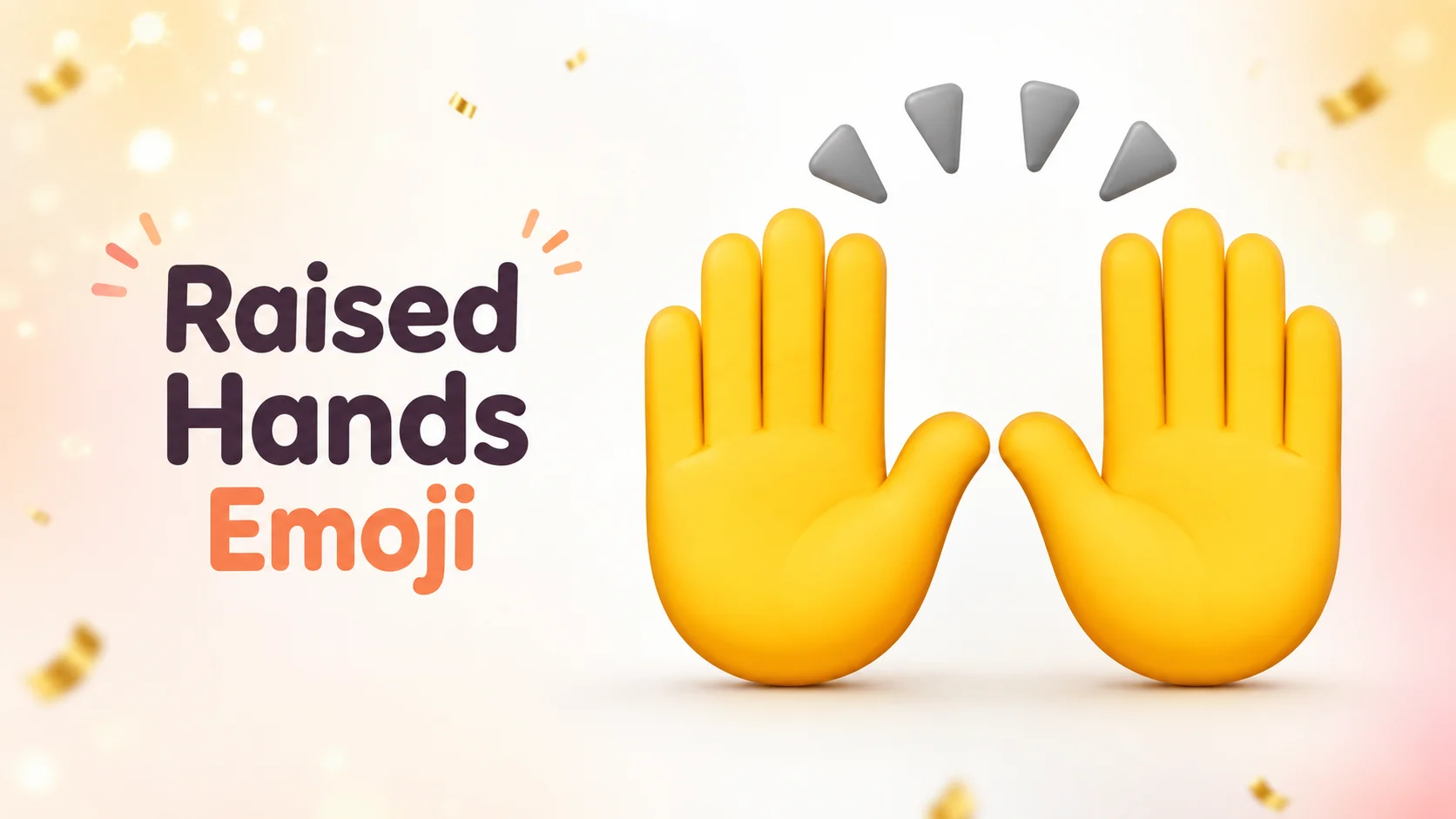
The 🙌 emoji is officially called Raising Hands. It commonly expresses celebration, excitement, praise, joy, approval, or a sense of “hooray!” It can also be used to show gratitude, relief, support, or enthusiasm depending on the conversation. Unicode identifies 🙌 as U+1F64C and lists related keywords including celebration, gesture, hooray, praise, and raising.
The raised hands emoji 🙌 is usually a positive reaction. People often use it when something exciting, successful, impressive, or worth celebrating happens. It can work like saying “Yes!”, “We did it!”, “Hooray!”, or “I’m celebrating with you.”
Unlike 👏, which specifically depicts clapping hands, 🙌 shows two hands raised upward. That makes it especially useful for expressing celebration, excitement, praise, or enthusiastic agreement. The exact feeling still depends on the words around it.
In a casual text, 🙌 can also make a message feel warmer and more energetic. Someone might use it after good news, a personal achievement, a funny victory, or a statement they strongly support. It does not automatically signal a romantic meaning; in most situations, it is simply an enthusiastic positive gesture.
What Does the 🙌 Raised Hands Emoji Mean?
The 🙌 emoji officially means Raising Hands. Its common conversational meanings include:
- Celebration
- Excitement
- Praise
- Approval
- Joy
- Support
- Enthusiasm
- Relief
- “Hooray!”
- “We did it!”
Unicode’s emoji data associates 🙌 with celebration, gesture, hooray, praise, raised, and raising.
For example:
“I finally finished my project 🙌”
Here, 🙌 communicates excitement and relief.
Or:
“We passed the exam 🙌”
In this context, it clearly works as a celebration.
The emoji can also emphasize agreement:
“No school tomorrow 🙌”
That usually means something like “Yes!” or “That’s great!”
🙌 Meaning in Text Messages
In texting, 🙌 is often a quick way to show enthusiasm or celebration without needing a long response.
For example:
“You got the job! 🙌”
This expresses congratulations and excitement.
Another example:
“Finally cleaned my room 🙌”
Here, the emoji adds a playful sense of accomplishment.
It can also respond to someone else’s good news:
Friend: “My presentation went really well!”
You: “🙌 That’s awesome!”
The emoji makes the reply feel energetic and supportive.
Is 🙌 a Celebration Emoji?
Yes. Celebration is one of the clearest common uses of 🙌. Unicode itself lists “celebration” and “hooray” among its related keywords.
You might see it after:
- Winning or succeeding
- Finishing a difficult task
- Receiving good news
- Reaching a goal
- Getting a day off
- Sharing exciting plans
- Celebrating someone else’s achievement
For example:
“I finally submitted my assignment 🙌”
The emoji adds a feeling of “Finally!” or “I did it!”
Does 🙌 Mean Praise or Approval?
It can. When someone uses 🙌 after a statement, they may be showing strong approval, appreciation, or support.
For example:
“That was such a great idea 🙌”
This communicates enthusiastic approval.
Similarly:
“Shoutout to everyone who helped 🙌”
Here, the emoji reinforces appreciation and praise.
The meaning is usually positive, but the exact shade depends on the message. In some situations, it can even be used humorously or dramatically.
Can 🙌 Mean Relief?
Yes. The raised hands emoji can express relief when something stressful or difficult is finally over.
For example:
“My final exam is done 🙌”
The main emotion may be relief rather than celebration.
Another example:
“The internet is finally working again 🙌”
Here, the emoji communicates a happy “thank goodness!” feeling.
This is a good example of why emoji meanings are not always limited to one emotion. A single gesture can communicate several closely related positive reactions.
Does 🙌 Mean “Hallelujah” or Praise?
Sometimes people use 🙌 in messages involving praise, worship, gratitude, or spiritual celebration. The emoji itself does not guarantee a religious meaning, though.
For example:
“So grateful for today 🙌”
This could simply express gratitude.
If the surrounding conversation is clearly religious, the same emoji may take on a more specific meaning related to praise or worship.
Context is what makes the distinction.
What Does 🙌 Mean From Someone?
If someone sends you 🙌, they are usually expressing a positive reaction to what you said.
Depending on the conversation, it might mean:
- “Yes!”
- “Awesome!”
- “I’m happy for you!”
- “That’s great!”
- “We did it!”
- “I agree!”
- “Finally!”
- “I support that!”
For example:
You: “I finally finished everything on my to-do list.”
Them: “🙌”
They are probably celebrating your accomplishment with you.
If someone sends 🙌 after you share exciting news, it is generally a friendly and supportive response.
Is 🙌 a Flirty Emoji?
Not usually. 🙌 is primarily a celebratory or supportive emoji, not a standard flirting emoji.
Someone can use it in a conversation with a crush, friend, family member, or classmate without it having romantic meaning.
For example:
“You’re coming to the party too? 🙌”
That most naturally means excitement about seeing the person or having them join the event.
It would be a mistake to treat 🙌 by itself as proof of attraction or romantic interest. The surrounding conversation provides much more useful context.
Is 🙌 Different From 👏?
Yes. Both can communicate positive reactions, but they emphasize different gestures.
🙌 Raising Hands tends to suggest celebration, excitement, praise, or “hooray.”
👏 Clapping Hands more directly suggests applause, congratulations, approval, or appreciation.
Compare:
“You won the competition! 👏”
This sounds like applause or congratulations.
“We won the competition! 🙌”
This sounds more like shared celebration and excitement.
They can also be combined:
“You absolutely crushed it! 👏🙌”
That creates an especially enthusiastic reaction.
Related Emojis and Their Meanings
| Emoji | Official Name | Common Meaning | Tone | Where or When It Is Used |
|---|---|---|---|---|
| 🙌 | Raising Hands | Celebration, praise, excitement | Joyful, enthusiastic | Good news, achievements, victories, reactions |
| 👏 | Clapping Hands | Applause, approval, congratulations | Supportive, celebratory | Praising someone’s work or achievement |
| 🥳 | Partying Face | Celebration and excitement | Festive, playful | Parties, birthdays, exciting news |
| 🎉 | Party Popper | Celebration, congratulations | Energetic, festive | Milestones, announcements, victories |
| 🫶 | Heart Hands | Love, support, appreciation | Warm, affectionate | Gratitude, encouragement, supportive messages |
| 💪 | Flexed Biceps | Strength, confidence, determination | Motivational | Encouragement, accomplishments, perseverance |
| 👍 | Thumbs Up | Approval, agreement, acknowledgment | Positive, straightforward | Confirmation, agreement, quick replies |
| 🤲 | Palms Up Together | Offering, prayer, asking, or receiving | Gentle, respectful | Requests, gratitude, spiritual or supportive contexts |
| 🙏 | Folded Hands | Thanks, prayer, gratitude, or request | Respectful, thankful | Appreciation, apologies, requests, spiritual contexts |
The emojis most easily confused with 🙌 are 👏, 🫶, and 🙏, but their gestures communicate different ideas. 👏 focuses on applause, 🫶 creates a heart shape associated with affection or support, and 🙏 shows folded hands rather than raised hands. Unicode lists these as separate emoji characters with distinct official names.
🙌 vs. 🙏: What’s the Difference?
These two emojis are sometimes confused because both involve hands and can appear in thankful or positive messages.
🙌 = Raising Hands
Usually communicates celebration, praise, excitement, or “hooray.”
🙏 = Folded Hands
Can communicate thanks, prayer, a request, or respect.
Compare:
“We finally made it! 🙌”
This is celebratory.
“Thank you so much 🙏”
This is appreciative or thankful.
Of course, people sometimes use them in overlapping situations, so context still matters.
🙌 vs. 🫶: What’s the Difference?
The main difference is emotional emphasis.
🙌 is more about celebration, excitement, praise, or enthusiasm.
🫶 is more closely associated with love, affection, care, or support. Unicode identifies 🫶 as Heart Hands.
For example:
“You did it! 🙌”
sounds excited and celebratory.
“Thanks for always being there 🫶”
sounds warmer and more affectionate.
Neither emoji automatically establishes a romantic meaning.
Text Message Examples
Celebrating Success
“I passed my test 🙌”
Meaning: The sender is excited and celebrating their success.
Showing Support
“You’ve got this 🙌”
Meaning: The emoji adds encouragement and enthusiasm.
Reacting to Good News
“My vacation starts tomorrow 🙌”
Meaning: The sender is excited and happy about the upcoming break.
Expressing Relief
“The project is finally finished 🙌”
Meaning: The emoji communicates relief mixed with celebration.
Showing Approval
“That plan sounds perfect 🙌”
Meaning: The sender strongly supports the idea.
Playful Excitement
“No homework tonight 🙌😂”
Meaning: The sender is jokingly celebrating the good news.
How to Respond to 🙌
Your response can match the positive energy of the emoji.
If someone celebrates your achievement:
“Thank you! 🙌”
You’re celebrating together:
“We did it! 🎉”
If you’re unsure what they mean:
Look at the message before the emoji. 🙌 is usually positive, so there may not be anything negative to decode.
Common Misunderstandings About 🙌
It does not always mean prayer
The raised-hands gesture is different from 🙏, which is officially called Folded Hands.
It does not automatically mean flirting
🙌 can appear in romantic conversations, but its basic meaning remains celebration, excitement, or support.
It does not always mean victory
A person can use it for relief, praise, encouragement, or general excitement even when nobody has technically “won.”
It is not the same as clapping
👏 represents clapping hands, while 🙌 represents raising hands. Their meanings can overlap when someone is celebrating.
It does not guarantee one exact emotion
The emoji can communicate excitement, praise, celebration, relief, or support depending on the words around it.
Official Emoji Details
The official Unicode name for 🙌 is Raising Hands, and its code point is U+1F64C. Unicode’s current emoji charts place it in the hands category and associate it with celebration, gesture, hooray, praise, and raising.
The emoji also supports skin-tone modifiers. Unicode lists Raising Hands sequences ranging from light to dark skin tones, such as 🙌🏻, 🙌🏼, 🙌🏽, 🙌🏾, and 🙌🏿.
Different device and operating-system designs may vary in details such as hand shape, color, shading, and positioning, but the basic gesture remains the same.
FAQs
What does 🙌 mean in texting?
🙌 usually means celebration, excitement, praise, approval, or support. It can also express relief or a happy “hooray!” reaction.
What is the official name of 🙌?
The official Unicode name is Raising Hands. Its code point is U+1F64C.
Does 🙌 mean congratulations?
It can. People often use 🙌 to celebrate someone’s success or good news, although 👏 and 🎉 can also be used for congratulations.
Is 🙌 a positive emoji?
Yes. It generally communicates a positive, enthusiastic, supportive, or celebratory reaction.
What does 🙌 mean from a friend?
From a friend, it commonly means something like “Awesome!”, “Yes!”, “I’m happy for you!”, or “We did it!” The exact meaning depends on the conversation.
Conclusion
The 🙌 emoji, officially called Raising Hands, is a cheerful way to express celebration, excitement, praise, approval, support, or relief. It often works as a quick “Yes!”, “Hooray!”, or “We did it!” reaction.
Its meaning can shift slightly with context. It may celebrate an achievement, show support for someone, react enthusiastically to good news, or simply add extra energy to a casual message. It is generally positive and does not automatically suggest flirting or romance.
If you’re choosing between similar emojis, think about the gesture you want to communicate: use 🙌 for enthusiastic celebration, 👏 for applause, 🙏 for thanks or prayer-related contexts, and 🫶 when warmth or affection is the main idea.
Discover More Related Articles:
- Cry Laugh Emoji | Funny, Sarcastic & Everyday Uses In 2026
- Laughing Emoji | From LOL to Sarcasm In 2026
