Quick Answer
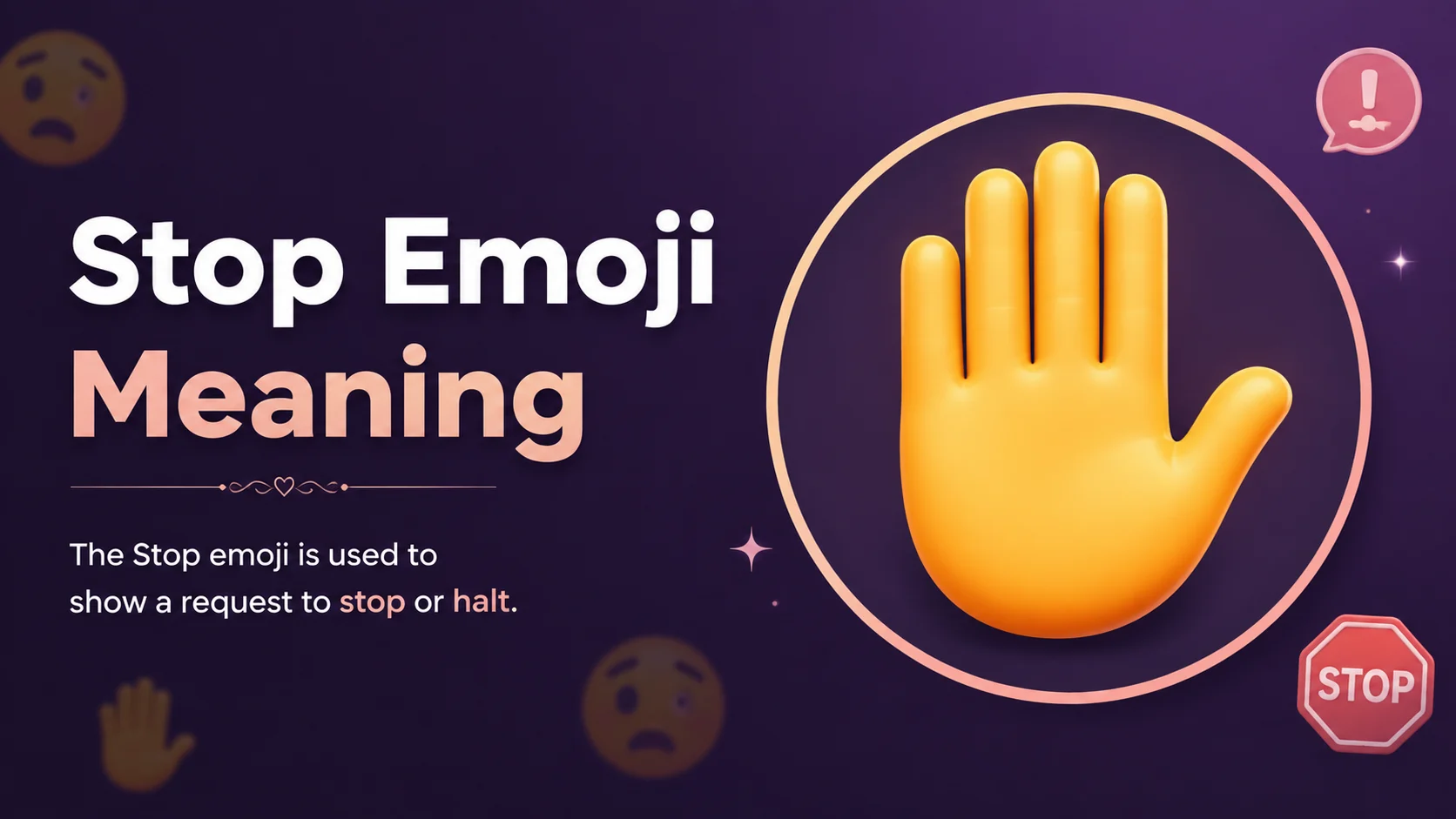
The stop emoji 🛑 usually means “stop,” “don’t,” “wait,” or “that’s enough.” It is the emoji version of a red stop sign, so it can communicate a clear warning, boundary, interruption, or request to pause. In casual texting, it can also be used playfully to say that something is too funny, embarrassing, surprising, or overwhelming to continue.
The 🛑 stop emoji is a red octagonal sign that signals a clear pause or command to stop. In everyday messages, it can be used literally, such as telling someone to stop doing something, or figuratively when a conversation has gone too far. Unicode identifies the character as OCTAGONAL SIGN, with the short name “stop sign” and code point U+1F6D1.
In texting, the tone of 🛑 depends heavily on the words around it. A message such as “🛑 Don’t send that” sounds firm, while “You are making me laugh too much 🛑😂” can be playful. The same emoji can therefore feel serious, humorous, dramatic, or simply attention-grabbing.
It is also useful to distinguish 🛑 from other warning and traffic-related emojis. A stop sign gives a direct “stop” signal, while ⚠️ usually signals caution or danger, and 🚦 represents traffic lights rather than a direct command. Understanding that difference makes it easier to choose the right emoji for your message.
What Does the Stop Emoji 🛑 Usually Mean?
The most direct meaning of 🛑 is stop. It visually represents a red octagonal stop sign, so it can stand in for words such as:
- Stop
- Wait
- Hold on
- Don’t do that
- Enough
- Pause
- Pay attention
Its tone is usually stronger than a simple 🙂 or 👍 because the visual itself is a command sign.
For example:
“🛑 Stop texting while you’re driving.”
Here, the emoji reinforces a serious instruction.
But the emoji does not always mean that the sender is angry. In a casual conversation, it can exaggerate a reaction for humor:
“🛑 You cannot tell me that story without laughing 😂.”
Here, 🛑 acts more like a dramatic “okay, stop!” than a literal warning.
What Does 🛑 Mean in Texting?
In text messages, 🛑 often functions as a visual way to interrupt or emphasize something. It may appear at the beginning of a message to make the instruction stand out or at the end to add emphasis.
For example:
“🛑 Wait, I need to explain.”
This usually means the sender wants the conversation to pause.
“Okay 🛑 that’s enough spoilers.”
This means the sender wants the other person to stop giving away information.
“🛑 I can’t handle another embarrassing story.”
Depending on the conversation, this could be playful rather than genuinely upset.
The surrounding words matter. A short message such as “🛑” can feel blunt, while “LOL 🛑😂” is much more likely to be humorous.
The Emotional Tone of the Stop Emoji
The 🛑 emoji can carry different levels of intensity.
Serious
When used with a direct instruction, it can communicate a firm boundary or warning.
“🛑 Please stop.”
This should generally be taken seriously.
Playful
Friends may use it when someone is joking too much or saying something ridiculous.
“🛑 You’re actually making me laugh.”
The meaning is closer to “Okay, you’re too funny” than a literal command.
Dramatic
The emoji can exaggerate a reaction for effect.
“🛑 This conversation is getting out of control 😂.”
The sender may simply be making the situation sound more dramatic.
Protective or Cautionary
It can also draw attention to something the sender thinks should not continue.
“🛑 Don’t share your personal information there.”
In this setting, the emoji emphasizes caution and concern.
Is 🛑 Rude or Angry?
Not necessarily. The stop emoji can look forceful because stop signs are designed to communicate a clear command. However, whether it sounds rude depends on the message, relationship, and situation.
Compare:
“🛑 Stop.”
with:
“LOL 🛑 you’re too much 😂.”
The first is direct and potentially serious. The second is clearly more playful.
If someone sends only 🛑 in response to something you wrote, it is reasonable to pause and consider the context rather than immediately assuming they are angry. If the conversation was serious, the emoji may be a genuine request to stop.
What Does 🛑 Mean From Someone?
When someone sends 🛑 to you, the safest interpretation is usually “stop,” “wait,” or “hold on.” The exact meaning depends on what happened immediately before it.
For example:
- “🛑 Don’t tell me the ending!” | They want you to stop giving spoilers.
- “Wait 🛑 I have an idea.” | They want you to pause while they add something.
- “🛑😂 You did not just say that.” | They are reacting dramatically or jokingly.
- “Please 🛑.” | This is more likely to be a genuine request to stop.
The emoji itself does not prove anger, rejection, sarcasm, or any other specific emotion. The surrounding conversation provides the important clues.
Can 🛑 Be Playful?
Yes. One of the most common informal uses of 🛑 is exaggerated humor.
Someone might write:
“🛑 I am laughing way too hard at this.”
The person is not necessarily asking the other person to stop. Instead, the stop sign creates a dramatic reaction.
It can also work with other emojis:
“🛑😂” — Stop, this is too funny.
“🛑😭” — Stop, I cannot handle this emotionally or humorously.
“🛑🤣” — Stop, this is hilarious.
These combinations show why interpreting one emoji by itself can be misleading.
Is the Stop Emoji Flirty?
🛑 is not inherently a flirting emoji. It can appear in playful or teasing conversations, including conversations between people who like each other, but the emoji alone does not establish romantic interest.
For example:
“🛑 You’re making me blush.”
This could be playful or affectionate, but the meaning comes from the complete sentence and the existing relationship between the people—not from 🛑 alone.
Avoid reading a romantic meaning into the emoji unless the broader conversation clearly supports it.
🛑 Compared With Similar Emojis
| Emoji | Official Name | Common Meaning | Tone | Where or When It Is Used |
|---|---|---|---|---|
| 🛑 | Octagonal Sign | Stop, pause, don’t continue | Firm or dramatic | Warnings, interruptions, boundaries, jokes |
| ⚠️ | Warning | Be careful, possible danger or problem | Cautious | Warnings, risks, alerts, serious reminders |
| 🚦 | Vertical Traffic Light | Traffic signal or stop/go situation | Neutral | Driving, traffic, timing, figurative decisions |
| 🚧 | Construction | Work area, blocked route, something under construction | Cautionary | Roadwork, interruptions, projects, obstacles |
| ⛔ | No Entry | Do not enter or prohibited | Firm | Restrictions, boundaries, blocked access |
| ❗ | Exclamation Mark | Strong emphasis, surprise, warning | Emphatic | Important messages, reactions, alerts |
| 🚫 | Prohibited | Not allowed, forbidden | Firm | Rules, restrictions, things that should not happen |
| ✋ | Raised Hand | Stop, wait, pause, or get attention | Direct but more personal | Interruptions, boundaries, asking someone to pause |
| 🔴 | Red Circle | Attention, emphasis, or a red signal | Neutral to emphatic | Highlighting something rather than directly saying stop |
The closest visual matches are ⛔, 🚫, ⚠️, and ✋, but their meanings are not identical. 🛑 most clearly communicates a stop or pause. ⚠️ focuses more on caution, while 🚫 emphasizes prohibition. ✋ can feel more like a person asking someone to pause.
Examples of 🛑 in Text Messages
“🛑 Wait, I forgot something.”
Likely meaning: The sender wants the conversation or action to pause.
“🛑 No more spoilers!”
Likely meaning: The sender is firmly asking you not to reveal more information.
“You are too funny 🛑😂”
Likely meaning: A playful, exaggerated reaction.
“🛑 Please don’t do that again.”
Likely meaning: A serious request to stop a behavior.
“Okay 🛑 I need a break from this conversation.”
Likely meaning: The sender genuinely wants to pause the discussion.
These examples show why the same emoji can range from lighthearted to serious.
Common Misunderstandings About 🛑
One common mistake is assuming that every use of 🛑 means the sender is angry. That is not always true. The emoji can be humorous, exaggerated, or conversational.
Another mistake is treating 🛑 as proof of a specific relationship feeling. It does not automatically mean someone is rejecting you, flirting with you, or upset with you.
It is also easy to confuse 🛑 with ⚠️. A warning sign says, in effect, “be careful,” while a stop sign gives a much more direct “stop” signal.
When the meaning is unclear, look at the complete message rather than interpreting the emoji alone.
How to Respond to the Stop Emoji
Your response should match the situation.
If they are serious:
“Got it. I’ll stop.”
If they are asking you to pause:
“Sure, take your time.”
A simple response is often better than trying to guess a hidden meaning.
When Should You Use 🛑?
Use 🛑 when you want a clear visual signal for stopping, pausing, or drawing attention to a boundary.
It works well for:
- Asking someone to stop
- Interrupting a conversation
- Saying “enough”
- Reacting dramatically
- Warning someone
- Stopping spoilers
- Making a humorous “okay, stop!” reaction
- Emphasizing that something should not continue
For a softer message, words may work better than the emoji alone. A standalone 🛑 can feel quite direct.
Copy and Paste Stop Emoji
🛑
You can copy and paste the stop emoji directly into texts, captions, comments, or notes.
Some common combinations include:
- 🛑😂
- 🛑😭
- 🛑❗
- 🛑🙅
- 🛑⚠️
The combination can change the tone, so choose one that fits the message.
Official Name and Unicode Details
The emoji commonly called the stop emoji is officially identified by Unicode as OCTAGONAL SIGN. Its Unicode code point is U+1F6D1, and Unicode’s current emoji charts list its CLDR short name as “stop sign.”
Unicode’s character information describes it as an octagonal sign associated with a stop sign and notes that it may contain text indicating “stop” or an equivalent word.
The emoji was included among the Unicode 9.0 candidate emoji in 2015.
Different devices and operating systems can draw the emoji slightly differently. The basic concept remains the same: a red octagonal sign associated with stopping.
FAQs
What does 🛑 mean?
🛑 usually means “stop,” “wait,” “don’t,” or “enough.” It can also be used humorously to exaggerate a reaction.
Is 🛑 a warning emoji?
It can function as a warning in conversation, but its official identity is an octagonal sign or stop sign. ⚠️ is more directly associated with warning or caution.
Does 🛑 mean no?
It can communicate “no” in some contexts, especially when someone wants an action to stop. However, it is more specifically associated with stopping than simply saying no.
Can 🛑 be sarcastic?
Yes. In playful conversations, someone may use 🛑 sarcastically or dramatically, especially alongside 😂 or 🤣. The surrounding message determines whether the tone is serious.
Is 🛑 rude?
It can sound blunt when used alone or with a serious command. In friendly conversations, however, it may simply be playful or exaggerated.
Conclusion
The 🛑 stop emoji is a clear visual symbol for stopping, pausing, or saying “enough.” In texts, it can sound firm and serious, but it can also be playful when used as an exaggerated reaction. The best way to understand it is to consider the surrounding words, the conversation, and the sender’s usual communication style.
Unlike ⚠️, which mainly signals caution, 🛑 gives a more direct stop-or-pause message. And while it can appear in friendly or teasing conversations, it does not automatically indicate anger, flirting, rejection, or any other specific relationship feeling.
Discover More Related Articles:
