Quick Answer
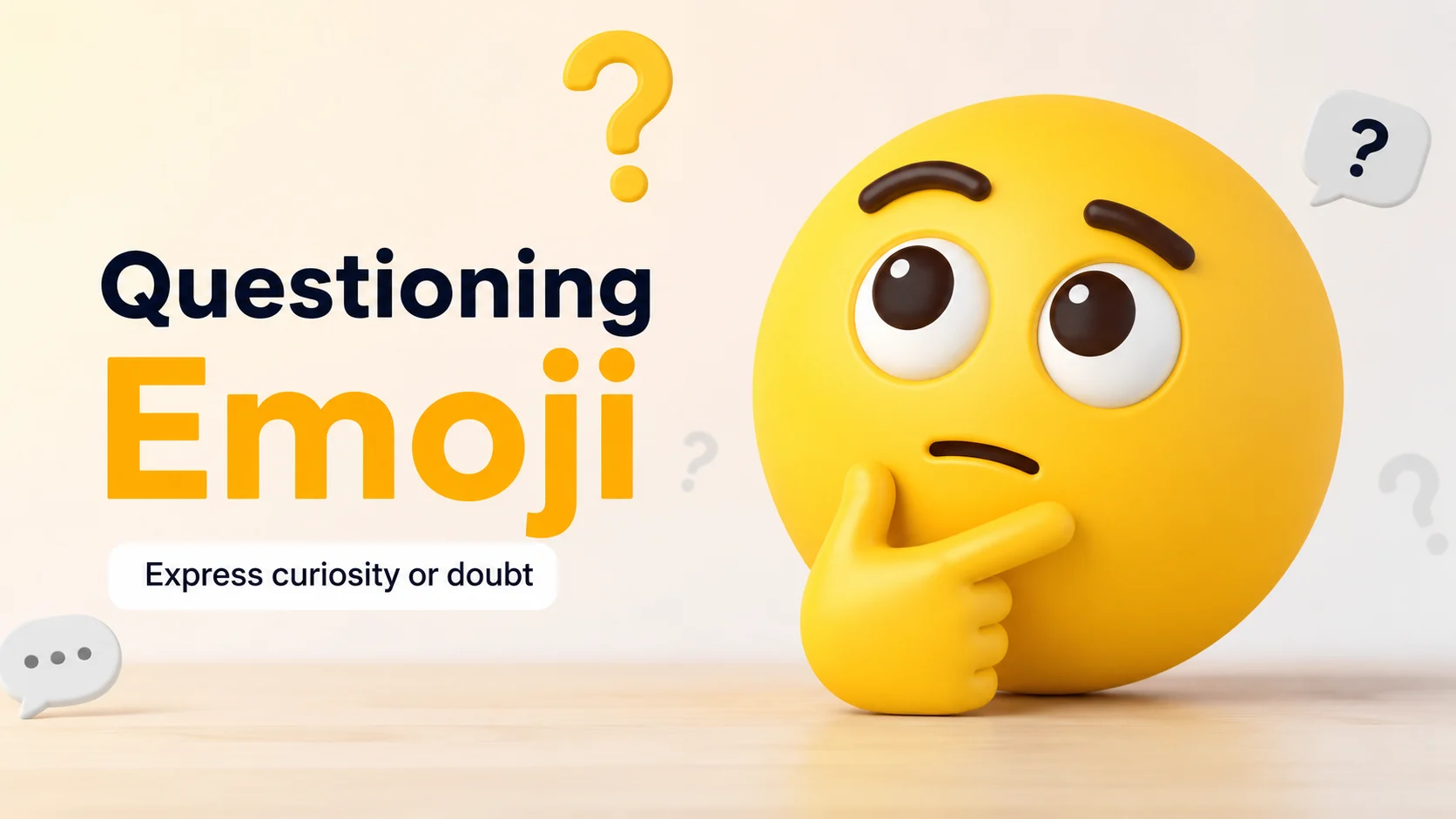
The questioning emoji 🤔 is officially called Thinking Face. It usually expresses thinking, curiosity, uncertainty, doubt, or trying to figure something out. In texts, it can mean “I’m thinking,” “Really?”, “I’m not sure,” or “Let me consider that.” Its exact tone depends on the surrounding message and conversation. It can be curious and thoughtful, but in some contexts it may also suggest skepticism or mild confusion.
The questioning emoji 🤔, officially known as Thinking Face, is commonly used when someone is thinking about an idea, questioning something, or deciding what they believe. Its hand-on-chin pose and raised eyebrow give it a thoughtful, curious expression.
In texting, 🤔 can replace a phrase such as “Hmm,” “Let me think,” or “I’m not sure about that.” It can also show that someone is examining a claim, trying to solve a problem, or considering what to say next.
Context makes a big difference. “What should we order? 🤔” sounds thoughtful and undecided, while “You really believe that? 🤔” can sound skeptical or questioning. The emoji itself does not automatically mean doubt or disagreement.
What Does the Questioning Emoji 🤔 Mean?
The most common meaning of 🤔 is thinking or considering something.
People use it when they want to show that they are:
- Thinking about a question
- Considering different choices
- Unsure about something
- Curious about an idea
- Trying to understand a situation
- Questioning information
- Deciding what to do
- Looking for an explanation
The expression is deliberately open-ended. Unlike an emoji that clearly shows happiness or sadness, 🤔 can represent several related mental reactions.
A simple interpretation is:
🤔 = “Hmm, let me think about that.”
What Does 🤔 Mean in Texting?
In text messages, 🤔 often adds a thoughtful pause to a conversation.
For example:
“Should I get the black one or the white one? 🤔”
Here, the emoji shows that the person is considering their options.
Another example:
“How did you know that? 🤔”
This could show curiosity or mild suspicion.
And:
“That sounds interesting 🤔”
may suggest that the sender is thinking about the idea rather than immediately agreeing with it.
The words around 🤔 are important because the same emoji can communicate curiosity, uncertainty, skepticism, or simple contemplation.
Is 🤔 a Questioning Emoji?
Yes, 🤔 can function as a questioning emoji, even though its official name is Thinking Face, not “Questioning Face.”
Its raised eyebrow and hand-on-chin pose visually suggest that the person is thinking about something. In conversation, that can naturally turn into a question or expression of doubt.
For example:
“Wait, how does that work? 🤔”
The emoji reinforces curiosity.
“Are you sure about that? 🤔”
The emoji can make the question feel more skeptical.
“Maybe we should leave earlier? 🤔”
Here, it shows consideration rather than suspicion.
So “questioning emoji” is a useful informal description of 🤔, but Thinking Face is the official Unicode name.
What Emotions Can 🤔 Express?
🤔 does not represent only one emotion. It is better understood as a visual signal that someone is mentally considering something.
Depending on the situation, it can suggest:
- Curiosity
- Thoughtfulness
- Uncertainty
- Doubt
- Confusion
- Skepticism
- Consideration
- Problem-solving
- Mild suspicion
These meanings are closely related, but they are not interchangeable.
For example, “Which movie should we watch? 🤔” is mostly about decision-making. “That explanation doesn’t make sense 🤔” can sound skeptical.
Can 🤔 Mean “I’m Thinking”?
Yes. This is one of its most natural uses.
Someone might send:
“Give me a minute 🤔”
The emoji reinforces the idea that they are thinking or deciding.
It can also be used without words:
“🤔”
A standalone 🤔 can mean “Hmm,” “Let me think,” “I’m wondering,” or “I’m not convinced.” Without additional context, its exact meaning is intentionally open.
Can 🤔 Mean Confusion?
Sometimes.
If someone does not understand something, they may use 🤔 to show that they are trying to make sense of it.
For example:
“I don’t understand how that happened 🤔”
Here, the emoji suggests that the sender is puzzled and thinking through the situation.
However, 🤔 is not as strongly associated with confusion as 😕 or 😵💫. It often suggests thinking about the confusion rather than simply being confused.
Can 🤔 Be Sarcastic?
Yes. 🤔 can take on a sarcastic or teasing tone when the surrounding words suggest it.
For example:
“You said you weren’t hungry, then ordered fries? 🤔”
The emoji can make the message feel teasing.
Another example:
“Interesting excuse 🤔”
Here, the emoji may suggest skepticism.
The important point is that sarcasm comes from the message and context, not from the official meaning of 🤔.
Does 🤔 Mean “I Don’t Believe You”?
It can, but this is not its only meaning.
For example:
“You finished the whole project in ten minutes? 🤔”
The emoji may suggest doubt.
But:
“Which restaurant should we try? 🤔”
clearly has nothing to do with disbelief.
If someone sends 🤔 after making a claim, it may signal that they are questioning the claim. If it appears while making a decision, it is more likely to mean consideration.
Is 🤔 Flirty?
🤔 is not inherently a flirty emoji.
It can appear in playful or romantic conversations, but the emoji itself usually communicates thinking, curiosity, or questioning rather than attraction.
For example:
“So what are you doing later? 🤔”
could be a normal question.
In a playful conversation, the same emoji might add a teasing tone. However, it should not automatically be interpreted as romantic interest.
Look at the complete conversation and the sender’s usual communication style rather than assuming that 🤔 has a hidden romantic meaning.
What Does 🤔 Mean From Someone?
When someone sends 🤔, they are usually signaling that they are thinking about, questioning, or considering something.
The message can help identify the intended tone:
“What should we do tomorrow? 🤔”
Likely meaning: They are considering options.
“Wait, you actually did that? 🤔”
Likely meaning: Surprise or mild disbelief.
“I’m not sure 🤔”
Likely meaning: Genuine uncertainty.
“Interesting… 🤔”
Likely meaning: They are thinking about what you said and may be curious or skeptical.
There is no universal secret meaning behind the emoji. The conversation matters more than the symbol alone.
Related Emojis and Their Meanings
| Emoji | Official Name | Common Meaning | Tone | Where or When It Is Used |
|---|---|---|---|---|
| 🤔 | Thinking Face | Thinking, questioning, uncertainty, curiosity | Thoughtful, curious | Questions, decisions, doubtful reactions |
| 🤨 | Face with Raised Eyebrow | Doubt, skepticism, questioning | Skeptical, suspicious | Questionable claims, teasing, disbelief |
| 🧐 | Face with Monocle | Close examination, scrutiny, curiosity | Analytical, observant | Examining details or investigating something |
| 😕 | Confused Face | Confusion, uncertainty, lack of understanding | Confused, concerned | Unclear explanations or situations |
| 🙄 | Face with Rolling Eyes | Annoyance, disbelief, exasperation | Sarcastic, annoyed | Frustrating or obvious statements |
| 😐 | Neutral Face | Neutrality, uncertainty, lack of reaction | Flat, restrained | Awkward or unclear situations |
| ❓ | Red Question Mark | A direct question or uncertainty | Direct, questioning | Asking a question or highlighting confusion |
| 💭 | Thought Balloon | A thought or idea | Reflective, imaginative | Thoughts, ideas, internal reactions |
The closest visual and conversational comparisons are 🤨 Face with Raised Eyebrow and 🧐 Face with Monocle. 🤔 usually focuses on thinking or consideration, while 🤨 can feel more skeptical and 🧐 can suggest examining something closely.
😕 is a better choice when the main idea is genuine confusion. 🙄 is stronger when the intended reaction is annoyance or disbelief. This makes 🤔 a flexible option when the sender wants to communicate “I’m thinking about this” without committing to a stronger emotional reaction.
🤔 vs. 🤨: What’s the Difference?
The difference is mainly the kind of questioning being expressed.
🤔 Thinking Face usually suggests:
“Hmm, let me think.”
🤨 Face with Raised Eyebrow is more likely to suggest:
“Really?”
🤔 can be curious and neutral, while 🤨 often carries more skepticism or suspicion.
For example:
“Which option is better? 🤔”
Thoughtful decision-making.
“You expect me to believe that? 🤨”
Skepticism or doubt.
🤔 vs. 🧐: What’s the Difference?
Both can suggest examination or curiosity, but they have different visual personalities.
🤔 looks like someone is thinking through an idea.
🧐, with its monocle, can feel more like someone is inspecting, analyzing, or scrutinizing something.
Compare:
“Should I take this offer? 🤔”
Considering a decision.
“Let’s look at the details 🧐”
Examining something carefully.
🤔 vs. 😕: What’s the Difference?
🤔 generally means thinking or questioning, while 😕 more directly communicates confusion or uncertainty.
Use 🤔 when you are considering an answer.
Use 😕 when something does not make sense or leaves you confused.
For example:
“Which one should I choose? 🤔”
versus:
“I don’t understand what happened 😕”
When Should You Use 🤔?
🤔 works well when you want to show that you are thinking without sounding overly serious.
You can use it for:
- Asking thoughtful questions
- Comparing choices
- Considering an idea
- Expressing curiosity
- Questioning a claim
- Reacting to something unexpected
- Adding a playful “hmm”
- Showing that you need time to decide
Examples:
“What should we eat tonight? 🤔”
“I might try that 🤔”
“How did you figure that out? 🤔”
“Maybe you’re right 🤔”
Each message leaves room for thought rather than giving a firm emotional reaction.
When Could 🤔 Be Misunderstood?
Because 🤔 can express both curiosity and skepticism, it can sometimes sound more doubtful than intended.
For example:
“That’s an interesting idea 🤔”
One person might mean genuine curiosity. Another reader might interpret it as “I’m not convinced.”
If you want to make your intention clearer, add words around the emoji.
For genuine interest:
“That’s interesting! I’d love to hear more 🤔”
For skepticism:
“I’m not sure that adds up 🤔”
The words make the intended tone easier to understand.
How to Respond to 🤔 in a Text
Your response depends on what the sender is questioning.
If they are questioning your statement
“Yep, that’s what happened.”
If they are teasing
“Haha, what? 😂”
A direct question can be especially useful when a standalone 🤔 is ambiguous.
Copy and Paste the Questioning Emoji
🤔
You can copy and paste 🤔 into texts, captions, comments, or messages.
Its official name is Thinking Face, so if you are searching for the “questioning emoji,” 🤔 is one of the most common emojis that fits that description.
Official Name and Unicode Details
The official Unicode name of 🤔 is Thinking Face. Its Unicode code point is U+1F914. Emojipedia identifies it as an emoji depicting a face with a hand on its chin, commonly associated with thinking or questioning. (unicode.org)
The emoji was approved under Unicode 8.0 in 2015 and later included in Emoji 1.0. (emojipedia.org)
Its artwork can vary slightly across Apple, Google, Samsung, and other platforms, but the central idea remains a thoughtful face with a hand on its chin.
FAQs
What is the questioning emoji?
🤔 is commonly used as a questioning emoji, although its official Unicode name is Thinking Face.
What does 🤔 mean from a girl?
The emoji does not have a different official meaning based on the sender’s gender. It can mean thinking, curiosity, uncertainty, or questioning regardless of who sends it.
What does 🤔 mean from a guy?
The same general meanings apply: thinking, curiosity, uncertainty, consideration, or doubt. The surrounding conversation is more useful than the sender’s gender for interpreting it.
Does 🤔 mean doubt?
It can suggest doubt when the surrounding message questions a statement or situation. However, it can also simply mean that someone is thinking.
Does 🤔 mean “hmm”?
Yes. A standalone 🤔 can naturally communicate a text-based “Hmm,” especially when someone is considering an idea or deciding what to say.
Conclusion
The questioning emoji 🤔 is officially called Thinking Face, and its main meaning is to show thinking, curiosity, uncertainty, or consideration. In texts, it can communicate anything from a simple “Hmm” to a more skeptical “Are you sure?”
The best way to understand 🤔 is to read it together with the surrounding words. Compared with 🤨, 😕, and 🧐, it is usually a more open-ended expression of thought rather than a definite sign of doubt, confusion, or suspicion.
Discover More Related Articles:
- Giggle Emoji | From Shy Laughs to Playful Moments In 2026
- Smug Emoji | Flirty, Playful, Confident & Sarcastic Meanings In 2026
