Quick Answer
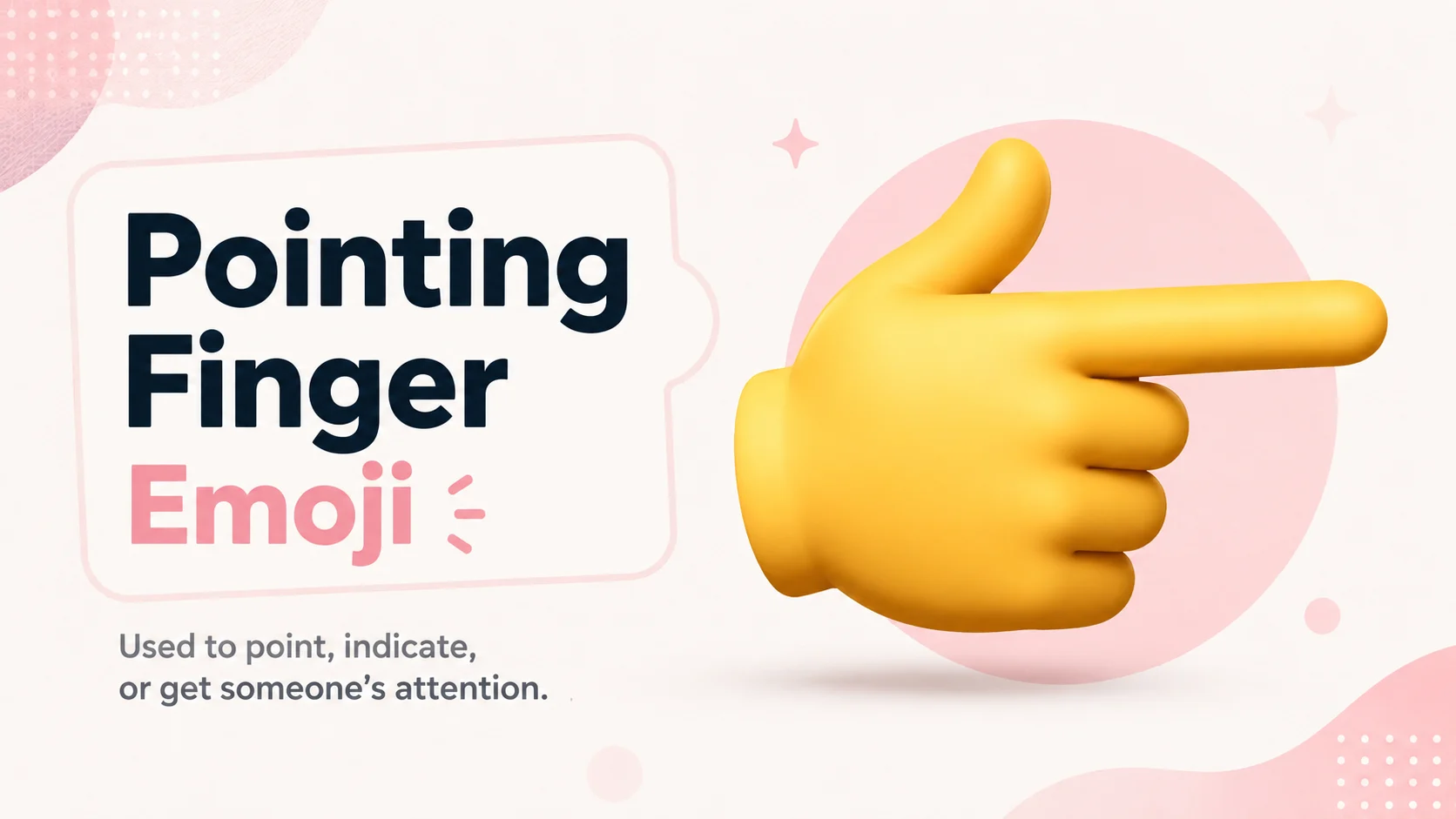
The 👉 emoji is officially called Backhand Index Pointing Right. It usually points toward something on the right, but in texts it can also mean “look here,” “this one,” “you,” “pay attention,” or “check this out.” Its meaning depends heavily on what appears next to it. Unicode lists 👉 as U+1F449, while Emojipedia describes it as an index finger pointing to the right.
The pointing finger emoji 👉 is one of the simplest hand emojis, but its meaning can change depending on how it is used. At its most literal, it simply points toward something on the right. In a text message, however, it can act almost like a visual arrow, directing attention toward a word, person, idea, or image.
People often use 👉 to emphasize something they want you to notice. For example, “Look at this 👉” uses the emoji as a visual cue telling you where to look. It can also point directly at someone in a playful way, especially when the surrounding message makes the intention obvious.
There are several pointing hand emojis, including 👈, 👆, 👇, ☝️, and 🫵. Although they all involve pointing, they are not interchangeable. Their direction, visual style, and conversational purpose can create slightly different meanings.
What Does the 👉 Pointing Finger Emoji Mean?
👉 is officially called Backhand Index Pointing Right. Its basic visual meaning is an index finger pointing toward the right. Unicode identifies it with the code point U+1F449.
In everyday texting, 👉 can commonly mean:
- Look here
- This one
- Check this out
- Pay attention to this
- You
- That thing over there
- I’m pointing something out
- This is the part I mean
For example:
“This is the part I was talking about 👉”
The emoji helps direct attention to whatever follows or sits nearby.
It can also be paired with another pointing emoji:
“The answer is right here 👉”
In this case, the emoji works almost like a visual pointer.
👉 Meaning in Text Messages
In texting, the pointing finger emoji often adds emphasis or direction without requiring a long explanation.
For example:
“You need to see this 👉😂”
Here, 👉 tells the reader to look at something, while 😂 adds a humorous tone.
Another example:
“That part right there 👉”
This emphasizes a particular point in the conversation.
The emoji can also be used to point toward a person:
“You 👉”
Depending on the surrounding message, this might mean “I’m talking to you,” “you’re the one,” or simply “you!”
Context determines whether that feels playful, neutral, teasing, or slightly confrontational.
What Does 👉 Mean From Someone?
If someone sends 👉 directly to you, they may simply be drawing attention to you or something you said.
For example:
“You said it yourself 👉”
This points back to the person or their previous statement.
It can also be playful:
“Look who finally showed up 👉😂”
Here, the emoji adds emphasis and makes the message feel teasing rather than serious.
If the emoji appears by itself, there may not be enough information to know exactly what the sender means. The previous messages usually provide the missing context.
Is 👉 a Flirty Emoji?
👉 is not inherently a flirting emoji. Its main function is pointing or directing attention.
However, people sometimes use pointing emojis in playful conversations, and the surrounding words can make the message feel teasing or affectionate. For example:
“You’re the one causing all this 👉😂”
That is more likely playful teasing than a clear romantic signal.
A single 👉 should not be treated as proof that someone is flirting or expressing romantic interest. The words, conversation history, and overall tone matter much more.
Can 👉 Sound Rude?
It can, depending on the message.
For example:
“You did this 👉”
Without additional context, that could sound accusatory.
But:
“You 😂👉”
could simply be playful teasing between friends.
The pointing finger itself is neutral. The words around it determine whether the gesture feels friendly, funny, direct, or critical.
Common Ways to Use 👉
To Point Something Out
“Check this out 👉”
Meaning: Directing someone’s attention to something.
To Emphasize a Person
“You 👉”
Meaning: Calling attention to the person being addressed.
To Highlight a Statement
“That is exactly what I meant 👉”
Meaning: Emphasizing the previous point.
For Playful Teasing
“Look who forgot again 👉😂”
Meaning: Lightly teasing someone.
To Direct Attention
“The important part is here 👉”
Meaning: Showing the reader where to focus.
Pointing Finger Emojis and Their Meanings
| Emoji | Official Name | Common Meaning | Tone | Where or When It Is Used |
|---|---|---|---|---|
| 👉 | Backhand Index Pointing Right | Look here, this, you, or something to the right | Direct, playful, neutral | Pointing out text, people, links, or ideas |
| 👈 | Backhand Index Pointing Left | Look left, this, or something on the left | Direct, playful | Drawing attention to something on the left |
| 👆 | Backhand Index Pointing Up | Look above, see this, or attention | Direct, emphatic | Pointing toward text or content above |
| 👇 | Backhand Index Pointing Down | Look below, see below, or this | Direct, casual | Highlighting something underneath |
| ☝️ | Index Pointing Up | One point, wait, reminder, or emphasis | Assertive, informative | Making a point or emphasizing an idea |
| 🫵 | Index Pointing at the Viewer | You, specifically addressing the reader | Direct, playful, emphatic | Calling attention directly to someone |
| 👍 | Thumbs Up | Approval, agreement, or “okay” | Positive, casual | Confirming or approving something |
| 🫰 | Hand with Index Finger and Thumb Crossed | Affection, heart gesture, or money-related meaning depending on context | Affectionate, playful | Expressing affection or a heart gesture |
The easiest emojis to confuse with 👉 are 👈, 👆, and 👇 because they all use an index finger to direct attention. The key difference is direction. 👉 points right, 👈 points left, 👆 points upward, and 👇 points downward. Unicode gives each of these a separate official name.
🫵 is different because it points directly at the viewer rather than toward a side. ☝️ also differs from 👉 because its main visual direction is upward and it is often used to emphasize a point rather than simply point toward something.
👉 vs. 🫵: What’s the Difference?
These two emojis can both appear to address a person, but they point in different ways.
👉 Backhand Index Pointing Right points toward the right and can be used to direct attention toward something.
🫵 Index Pointing at the Viewer points directly toward the person looking at the screen.
For example:
“Check this out 👉”
This directs attention toward something.
But:
“I mean you 🫵”
directly addresses the reader.
👉 vs. ☝️: What’s the Difference?
👉 usually works as a directional pointer.
☝️ can be used to emphasize one important point, suggest “wait a second,” or draw attention to an idea.
Compare:
“The answer is over there 👉”
with:
“One thing to remember ☝️”
The first directs attention. The second emphasizes a point.
👉 and 👈 Together
The combination 👉👈 has developed a recognizable informal use online. It can be paired with 🥺 to create a bashful or shy-looking gesture, often written as 🥺👉👈. Emojipedia documents this combination as a commonly recognized “shy pose.”
The individual emojis still retain their basic pointing meanings, but together they can create a completely different visual effect.
Text Message Examples
“Look at This”
“You have to see this 👉”
Meaning: The sender wants you to look at something.
“I Mean You”
“Yes, you 👉😂”
Meaning: The sender is playfully calling you out.
“This Part”
“This is exactly what I was talking about 👉”
Meaning: The emoji emphasizes a particular point.
“Check Below”
“The details are right here 👇”
Meaning: A downward-pointing emoji is more suitable when directing attention below.
“Just Kidding”
“Look who thinks they’re funny 👉😂”
Meaning: The pointing emoji adds playful emphasis, while 😂 makes the joke clearer.
How to Respond to 👉
Your response depends on what the sender is pointing toward.
If they’re pointing at you:
“Me? 😂”
They’re showing you something:
“Okay, I’m looking 👀”
If they’re teasing you:
“Why are you pointing at me? 😂”
These responses keep the conversation natural without assuming what the sender intended.
Common Misunderstandings About the Pointing Finger Emoji
👉 Does not always mean “you”
It can point toward a person, but it can just as easily point toward an object, statement, image, or idea.
👉 Does not automatically mean flirting
A playful message can sometimes feel flirty, but the emoji itself does not have a standard romantic meaning.
👉 Does not always sound aggressive
A pointing gesture can look direct, but friends often use it casually or jokingly.
👉 Direction matters
👉 points right, while 👈 points left. Using the wrong direction can change the visual meaning of a message.
👉 It is not the same as 🫵
🫵 is specifically Index Pointing at the Viewer, while 👉 is Backhand Index Pointing Right.
Official Emoji Details
The official Unicode name for 👉 is Backhand Index Pointing Right. Its Unicode code point is U+1F449. Unicode places it in the hand-single-finger category alongside other pointing gestures such as 👈, 👆, and 👇.
👉 was approved as part of Unicode 6.0 in 2010 under the earlier name “White Right Pointing Backhand Index” and was added to Emoji 1.0 in 2015, according to Emojipedia.
Different emoji platforms can give the hand slightly different colors, shading, or visual details. The basic concept remains the same: an index finger pointing to the right.
FAQs
What is the official name of 👉?
The official Unicode name is Backhand Index Pointing Right.
What does the pointing finger emoji mean in texting?
👉 commonly means look here, check this out, this one, or you. The surrounding message determines the exact meaning.
What does 👉 mean from a friend?
A friend may use it to point something out, emphasize a statement, or playfully call attention to you.
Is 👉 a rude emoji?
Not by itself. It can sound rude or accusatory in certain messages, but it is also commonly used in casual and playful ways.
Is 👉 a flirting emoji?
Not specifically. It can appear in playful conversations, but the emoji alone does not establish romantic interest.
Conclusion
The 👉 emoji is officially called Backhand Index Pointing Right, and its basic purpose is to point toward something on the right. In texting, it can also mean “look here,” “this one,” “check this out,” or “you.”
Its meaning becomes clearer when you look at the words around it. A message such as “Check this out 👉” is simply directing attention, while “You 👉😂” is more likely playful teasing. It is not automatically rude or flirty.
If you want to choose the right pointing emoji, focus on direction and purpose. Use 👉 for the right, 👈 for the left, 👆 for something above, 👇 for something below, and 🫵 when you want to point directly at the person reading the message.
Discover More Related Articles:
