Quick Answer
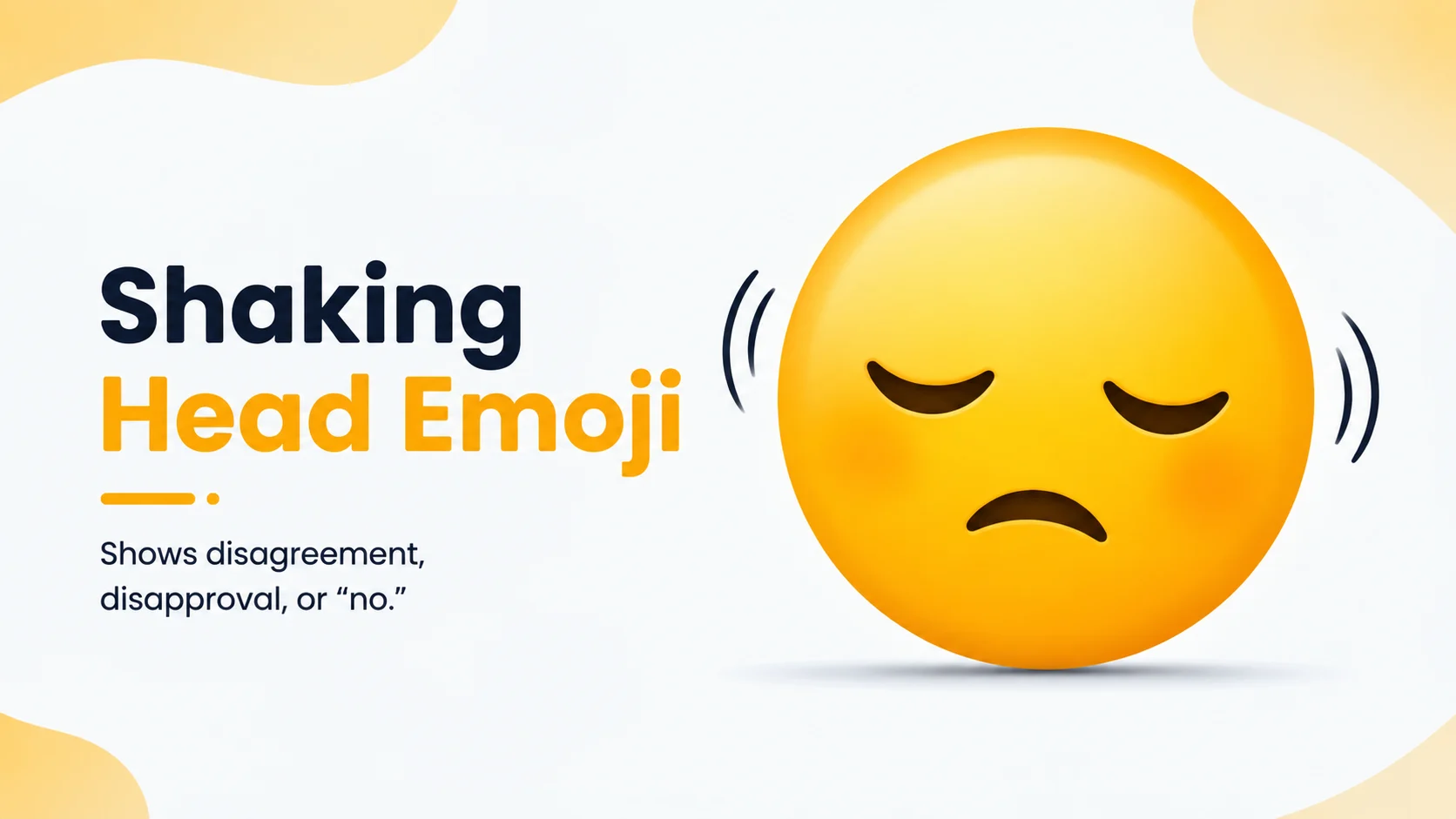
The shaking head emoji 🙂↔️, officially called Head Shaking Horizontally, represents a face moving from side to side. It commonly communicates “no,” disagreement, denial, rejection, or disbelief. The emoji can make a refusal feel softer or more playful because it uses a slightly smiling face rather than an angry expression. Unicode lists it as a ZWJ emoji sequence made from 🙂, a Zero Width Joiner, and ↔️. It was added in Emoji 15.1 in 2023.
The shaking head emoji 🙂↔️ is a visual way to show the familiar side-to-side head movement people often use to mean “no.” In a text, it can replace a simple “nope,” show disagreement, or react to something that seems unbelievable.
Unlike a strongly negative emoji, 🙂↔️ has a slightly smiling face. That gives it a softer and sometimes playful tone. A message such as “Are you really doing that? 🙂↔️” can feel more teasing than angry.
Context still matters. The same emoji can communicate a gentle refusal, disbelief, mild disapproval, or playful disagreement depending on the words around it and the relationship between the people chatting.
What Does the Shaking Head Emoji 🙂↔️ Mean?
The main meaning of 🙂↔️ is “no” or “I disagree.”
It depicts a face shaking horizontally from side to side. This motion is commonly associated with saying no, rejecting an idea, or showing disagreement. Unicode’s emoji list identifies the relevant keywords as head, horizontally, no, shake, and shaking.
People may use 🙂↔️ to express:
- No
- Disagreement
- Refusal
- Denial
- Disbelief
- Mild disapproval
- “Absolutely not”
- “Nope”
- “I don’t agree”
- A playful reaction to someone’s idea
The exact strength depends on the message.
“Want pizza again tonight? 🙂↔️”
Likely means a casual or playful “no.”
“You think I’m going to do that? 🙂↔️”
Could express disbelief or a firm refusal.
What Does 🙂↔️ Mean in Texting?
In texting, 🙂↔️ is often a visual replacement for “nope,” “not happening,” or “I disagree.”
It can be useful when the sender wants to communicate a negative response without making the message sound overly harsh.
For example:
“Are you waking up at 5 a.m. tomorrow? 🙂↔️”
The likely meaning is: “No, definitely not.”
Or:
“You actually think that was a good idea? 🙂↔️”
Here, the emoji can suggest disagreement or disbelief.
The smile makes the reaction less severe than simply sending an angry or aggressive-looking emoji.
Is the Shaking Head Emoji Rude?
Not necessarily.
🙂↔️ can be a polite, playful, or casual way to disagree. However, its tone can become sharper if it follows an argument or a strongly worded message.
Compare:
“Want another slice? 🙂↔️”
Friendly refusal.
“You’re seriously blaming me for this? 🙂↔️”
Stronger disbelief or disagreement.
“No, I’m not doing that 🙂↔️”
A clear refusal with a slightly lighter visual tone.
So, the emoji itself is not automatically rude. The surrounding conversation determines how it lands.
Can 🙂↔️ Mean Disbelief?
Yes.
A side-to-side head shake can communicate more than a simple “no.” It can also represent “I can’t believe this,” “seriously?” or “that’s not true.”
For example:
“He forgot his own birthday. 🙂↔️”
The emoji can show disbelief or amused disappointment.
Likewise:
“They canceled the event again 🙂↔️”
Here, it could express frustration, disbelief, or resignation.
The emotion comes from the situation, while the emoji provides the visual head-shaking reaction.
Can 🙂↔️ Be Playful?
Yes. The slightly smiling face makes it especially suitable for light teasing and playful disagreement.
For example:
“You thought I’d fall for that? 🙂↔️”
This can mean “Nice try, but no.”
Or:
“Me volunteering to clean the kitchen? 🙂↔️”
Here, the emoji adds a humorous “absolutely not” feeling.
It can therefore be softer than a direct “NO,” especially in casual conversations.
Does 🙂↔️ Mean “Nope”?
Often, yes.
If someone sends only:
🙂↔️
a natural interpretation is “no,” “nope,” or “not really.”
However, a single emoji can be ambiguous. If the conversation is unclear, look at the previous message before deciding exactly what the sender means.
For example:
“Are you coming with us?”
“🙂↔️”
Most likely: “No.”
But:
“You really did that?”
“🙂↔️”
could mean: “No,” “I can’t believe it,” or “Definitely not.”
What Does 🙂↔️ Mean From Someone?
When someone sends 🙂↔️, the safest interpretation is usually that they are disagreeing, declining, or reacting negatively to the idea being discussed.
It does not automatically mean anger, dislike, or rejection of the person.
For example:
“Want to go out tonight?” — “🙂↔️”
Likely a simple no.
“You think that’s going to work? 🙂↔️”
Likely disbelief or disagreement.
“Should I send another message? 🙂↔️”
Likely means “No, don’t do that.”
The meaning comes from the message being answered.
Is 🙂↔️ Flirty?
The shaking head emoji is not inherently flirty.
It can appear in a playful or teasing conversation, including one with romantic undertones, but the emoji itself primarily communicates a side-to-side “no” gesture.
For example:
“So you’re saying I can’t convince you? 🙂↔️”
could be playful depending on the conversation.
But:
“Are you coming to the party? 🙂↔️”
is simply a negative response.
It is better not to interpret 🙂↔️ as romantic interest without additional context.
Emojis Similar to the Shaking Head Emoji
| Emoji | Official Name | Common Meaning | Tone | Where or When It Is Used |
|---|---|---|---|---|
| 🙂↔️ | Head Shaking Horizontally | No, disagreement, refusal | Gentle, playful, disapproving | Casual refusals, reactions, disagreement |
| 🙂↕️ | Head Shaking Vertically | Yes, agreement, acknowledgment | Positive, agreeable | Confirming, agreeing, acknowledging |
| 🙄 | Face with Rolling Eyes | Annoyance, disbelief, exasperation | Irritated, sarcastic | Frustrating or ridiculous situations |
| 😐 | Neutral Face | Little or no emotion | Neutral, reserved | Unclear, ordinary, or awkward reactions |
| 😒 | Unamused Face | Displeasure or dissatisfaction | Unimpressed, annoyed | Disagreement or frustration |
| 🤦 | Person Facepalming | Frustration, embarrassment, disbelief | Exasperated, humorous | Mistakes, awkward moments, obvious errors |
| 🤷 | Person Shrugging | Uncertainty or “I don’t know” | Casual, uncertain | Questions without a clear answer |
| ❌ | Cross Mark | No, wrong, incorrect | Direct, firm | Clear rejection or marking something as incorrect |
The most important comparison is 🙂↔️ versus 🙂↕️. They are designed as a matching pair: horizontal movement represents a head shake associated with “no,” while vertical movement represents a nod associated with “yes.” Both were added in Emoji 15.1.
Another useful distinction is between 🙂↔️ and 🙄. The shaking-head emoji focuses on the “no” or disagreement gesture, while 🙄 more strongly communicates annoyance, exasperation, or an eye-roll reaction.
🙂↔️ vs. 🙄: What’s the Difference?
🙂↔️ generally says “no” or “I disagree.”
🙄 generally says “Seriously?” or “That’s annoying.”
For example:
“Want to order mushrooms?” — “🙂↔️”
Simple refusal.
“He forgot the meeting again. 🙄”
Annoyance or exasperation.
The difference is useful when you want to disagree without necessarily sounding irritated.
🙂↔️ vs. 🙂↕️: No vs. Yes
These two emojis are easy to confuse because they use the same basic smiling face.
🙂↔️ = Head Shaking Horizontally
Side-to-side movement → usually “no.”
🙂↕️ = Head Shaking Vertically
Up-and-down movement → usually “yes” or agreement.
Unicode identifies both as separate ZWJ sequences and includes them in its current emoji list.
A quick memory trick:
- ↔️ = left and right = no
- ↕️ = up and down = yes
How to Use the Shaking Head Emoji
🙂↔️ works best when the message calls for a clear but casual negative reaction.
Friendly Refusal
“Want to watch another movie? 🙂↔️”
Meaning: “No, I’m good.”
Playful Disagreement
“You really think that’s the best option? 🙂↔️”
Meaning: “I don’t agree.”
Disbelief
“They canceled it for the third time 🙂↔️”
Meaning: “I can’t believe this.”
Teasing
“You thought that excuse would work on me? 🙂↔️”
Meaning: “Nice try, but no.”
When Should You Avoid 🙂↔️?
Although it is useful for casual conversations, it may not be the clearest choice when a serious or formal response is needed.
If someone is asking an important question, using only 🙂↔️ might leave them unsure whether you mean:
- No
- I disagree
- I don’t know
- I’m joking
- I’m disappointed
In those situations, words can make your meaning clearer.
For example, instead of only:
“🙂↔️”
you could say:
“No, I don’t think that’s a good idea 🙂↔️”
The words provide the exact meaning, while the emoji adds tone.
How to Respond to 🙂↔️
The best response depends on what the sender is rejecting.
If they simply said no
“No worries!”
If they rejected an idea
“Got it. We can do something else.”
These responses keep the conversation natural without assuming why the person said no.
Copy and Paste the Shaking Head Emoji
🙂↔️
You can copy and paste 🙂↔️ into a text, caption, comment, or message where you want to show a side-to-side “no” reaction.
Official Name and Unicode Details
The official Unicode name is Head Shaking Horizontally. Its sequence is U+1F642 U+200D U+2194 U+FE0F, combining 🙂 Slightly Smiling Face, a Zero Width Joiner, and ↔️ Left-Right Arrow. Unicode lists its short-name keywords around the concepts of head movement, horizontal movement, “no,” and shaking.
The emoji was added in Emoji 15.1 in 2023. Because it is a relatively newer emoji sequence, its visual appearance can differ between devices, and unsupported systems may not render it as one combined emoji.
FAQs
What does the shaking head emoji 🙂↔️ mean?
It usually means no, disagreement, refusal, or disbelief. The side-to-side movement represents the familiar head-shaking gesture.
What is the official name of 🙂↔️?
Its official Unicode name is Head Shaking Horizontally.
Does 🙂↔️ mean no?
Yes. “No” is one of its clearest intended interpretations, although the exact message can also express disagreement or disbelief.
Is 🙂↔️ the same as 🙄?
No. 🙂↔️ primarily represents a head shake and “no,” while 🙄 represents rolling eyes and often carries a stronger feeling of annoyance or exasperation.
What is the opposite of 🙂↔️?
🙂↕️ Head Shaking Vertically is its matching opposite. It represents an up-and-down nod and is commonly associated with yes or agreement.
Conclusion
The shaking head emoji 🙂↔️, officially called Head Shaking Horizontally, is mainly used to communicate “no,” disagreement, refusal, or disbelief. Its slightly smiling face gives the gesture a softer and more casual feel than a strongly negative reaction.
The key is to read the emoji together with the message around it. 🙂↔️ can be a simple “no,” a playful rejection, or an amused “I can’t believe this.” When you need to show agreement instead, its matching emoji 🙂↕️ represents a vertical head shake or nod.
Discover More Related Articles:
