Quick Answer
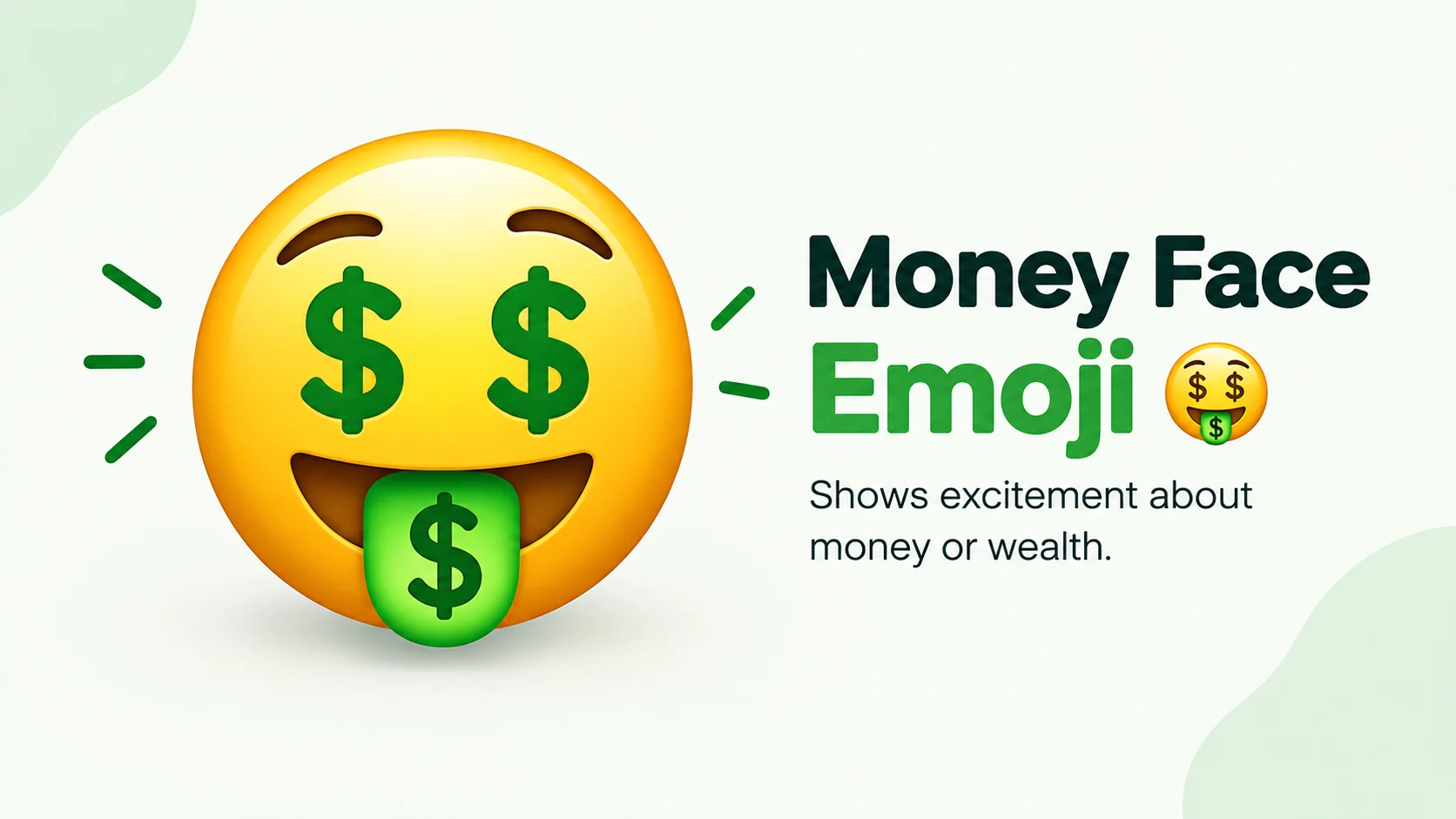
The money face emoji 🤑, officially called Money-Mouth Face, usually expresses excitement about money, wealth, earning, spending, or getting a good financial opportunity. It can also suggest feeling successful, being impressed by money, or joking about greed and wanting more. The tone can be positive, playful, or sarcastic depending on the message around it. Unicode identifies 🤑 as U+1F911 Money-Mouth Face, with keywords including “money,” “money-mouth,” and “paid.”
The money face emoji 🤑 is one of the easiest emojis to recognize because its design directly connects a facial expression with money. It has dollar signs for eyes and a dollar symbol shown in the mouth, making it a natural choice when a message involves cash, wealth, payment, or financial excitement.
In texting, 🤑 can mean much more than simply “money.” Someone might use it after getting paid, talking about a profitable idea, seeing something expensive, or joking about wanting to become rich. It can also exaggerate excitement, especially when the sender is being playful.
The context is what determines whether the emoji feels excited, humorous, ambitious, greedy, or sarcastic. A message such as “I got paid today 🤑” has a straightforward celebratory meaning, while “You really bought that? 🤑” could jokingly focus on the amount of money involved.
What Does the Money Face Emoji 🤑 Mean?
The Money-Mouth Face 🤑 commonly represents a strong focus on money or financial excitement.
It can communicate ideas such as:
- Making money
- Getting paid
- Financial success
- Wanting money
- Wealth
- A profitable opportunity
- Excitement about a purchase
- Being impressed by something expensive
- Joking about greed
- Feeling financially successful
The Unicode emoji charts list money, money-mouth, and paid among its keywords.
Because emoji meanings are not limited to their official names, 🤑 can take on additional meanings in everyday conversations. Unicode itself notes that a character name does not define every possible meaning of an emoji.
Money Face Emoji Meaning in Text
In a text message, 🤑 usually draws attention to money or financial excitement.
For example:
“I just got my paycheck 🤑”
Here, the emoji emphasizes happiness about getting paid.
Another example:
“That side project is finally making money 🤑”
In this context, 🤑 expresses excitement about earning.
It can also be used humorously:
“Me looking at the price of my dream car 🤑”
Here, the emoji can exaggerate the connection between the person and a large amount of money.
The emoji does not automatically mean the sender is wealthy. It can simply be a playful reaction to anything involving money.
What Does 🤑 Mean From Someone?
When someone sends 🤑 directly to you, the meaning depends on what you were discussing.
If you were talking about a payment:
“The money finally came through 🤑”
It probably means they are excited about getting paid.
If you were discussing an expensive item:
“Those shoes are $900 🤑”
The emoji may emphasize how expensive they are.
If you were discussing a business opportunity:
“This could actually make us some money 🤑”
The sender is expressing financial excitement or optimism.
If there is no money-related context, 🤑 may simply be used as a joke about being rich, greedy, ambitious, or impressed by something valuable.
Is the Money Face Emoji Positive or Negative?
The tone of 🤑 can be positive, neutral, or negative.
Positive Use
It can celebrate earning or receiving money.
“I got my first paycheck 🤑🎉”
The tone is excited and celebratory.
Playful Use
It can make a joke about wanting something expensive.
“I need that new laptop 🤑”
The emoji makes the statement feel exaggerated and playful.
Negative or Critical Use
It can sometimes suggest greed or excessive focus on money.
“All he cares about is getting paid 🤑”
Here, the emoji may reinforce criticism rather than excitement.
The emoji itself does not guarantee a positive or negative interpretation. The wording determines much of the emotional tone.
Does 🤑 Mean Greedy?
It can suggest greed, but that is not its only meaning.
Because the emoji visually focuses on money, someone might use it to joke about being greedy or obsessed with getting paid.
For example:
“Give me another slice of cake 🤑”
There is no actual money involved. The emoji is being used humorously to exaggerate desire.
In another message:
“He only talks about how much everything costs 🤑”
The same emoji can suggest that the person is overly focused on money.
So, 🤑 can represent greed as a joke or criticism, but it does not automatically accuse someone of being greedy.
Does 🤑 Mean Rich or Wealthy?
Not necessarily.
The money face emoji can represent interest in money, rather than proof that someone has money.
For example:
“One day I’m going to buy that house 🤑”
The sender may be expressing an ambition or dream rather than saying they are currently wealthy.
Likewise:
“That bonus would be amazing 🤑”
This shows excitement about potential money, not necessarily current financial status.
Is the Money Face Emoji Flirty?
The 🤑 emoji is not inherently a flirting emoji.
Someone may use it in a playful conversation about shopping, gifts, expensive restaurants, or money, but the emoji itself does not establish romantic interest.
For example:
“You really bought that for me? 🤑😂”
This could simply be a joking reaction to receiving something expensive.
If a conversation has romantic or teasing context, 🤑 may contribute to that tone, but its basic meaning remains connected to money or financial excitement.
Can 🤑 Be Sarcastic?
Yes. 🤑 is often useful for exaggeration and sarcasm.
For example:
“Sure, I have plenty of money for that $5,000 phone 🤑”
The sender probably does not literally mean they have unlimited money. The emoji makes the financial joke more obvious.
Another example:
“My bank account after one trip to the mall 🤑”
Here, the emoji can be part of a humorous exaggeration about spending.
The surrounding text is what makes the sarcastic reading clear.
Money Face Emoji After Getting Paid
One of the most straightforward uses of 🤑 is after receiving money.
Examples include:
“Payday is finally here 🤑”
“Just got paid! 🤑”
“The payment went through 🤑”
In these situations, the emoji adds excitement to the idea of receiving or earning money.
It can also be paired with 🎉, 💰, or 💵 when the sender wants to make the financial theme even clearer.
Money Face Emoji and Shopping
The emoji can also appear when someone is excited about buying something.
For example:
“I found the shoes I wanted 🤑”
Depending on the conversation, this could mean the sender is excited to buy them or joking about how expensive they are.
It can also be used when someone sees something luxurious:
“That car is beautiful 🤑”
Here, 🤑 can suggest that the sender is thinking about the cost or imagining being able to afford it.
Money Face Emoji and Success
🤑 can represent success when money is the result of an achievement.
For example:
“First client signed! 🤑”
The emoji can emphasize the financial side of the accomplishment.
Another example:
“My little business finally made a profit 🤑”
Here, the emoji communicates excitement about earning money.
The important distinction is that 🤑 focuses specifically on the financial aspect of success. Other emojis may be better if the main point is simply achievement or celebration.
Related Money Emojis and Their Meanings
| Emoji | Official Name | Common Meaning | Tone | Where or When It Is Used |
|---|---|---|---|---|
| 🤑 | Money-Mouth Face | Money, financial excitement, getting paid | Excited, playful, sometimes greedy | Paydays, profits, expensive items, money jokes |
| 💰 | Money Bag | Wealth, money, financial value | Positive, playful | Talking about savings, wealth, or money |
| 💸 | Money with Wings | Spending, losing, or sending money | Humorous, dramatic | Bills, shopping, expensive purchases |
| 💵 | Dollar Banknote | Cash or U.S. dollars | Neutral, practical | Payments, prices, cash, financial discussions |
| 💎 | Gem Stone | Luxury, value, something precious | Glamorous, playful | Expensive items, luxury, high value |
| 🪙 | Coin | Coins, small amounts of money, currency | Neutral, casual | Money discussions, saving, payment |
| 💳 | Credit Card | Paying by card or making a purchase | Practical, neutral | Shopping, payments, purchases |
| 📈 | Chart Increasing | Growth, progress, rising value | Positive, businesslike | Business, investments, earnings, improvement |
The biggest distinction is between 🤑 and 💰. 🤑 is a facial reaction, so it often communicates an emotional response to money. 💰 is more directly a symbol for money or wealth.
💸 Money with Wings has a different feel because it often suggests money being spent or disappearing. 💵 Dollar Banknote is more literal and can simply refer to cash or U.S. currency.
🤑 vs. 💰: What’s the Difference?
🤑 is more emotional and expressive.
“I got paid today 🤑”
This sounds like a reaction to money.
💰 is more symbolic.
“Building my savings 💰”
This focuses on money or wealth itself.
You can also combine them:
“Finally got paid 🤑💰”
That combination makes the financial theme especially clear.
🤑 vs. 💸: What’s the Difference?
These two emojis can both appear in conversations about money, but they point in different directions.
🤑 usually suggests excitement about money.
💸 often suggests spending, losing, or sending money away.
Compare:
“My paycheck came in 🤑”
with:
“There goes my paycheck on bills 💸”
The first focuses on receiving money. The second focuses on money leaving your account.
🤑 vs. 💵: What’s the Difference?
🤑 represents a facial reaction to money.
💵 represents a dollar banknote.
If you are saying:
“I need some cash 💵”
the banknote is the more literal choice.
If you are saying:
“I just got paid 🤑”
the money face adds emotion and excitement.
Money Face Emoji Examples in Text Messages
Excited about getting paid
Message: “Payday is here 🤑”
Likely meaning: The sender is happy or excited about receiving their paycheck.
Talking about profit
Message: “We actually made a profit this month 🤑”
Likely meaning: The sender is celebrating financial success.
Joking about an expensive purchase
Message: “That gaming setup costs a fortune 🤑”
Likely meaning: The emoji exaggerates the price and adds humor.
Showing ambition
Message: “One day I’m buying that house 🤑”
Likely meaning: The sender is jokingly or confidently imagining financial success.
Criticizing greed
Message: “He sees everything as a business opportunity 🤑”
Likely meaning: The emoji can make the money-focused behavior sound exaggerated or greedy.
How to Respond to 🤑
Your response can depend on what the sender is talking about.
They are celebrating getting paid
“Nice! Treat yourself 😂”
If they are joking about something expensive
“That price is wild 😂”
You want to keep it neutral
“Haha, I get you.”
If you’re not sure what they mean
You can simply respond to the surrounding message instead of trying to interpret the emoji on its own.
For example, if they write:
“I finally got the payment 🤑”
you could say:
“Nice, glad it came through!”
Common Misunderstandings About 🤑
One common mistake is assuming that 🤑 always means “I am rich.” It does not. Someone can use it when they are hoping to make money, joking about money, or reacting to an expensive item.
Another misunderstanding is treating it as automatically positive. In some conversations, 🤑 can suggest greed or excessive interest in money.
It is also easy to confuse financial excitement with actual financial status. The emoji communicates a reaction or idea; it does not prove anything about the sender’s income, wealth, or spending habits.
Finally, 🤑 does not automatically mean flirting. If it appears in a romantic conversation, the surrounding message still matters more than the emoji itself.
Money Face Emoji Copy and Paste
Here is the official Money-Mouth Face emoji:
🤑
You can also combine it with related emojis:
🤑💰
🤑💵
🤑🎉
🤑💳
🤑💸
These combinations can make the intended money-related context easier to understand.
Official Name and Unicode Details
The official Unicode/CLDR short name for 🤑 is Money-Mouth Face. Its Unicode code point is U+1F911. Unicode’s current emoji charts list keywords including face, money, money-mouth, and paid.
🤑 was included in Unicode 8.0, released in 2015. Emojipedia’s Unicode 8.0 listing also identifies 🤑 as Money-Mouth Face.
The emoji’s official name helps identify the character, but the name does not limit every way people can use it. Unicode specifically explains that an emoji’s character name is not a complete definition of its possible meanings.
Does 🤑 Mean “Paid”?
It can. “Paid” is one of Unicode’s listed keywords for Money-Mouth Face.
That makes 🤑 a natural choice for messages about:
- Getting paid
- Receiving a paycheck
- Making a profit
- Earning money
- A successful sale
- A profitable opportunity
However, the emoji can also be used more broadly for money, wealth, expensive things, or jokes about greed.
FAQs
What does the money face emoji 🤑 mean?
🤑 usually means excitement about money, wealth, getting paid, earning, or something expensive. It can also be used humorously to suggest greed or wanting more money.
What is the official name of 🤑?
The official Unicode/CLDR short name is Money-Mouth Face. Its code point is U+1F911.
Does 🤑 mean getting paid?
It can. “Paid” is one of the keywords associated with the emoji, so it works naturally in messages about paychecks, payments, or earnings.
Does 🤑 mean greed?
Sometimes. It can jokingly or critically suggest greed, but it more commonly expresses excitement or interest related to money.
Is 🤑 a flirting emoji?
No. 🤑 does not have an inherently romantic meaning. A flirty interpretation would depend on the larger conversation.
Conclusion
The money face emoji 🤑 usually expresses excitement about money, getting paid, earning, wealth, or something expensive. Its official name is Money-Mouth Face, and Unicode lists “money” and “paid” among its associated keywords.
Its tone can change with context. It may celebrate a paycheck, joke about an expensive purchase, suggest ambition, or even make a critical comment about greed sound more humorous. It does not automatically mean someone is rich, greedy, or flirting.
When you see 🤑 in a message, look at the words around it first. That will usually tell you whether the sender is celebrating money, joking about it, or simply reacting to something expensive.
Discover More Related Articles:
