Quick Answer
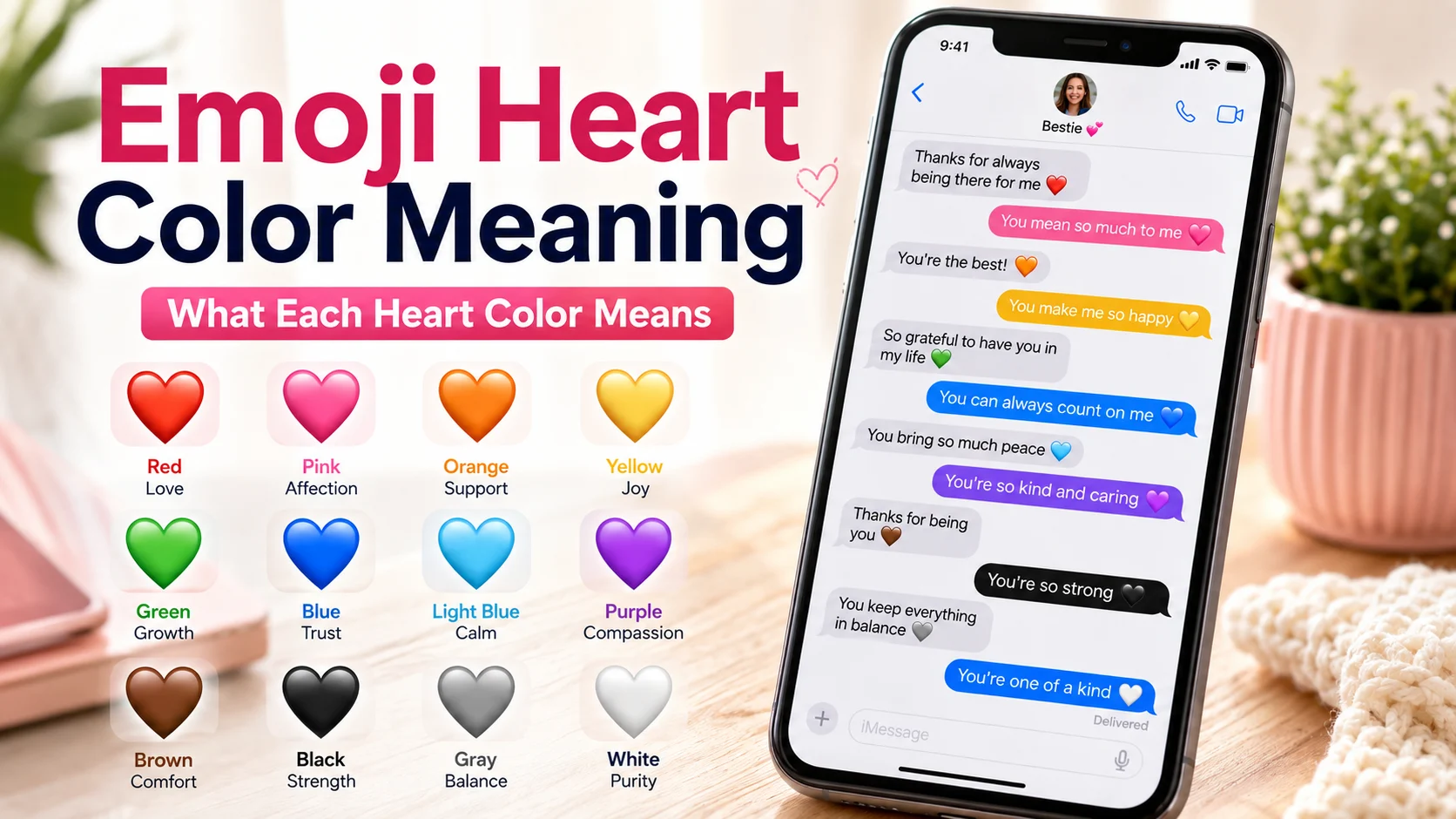
The emoji heart color meaning depends on the color, the surrounding message, and the relationship between the people texting. ❤️ Red Heart is commonly associated with love and strong affection, while 🩷 Pink Heart can express warmth, friendship, sweetness, or affection.
💛 Yellow Heart often feels cheerful and friendly, 💙 Blue Heart can suggest trust or support, and 💜 Purple Heart may express affection or admiration. Other colors can carry their own associations, but there is no universal secret code that makes one heart mean exactly one thing.
If someone sends you a colored heart, the shade can add a little extra meaning to the message. A ❤️ may feel more emotionally direct, while 🩷 can come across as sweet, warm, or affectionate. That difference can matter when a short text contains little else to explain the sender’s tone.
The emoji heart color meaning is not a fixed dictionary where every color has only one definition. People use heart emojis for friendship, affection, encouragement, appreciation, humor, support, celebrations, and romantic feelings. The same 🩷 or 💙 can therefore feel different depending on the words around it.
The safest way to understand a heart emoji is to look at the whole message. Consider what was said, how the person normally texts, and what kind of relationship you have. An emoji can reinforce the tone of a message, but by itself it usually cannot prove that someone is flirting, in love, upset, or trying to communicate a hidden message.
What Does the Emoji Heart Color Mean?
Colored heart emojis are visual variations of the same basic heart idea, but people often use different colors to create different emotional tones.
Here is a practical guide:
- ❤️ Red Heart: Love, deep affection, care, or strong appreciation.
- 🩷 Pink Heart: Warmth, sweetness, affection, friendship, or gentle love.
- 🧡 Orange Heart: Care, warmth, encouragement, and affection that may feel less intense than a red heart.
- 💛 Yellow Heart: Friendship, happiness, positivity, and cheerful affection.
- 💚 Green Heart: Caring, nature-related feelings, support, or other context-specific associations.
- 💙 Blue Heart: Trust, support, loyalty, calm affection, or appreciation.
- 🩵 Light Blue Heart: Gentle affection, warmth, calmness, or a soft supportive tone.
- 💜 Purple Heart: Affection, admiration, care, or a playful decorative feeling.
- 🤎 Brown Heart: Warmth, comfort, earthiness, or appreciation associated with the color brown.
- 🖤 Black Heart: Dark humor, sadness, seriousness, or affection expressed with a darker aesthetic.
- 🩶 Grey Heart: A subdued, neutral, gentle, or understated emotional tone.
- 🤍 White Heart: Care, kindness, sympathy, purity, or gentle affection.
These are common interpretations rather than strict rules. The Unicode Consortium provides the emoji characters and names, while real-world usage gives them additional shades of meaning.
❤️ Red Heart Meaning
The ❤️ Red Heart is one of the clearest ways to express love, affection, or strong emotional warmth.
In a romantic message, it can communicate love or attraction. Between friends or family members, it can simply show deep care and appreciation.
Example:
“Thank you for always being there for me ❤️”
Here, the heart strengthens the feeling of gratitude and affection. It does not automatically make the message romantic.
The important distinction is context. A red heart from a romantic partner may feel very different from the same emoji in a message from a close friend or family member.
Pink Heart Meaning
The 🩷 Pink Heart commonly expresses love, friendship, warmth, sweetness, and affection. It can feel softer or more playful than a traditional red heart.
It can work naturally in messages such as:
“You’re so sweet 🩷”
or
“Thanks for helping me today 🩷”
A pink heart can also be used romantically, but receiving 🩷 alone does not establish romantic interest. The rest of the conversation matters.
The Pink Heart was added to the Unicode emoji set with Emoji 15.0 in 2022. Its official Unicode name is Pink Heart, and its code point is U+1FA77.
🧡 Orange Heart Meaning
The 🧡 Orange Heart often communicates warmth, care, encouragement, and affection.
It can be useful when someone wants to show emotional support without making the message feel as intense as a traditional red heart.
For example:
“You’ve got this! 🧡”
The orange color can also simply match a visual theme or personal preference. It should not automatically be interpreted as a specific type of relationship.
💛 Yellow Heart Meaning
The 💛 Yellow Heart often has a cheerful and friendly feeling. It can express happiness, appreciation, positivity, and caring.
For example:
“So happy for you 💛”
The yellow heart may feel especially natural in upbeat or supportive messages. However, it can still be used between romantic partners or family members. Color alone does not determine the relationship.
💚 Green Heart Meaning
The 💚 Green Heart can communicate care, support, affection, or a connection to something associated with the color green.
Its meaning can change considerably with context. A message about nature might make the green color literal or thematic, while a personal message may use it simply as a heart of affection.
For example:
“Thanks for checking in on me 💚”
Here, the heart can simply reinforce appreciation and care.
💙 Blue Heart Meaning
The 💙 Blue Heart often creates a calm, supportive, or caring tone. It may be used to show trust, appreciation, loyalty, or emotional support.
For example:
“I’m proud of you 💙”
The blue color can make the message feel different from a red heart, but there is no universal rule saying that 💙 must represent friendship or that it cannot be romantic.
Light Blue Heart Meaning
The 🩵 Light Blue Heart gives a softer and lighter emotional impression than the traditional blue heart.
It can express gentle affection, support, warmth, or appreciation. Some people also choose it simply because they like the color.
For example:
“Hope everything goes well today 🩵”
The surrounding words are more useful for interpretation than the color alone.
💜 Purple Heart Meaning
The 💜 Purple Heart can communicate affection, admiration, care, or emotional warmth. It can also be selected because purple fits a particular aesthetic or theme.
For example:
“You did an amazing job 💜”
In this case, the emoji adds appreciation without necessarily changing the message into a romantic one.
🤎 Brown Heart Meaning
The 🤎 Brown Heart often gives messages a warm, cozy, grounded, or comforting tone.
For example:
“This made me smile 🤎”
It can also be used for color-based themes, autumn-related posts, food, nature, or personal aesthetic choices.
There is no single relationship meaning attached to the brown heart.
🖤 Black Heart Meaning
The 🖤 Black Heart can express affection while adding a darker, more serious, ironic, or playful tone.
For example:
“That joke was terrible 🖤”
Depending on the conversation, the black heart may make a message feel humorous or dramatic rather than simply affectionate.
It can also be used sincerely:
“Thinking of you 🖤”
The surrounding message is especially important with this emoji because its tone can vary widely.
🩶 Grey Heart Meaning
The 🩶 Grey Heart is a more subdued heart color. It can suggest quiet affection, understated support, neutrality, or simply a preference for the color.
For example:
“Thanks for understanding 🩶”
It may feel less visually intense than ❤️ or 💖, but that does not mean the sender cares less.
🤍 White Heart Meaning
The 🤍 White Heart can express kindness, gentle affection, sympathy, care, or a soft emotional tone.
For example:
“I’m here for you 🤍”
In supportive conversations, the white heart can feel calm and sincere. In other situations, it may simply be decorative or connected to a white-themed aesthetic.
Emoji Heart Color Meaning Compared
| Emoji | Official Name | Common Meaning | Tone | Where or When It Is Used |
|---|---|---|---|---|
| ❤️ | Red Heart | Love, affection, deep care | Strong, warm, affectionate | Romantic messages, family, close friends, appreciation |
| 🩷 | Pink Heart | Warmth, sweetness, affection | Soft, sweet, playful | Friendly texts, appreciation, affection, gentle romance |
| 🧡 | Orange Heart | Care, warmth, encouragement | Warm, supportive | Encouragement, friendship, appreciation |
| 💛 | Yellow Heart | Happiness, friendship, positivity | Cheerful, friendly | Celebrations, supportive texts, friendly messages |
| 💚 | Green Heart | Care, support, green-themed affection | Fresh, caring | Support, nature themes, appreciation |
| 💙 | Blue Heart | Trust, support, care | Calm, steady | Supportive messages, friendship, appreciation |
| 🩵 | Light Blue Heart | Gentle affection, warmth, support | Soft, calm | Kind messages, encouragement, light affection |
| 💜 | Purple Heart | Affection, admiration, care | Warm, expressive | Appreciation, affection, themed messages |
| 🖤 | Black Heart | Affection, dark humor, seriousness | Dramatic, ironic, sincere | Jokes, serious messages, darker aesthetics |
| 🤍 | White Heart | Kindness, care, sympathy | Gentle, calm | Support, sympathy, affection, soft messages |
The easiest hearts to confuse are often ❤️, 🩷, 💛, 💙, and 💜 because all can communicate affection. The difference is usually the emotional shade rather than a completely different message.
For example, ❤️ can feel more direct, 🩷 often feels softer, 💛 more cheerful, 💙 calmer, and 💜 more expressive or admiring. These are tendencies, not fixed rules.
Does Heart Color Change the Meaning of a Text?
Yes, it can change the tone, but it does not completely rewrite the message.
Compare:
“Thank you ❤️”
“Thank you 🩷”
“Thank you 💛”
All three communicate appreciation. The first may feel more emotionally strong, the second sweeter, and the third more cheerful.
But the sender’s usual texting style matters. Someone who uses colored hearts with everyone may not be making a subtle emotional statement each time.
Is a Colored Heart Romantic?
It can be, but a colored heart does not automatically mean romance.
❤️ is commonly associated with romantic love, but it is also widely used for family, friendship, support, and appreciation. 🩷 can also appear in romantic conversations, while 💛, 💙, 💜, or other hearts can be used between romantic partners.
If you are trying to understand whether someone is flirting, look at the complete conversation instead of treating one emoji as proof.
Words, timing, relationship history, and the person’s normal communication style provide much stronger context.
Can Heart Emojis Be Used Sarcastically?
Yes. Almost any emoji can be used playfully or sarcastically when the surrounding message creates that tone.
For example:
“Wow, you remembered my birthday two weeks later 🖤”
The black heart may add dramatic humor.
Likewise:
“Great job deleting the entire file 💛”
The yellow heart could make an obviously frustrated sentence sound deliberately exaggerated.
The emoji does not have a built-in sarcasm setting. The words around it create the joke.
What Does a Heart Emoji Mean From Someone?
A heart emoji from someone usually signals some form of positive emotion, such as affection, appreciation, support, warmth, or friendliness.
The exact meaning depends on the situation.
Message:
“Good luck on your test ❤️”
Likely meaning: encouragement and care.
Message:
“I had such a great time with you 🩷”
Likely meaning: warmth or affection, possibly romantic depending on the relationship.
Message:
“You always make me laugh 💛”
Likely meaning: friendly appreciation or affection.
None of these examples proves a particular relationship. The surrounding conversation provides the missing context.
How to Respond to a Heart Emoji
Your response can match the tone of the original message.
Warm:
“Aww, thank you ❤️”
Friendly:
“You’re the best 💛”
Supportive:
“Always here for you 💙”
Sweet:
“That’s so kind of you 🩷”
Neutral:
“Thank you! I really appreciate it.”
If you are unsure whether the sender intended a romantic meaning, you do not have to guess. You can simply respond naturally to what the message actually says.
Common Misunderstandings About Heart Colors
One of the biggest mistakes is treating heart colors like a universal code.
For example, it is tempting to say that one heart always means friendship while another always means romance. Real emoji use is more flexible than that.
Another common mistake is assuming that a particular heart proves attraction. It does not. A person may use ❤️ with a sibling, 🩷 with a friend, or 💙 with a romantic partner.
It is also easy to overread a single emoji. If the message is simply “Thanks 💛,” there may not be a hidden message at all. The person may have chosen the yellow heart because they like it.
What Is the Official Name of the Pink Heart Emoji?
The official Unicode name of 🩷 is Pink Heart.
Its Unicode code point is U+1FA77. It was approved in Unicode 15.0 and added to Emoji 15.0 in 2022.
The Unicode emoji charts list 🩷 alongside other colored heart symbols, including ❤️ Red Heart, 🧡 Orange Heart, 💛 Yellow Heart, 💚 Green Heart, 💙 Blue Heart, 🩵 Light Blue Heart, 💜 Purple Heart, 🤎 Brown Heart, 🖤 Black Heart, 🩶 Grey Heart, and 🤍 White Heart.
The technical name helps identify the character, but it does not mean every user must interpret the emoji in exactly the same way.
Heart Emoji Color Meaning: Which One Should You Use?
Choose based on the feeling you want to add rather than trying to follow a strict secret code.
- ❤️ for strong love or heartfelt affection
- 🩷 for sweet, warm, or gentle affection
- 🧡 for warmth and encouragement
- 💛 for cheerful friendship and positivity
- 💚 for care or green-themed messages
- 💙 for calm support, trust, or appreciation
- 🩵 for soft and gentle support
- 💜 for affection or admiration
- 🤎 for warmth and comfort
- 🖤 for darker humor, drama, or sincere affection
- 🩶 for understated or neutral warmth
- 🤍 for gentle care, sympathy, or kindness
There is no need to overthink it. If the color fits the mood and the message feels natural, it is usually a good choice.
FAQs
Does every heart color have a different meaning?
No. Heart colors can suggest different emotional tones, but their meanings overlap. Context and personal texting habits matter.
Is ❤️ stronger than 🩷?
It can feel more emotionally direct because the red heart is strongly associated with love, but there is no universal intensity scale for heart colors.
What does 💛 mean from a friend?
It often feels cheerful, friendly, supportive, or appreciative. However, the exact meaning depends on the conversation.
What does 💙 mean in a text?
💙 can express care, trust, support, loyalty, or affection. It does not have one guaranteed interpretation.
Can 🖤 mean something positive?
Yes. 🖤 can express affection, humor, appreciation, or sincerity. It can also add a darker or more dramatic tone.
Can a heart emoji mean friendship?
Absolutely. Heart emojis are commonly used in friendly conversations as well as romantic ones.
Conclusion
The emoji heart color meaning is best understood as a matter of tone, not a strict code. ❤️ may feel strongly affectionate, 🩷 often feels sweet and warm, 💛 cheerful, 💙 calm and supportive, and other colors add their own visual flavor.
Still, no colored heart can tell you exactly what someone feels on its own. The words, relationship, conversation history, and the sender’s usual style all matter. When you read a heart emoji in context, you are much less likely to mistake a friendly gesture for a romantic signal or miss the tone the sender intended.
