Quick Answer
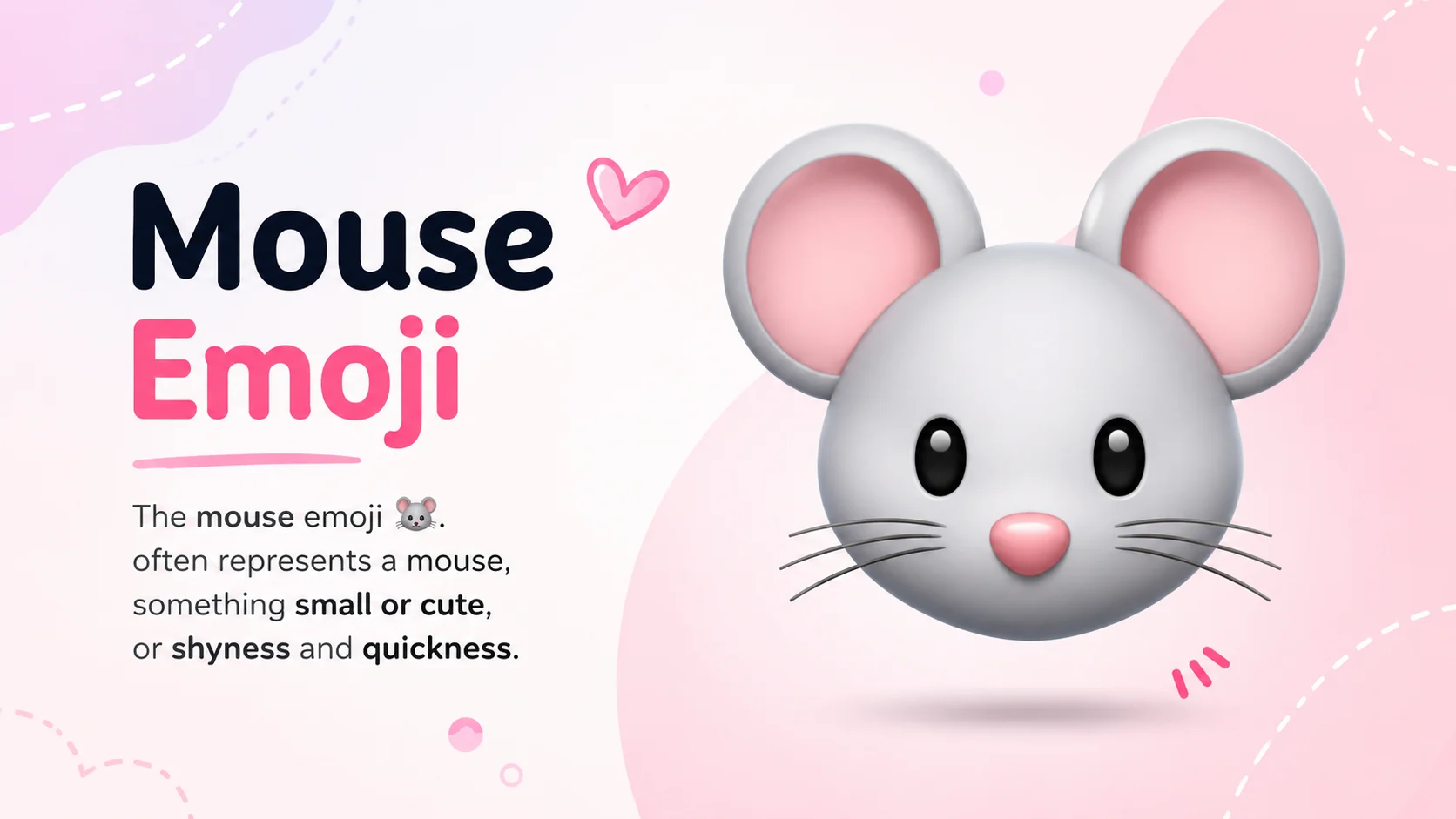
The mouse emoji 🐭 usually represents a mouse, small animal, or something cute and tiny. In texts, it can also suggest cuteness, shyness, nervousness, playfulness, or a small amount of something, depending on the conversation. It is generally lighthearted, but its meaning can change when combined with other emojis or words.
The 🐭 Mouse Face emoji shows the face of a mouse and is most commonly used when someone is talking about mice, small animals, pets, or something that feels tiny and cute. Unlike many expressive face emojis, its meaning is often tied directly to the animal itself.
In casual texting, however, 🐭 can take on a more playful meaning. Someone might use it to describe a shy reaction, a timid mood, or something small and adorable. The surrounding message usually tells you whether the emoji is meant literally or playfully.
It is also useful to distinguish 🐭 from other mouse-related emojis. Unicode includes both 🐭 Mouse Face and 🐁 Mouse, but they have different visual forms. The face emoji is often more expressive, while 🐁 represents the animal’s full body. Neither emoji has one universal emotional meaning.
What Does the Mouse Emoji 🐭 Mean?
The most direct meaning of 🐭 is simply a mouse.
Someone might use it when talking about:
- A real mouse
- A pet mouse
- Small animals
- A cartoon mouse
- Something tiny or cute
- A funny animal-related situation
For example:
“There’s a tiny mouse in the garage 🐭”
Here, the emoji is literal and simply reinforces what the message says.
But 🐭 can also add an emotional layer. Because mice are often associated with being small and timid, the emoji can sometimes be used playfully to describe a shy or nervous reaction.
Mouse Emoji Meaning in Text
In texting, 🐭 can have several possible meanings depending on context.
Literal mouse
The simplest use is talking about the animal.
“We saw a mouse outside 🐭”
The emoji directly represents the subject of the sentence.
Cute or adorable
Someone may use 🐭 when describing something small and cute.
“Look at this little guy 🐭”
Here, the emoji adds a sweet and playful feeling.
Shy or timid
Because mice are commonly imagined as small and cautious, 🐭 can sometimes be used metaphorically.
“Me trying to ask for help 🐭”
The emoji makes the message sound jokingly timid.
Small or tiny
The emoji may also accompany a comment about something being very small.
“That is the tiniest cookie I’ve ever seen 🐭”
In this situation, 🐭 is more of a playful visual reaction than a literal reference to a mouse.
Is the Mouse Emoji Cute?
Yes, 🐭 can easily have a cute and playful tone, especially when the conversation involves animals, small objects, or affectionate jokes.
For example:
“My new hamster is so tiny 🐭”
The emoji helps emphasize the adorable animal theme.
However, “cute” is a contextual interpretation rather than the official definition of the emoji. The official character is Mouse Face, so its basic meaning remains connected to a mouse.
Can the Mouse Emoji Mean Shy?
It can, but this is an informal interpretation.
A person might use 🐭 to jokingly describe themselves as quiet, timid, or nervous.
For example:
“I wanted to say hi but I got nervous 🐭”
The mouse image reinforces the idea of being timid.
That does not mean every 🐭 represents shyness. If someone sends:
“There was a mouse in my kitchen 🐭”
the emoji is clearly literal.
Mouse Emoji Meaning From Someone
If someone sends you 🐭 by itself, there is not enough information to assign one definite meaning.
It could mean:
- “Mouse”
- “That’s cute”
- “I feel shy”
- “Something is tiny”
- A reference to an animal
- An inside joke
Look at the message before and after it. If the conversation is about pets, it is probably literal. If someone is joking about being nervous, the emoji may be metaphorical.
Avoid assuming that 🐭 automatically means affection, flirting, or romantic interest.
Is the Mouse Emoji Flirty?
The 🐭 emoji is not inherently a flirting emoji.
It can appear in a playful or affectionate conversation, but the character itself does not establish romantic interest.
For example:
“You’re being so shy today 🐭”
could sound teasing or affectionate depending on the relationship and conversation.
By contrast:
“I saw a mouse in the kitchen 🐭”
has no obvious romantic meaning.
The surrounding words and relationship context matter more than the emoji alone.
Can the Mouse Emoji Be Used as an Insult?
Usually, 🐭 is not an insult on its own.
However, animals can be used metaphorically in negative ways, and a sender could use 🐭 in a teasing or critical message.
For example:
“Why are you hiding over there? 🐭”
could be playful teasing or could feel insulting depending on the conversation.
The emoji does not automatically make the message friendly or rude. Tone comes from the entire message.
Mouse Emoji in Different Situations
Talking about animals
“I saw a mouse at the pet store 🐭”
Meaning: A literal mouse.
Describing something tiny
“This little cake is so small 🐭”
Meaning: Playful emphasis on its tiny size.
Showing nervousness
“I have to present in front of everyone tomorrow 🐭”
Meaning: A joking way to show nervousness or timidity.
Making a cute comment
“Look at those tiny ears 🐭”
Meaning: The emoji adds an adorable animal-related tone.
Making a joke
“Me when someone says ‘volunteer’ 🐭”
Meaning: Playfully pretending to hide or be timid.
Mouse Emoji vs. Similar Animal Emojis
| Emoji | Official Name | Common Meaning | Tone | Where or When It Is Used |
|---|---|---|---|---|
| 🐭 | Mouse Face | Mouse, small or cute animal | Cute, playful | Animal talk, jokes, tiny things |
| 🐁 | Mouse | A mouse or small rodent | Neutral, literal | Animals, nature, stories |
| 🐹 | Hamster | Hamster, cuteness, pet | Cute, cheerful | Pets, adorable reactions |
| 🐰 | Rabbit Face | Rabbit, bunny, cuteness | Cute, friendly | Animals, playful messages |
| 🐱 | Cat Face | Cat, affection, playful mood | Cute, casual | Pets, animal conversations |
| 🦔 | Hedgehog | Hedgehog, small animal | Cute, quirky | Animal topics, playful reactions |
| 🐿️ | Chipmunk | Chipmunk, small woodland animal | Playful, energetic | Nature, animals, jokes |
| 🐾 | Paw Prints | Animals, pets, footprints | Playful, affectionate | Pet posts, animal conversations |
The biggest distinction is between 🐭 Mouse Face and 🐁 Mouse. Both represent mice, but 🐭 focuses on the animal’s face while 🐁 depicts the full animal. 🐹 is often a better choice when the subject is specifically a hamster, while 🐾 is broader and can refer to animals or pets in general.
🐭 Mouse Face vs. 🐁 Mouse
These two emojis are easy to confuse.
🐭 Mouse Face is a close-up face of a mouse. Its appearance can make it feel more expressive or cute.
🐁 Mouse shows the full body of a mouse. It is more straightforward when you simply want to represent the animal.
So if you’re writing:
“I saw a mouse today 🐁”
the full-body mouse works naturally.
For a playful reaction such as:
“Look how cute this little mouse is 🐭”
the face emoji may fit better.
Neither one has a guaranteed emotional meaning.
How to Respond to the Mouse Emoji
Your response can depend on what the sender means.
If they are sharing something cute
“Aww, that’s adorable! 🥹”
If they are joking about being shy
“Haha, you’re fine 😂”
A simple clarification is better than trying to guess a hidden meaning.
Common Mouse Emoji Combinations
The 🐭 emoji can work with other emojis to make the intended idea clearer.
- 🐭❤️ | affection toward a mouse or something cute
- 🐭😂 | funny mouse-related situation
- 🐭🥹 | something extremely cute or heartwarming
- 🐭😳 | surprised or nervous reaction involving a mouse
- 🐭🏠 | a mouse in or around a house
- 🐭🐾 | animal or pet theme
- 🐭✨ | cute or playful presentation
These combinations do not have fixed dictionary meanings. They are simply ways users can build context around the mouse emoji.
Mouse Emoji Copy and Paste
Here is the mouse emoji ready to copy:
🐭
Related options:
🐭 🐁 🐹 🐰 🐱 🦔 🐿️ 🐾
Choose 🐭 when you want the mouse-face appearance specifically. If you want to show the entire animal, 🐁 may be a better fit.
Official Mouse Emoji Name and Details
The official Unicode name for 🐭 is Mouse Face.
The character is part of the Unicode emoji set, where emoji characters receive standardized names and code points. Its Unicode code point is U+1F42D.
The related full-body mouse emoji, 🐁, has the official name Mouse and uses the code point U+1F401.
The visual design can vary between Apple, Google, Samsung, Microsoft, and other platforms. The exact colors, facial details, and shape may therefore look slightly different depending on the device or service.
These design differences do not create separate official meanings.
FAQs
What does 🐭 mean?
🐭 is officially Mouse Face. It usually represents a mouse and can also be used playfully for something cute, tiny, shy, or timid.
What is the difference between 🐭 and 🐁?
🐭 is Mouse Face, showing a close-up mouse face. 🐁 is Mouse, showing the full animal. Both can represent a mouse.
Does 🐭 mean cute?
It can suggest cuteness in the right context, especially when discussing small animals or adorable things. “Cute” is a common contextual interpretation rather than the emoji’s official name.
Does 🐭 mean shy?
Sometimes. People can use the mouse image as a playful metaphor for being timid or nervous, but that meaning depends on context.
Is 🐭 a flirting emoji?
Not inherently. It can appear in a playful or affectionate conversation, but 🐭 alone does not prove romantic interest.
Conclusion
The mouse emoji 🐭 officially represents a Mouse Face, but its conversational use can be broader. It may refer to a real mouse, something tiny and cute, or a playful feeling of shyness or nervousness.
Context is the key. A message about an actual animal is likely literal, while a joke about hiding or feeling nervous may use 🐭 metaphorically. And while it can appear in affectionate conversations, it is not automatically a flirting or romantic emoji.
Discover More Related Articles:
- Yes Emoji | From Simple Agreement to Excitement In 2026
- Bye Emoji | Goodbye, Hello or Something Else In 2026
