Quick Answer
The envelope emoji ✉️ represents a letter, written message, mail, or email. People commonly use it when talking about sending or receiving messages, checking their inbox, or sharing written communication. Depending on the context, it can also suggest an important announcement, a personal note, or a message waiting to be read.
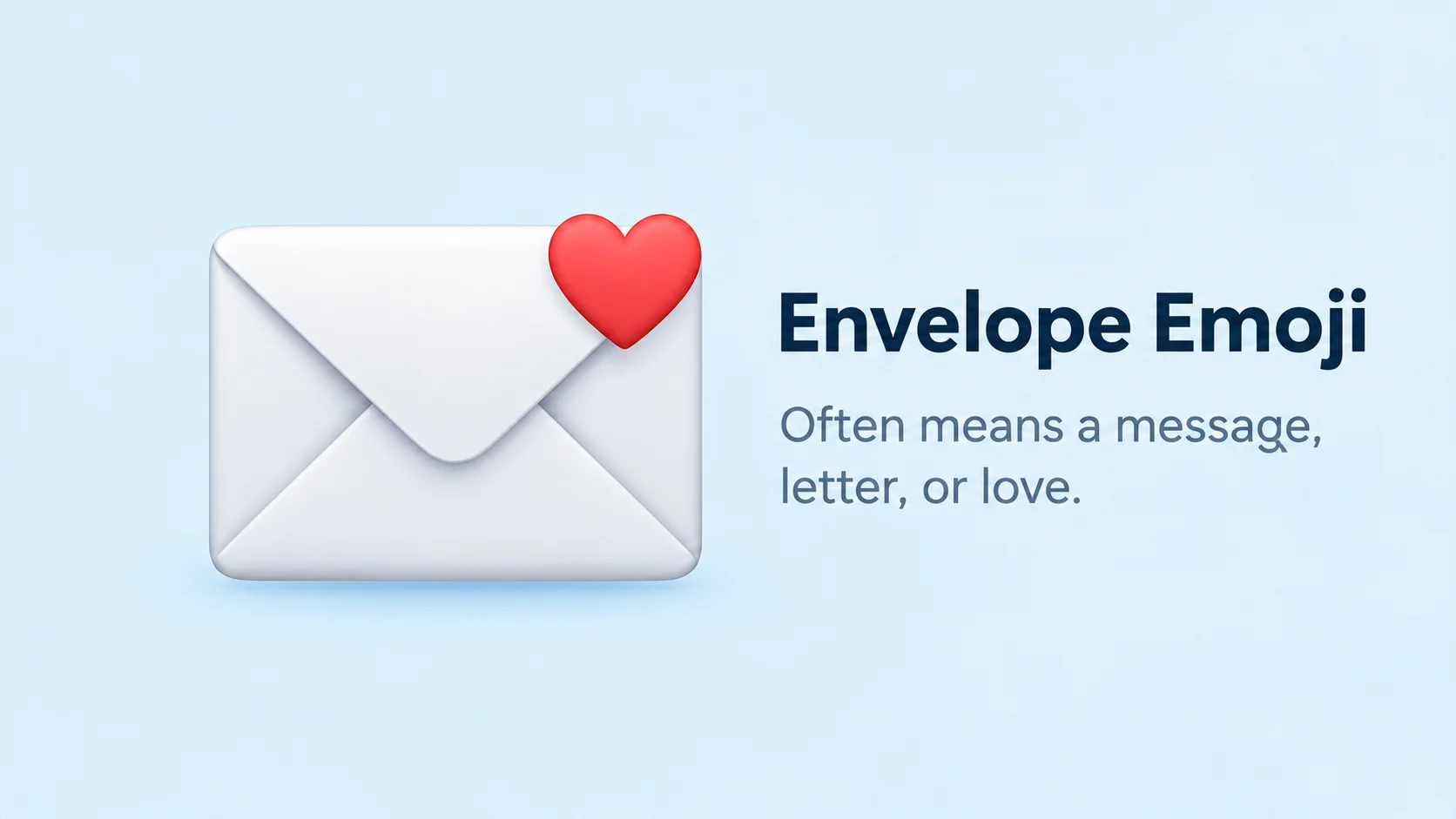
The ✉️ emoji, officially called Envelope, represents a traditional envelope used to carry a letter. In digital conversations, it commonly refers to mail, email, written communication, or sending a message. It offers a simple visual way to talk about correspondence without writing a long explanation.
When someone uses the envelope emoji in a text, they might be talking about an email they sent, a letter they received, or a message they want another person to check. It can also appear in social media posts, business announcements, online forms, and contact information to indicate that a message can be sent.
However, ✉️ does not always mean the same thing in every conversation. A work-related message might use it to refer to an email, while a personal conversation might use it to suggest a letter or thoughtful note. The surrounding words help explain what the sender means.
What Does the Envelope Emoji ✉️ Mean in Texting?
In texting, ✉️ usually refers to a written message, an email, or the act of sending or receiving correspondence. Its meaning is practical rather than strongly emotional.
Here are a few examples:
- “I sent you the details ✉️” — The sender is referring to a message or written information they sent.
- “Check your email ✉️” — The sender wants you to look at your inbox.
- “Your letter is ready ✉️” — The emoji refers to a letter that is prepared to be sent.
- “Contact us ✉️” — The emoji indicates that written contact is available.
Unlike a smiling face or a heart, ✉️ does not normally express a specific emotion. It identifies the topic of communication.
What Does ✉️ Mean on Social Media?
On social media, the envelope emoji can refer to messages, email contact, written announcements, or private correspondence.
Its meaning depends on how it appears in the post:
- In a profile bio: It may indicate an email address or a way to contact someone.
- In a business post: It can suggest contacting a company for information.
- In an announcement: It may refer to a message, letter, or email containing details.
- In a personal caption: It can represent a handwritten letter or a message intended for someone.
- In a conversation: It may simply mean that someone has sent or received a message.
The emoji does not automatically mean that a private message has arrived. The sender may just be using it as a general symbol for written communication.
Does the Envelope Emoji Mean Email or a Letter?
It can mean either one.
The traditional envelope design represents physical correspondence, but digital communication has made it a familiar symbol for email and online messaging too.
For example:
“I mailed the invitation today ✉️”
Here, the emoji refers to a physical letter or invitation.
“I’ll email you the document ✉️”
In this case, it represents electronic correspondence.
When the distinction matters, use the surrounding words to make clear whether you mean postal mail, an email, or a message sent through an app.
Is the Envelope Emoji Romantic?
The ✉️ emoji is not inherently romantic, but it can appear in affectionate or sentimental messages.
A traditional letter may feel personal or thoughtful, particularly when someone is talking about a handwritten note, a special invitation, or a message to a loved one.
For example:
“I wrote you a little letter ✉️”
This could suggest a personal or thoughtful gesture.
However, the emoji alone does not prove romantic interest. In a work conversation, the same symbol would more likely refer to an ordinary email or document.
If you want to make a message more clearly affectionate, 💌, the Love Letter emoji, may communicate that idea more directly.
Related Envelope Emojis and Their Meanings
The following emojis are closely related to ✉️ and can help you choose the right symbol for different types of correspondence. Their official names are listed in the Unicode emoji charts.

unicode.org+1
| Emoji | Official Name | Common Meaning | Tone | Where or When It Is Used |
|---|---|---|---|---|
| ✉️ | Envelope | Letter, mail, or written communication | Neutral, practical | Emails, letters, contact details |
| 📧 | Electronic mail | Practical, professional | Email addresses and email-related messages | |
| 📨 | Incoming Envelope | Receiving mail or a message | Informational | Incoming correspondence and notifications |
| 📩 | Envelope with Arrow | Sending or directing a message | Action-oriented | Sent messages and email instructions |
| 💌 | Love Letter | Affectionate note or romantic letter | Romantic, sentimental | Love notes, Valentine’s Day, thoughtful messages |
| 📥 | Inbox Tray | Incoming messages or items | Practical, organizational | Inbox references and received documents |
| 📤 | Outbox Tray | Outgoing messages or items | Practical, organizational | Sent mail and outgoing correspondence |
| 📫 | Closed Mailbox with Raised Flag | Mail waiting in a mailbox | Informational | Postal mail and mail delivery |
| 📬 | Open Mailbox with Raised Flag | Mailbox with mail available | Informational, positive | Receiving letters or checking the mail |
✉️ vs. 📧: What’s the Difference?
✉️ represents a general envelope and can refer to physical letters or electronic messages. 📧, officially called E-mail, is more specifically associated with electronic mail.
Use ✉️ when you mean correspondence in general. Choose 📧 when you want to make the email connection clearer.
✉️ vs. 📨: What’s the Difference?
✉️ is a general envelope symbol. 📨, Incoming Envelope, more specifically suggests mail or a message coming in.
For example, ✉️ works well beside a contact address, while 📨 may be a better fit for a notification about received correspondence.
✉️ vs. 📩: What’s the Difference?
📩, officially called Envelope with Arrow, features an arrow pointing toward the envelope. It is commonly used to represent sending or directing a message.
Choose ✉️ for a general reference to mail and 📩 when the emphasis is on sending a message.
✉️ vs. 💌: What’s the Difference?
The main difference is emotional tone.
✉️ is a general symbol for correspondence, while 💌, Love Letter, suggests affection, romance, or a sentimental note. If you’re talking about a business email, ✉️ is usually the clearer choice. If you’re sharing a love note, 💌 may fit better.
How to Respond When Someone Sends ✉️
The best response depends on the message accompanying the emoji.
If someone says they sent you an email:
“Thanks! I’ll check it.”
If someone says they mailed you a letter:
“That’s thoughtful of you!”
If someone asks you to contact them:
“Sure, I’ll send you a message.”
If someone shares a business contact address:
“Thank you for the contact information.”
You do not need to reply with another emoji. A short, relevant response is usually enough.
Copy and Paste the Envelope Emoji
✉️
Copy the envelope emoji for your next message, email, caption, or post. Copy Envelope Emoji ✉️
You can also copy these related symbols:
📧 E-mailCopy
📨 Incoming EnvelopeCopy
📩 Envelope with ArrowCopy
💌 Love LetterCopy
Official Envelope Emoji Name and Unicode Details
The official Unicode name of ✉️ is ENVELOPE, and its code point is U+2709. Unicode lists it among its emoji characters and associates it with email and letter-related keywords.
unicode.org+1
The emoji may look slightly different across operating systems, browsers, and applications. Some designs show a simple white envelope with a visible flap, while others use different outlines or shading. These visual differences do not change its basic meaning.
The envelope symbol also has a text-style presentation, ✉, and an emoji-style presentation, ✉️. The latter includes a variation selector that requests emoji-style display where supported.
FAQs
What does the ✉️ emoji mean?
It represents an envelope, letter, email, or written communication. The exact meaning depends on the message in which it appears.
Does ✉️ mean someone sent me an email?
It can refer to an email, but it does not confirm that an email has actually been sent or received. Check the accompanying message for that information.
What is the difference between ✉️ and 💌?
✉️ is a general envelope symbol. 💌 represents a Love Letter and has a stronger affectionate or romantic association.
Can I use ✉️ in a professional email or business post?
Yes. It can indicate email contact, correspondence, or a way to reach a business.
Does ✉️ mean a private message?
Not necessarily. It may refer to email, a physical letter, or written communication in general. It does not specifically identify a private message on any particular platform.
Conclusion
The envelope emoji ✉️ is a straightforward symbol for letters, email, mail, and written communication. It works in personal messages, business posts, contact information, and announcements whenever you want to refer to correspondence.
Its meaning becomes clearer when you compare it with related emojis: 📧 specifically suggests email, 📨 indicates incoming correspondence, 📩 suggests sending a message, and 💌 adds a more affectionate tone. Choose the symbol that best matches the message you want to communicate.
Discover More Related Articles:
- Wide Eye Emoji | Surprise, Curiosity & Suspicion In 2026
- Joker Emoji | Captions, Comments & Bios In 2026
