Quick Answer
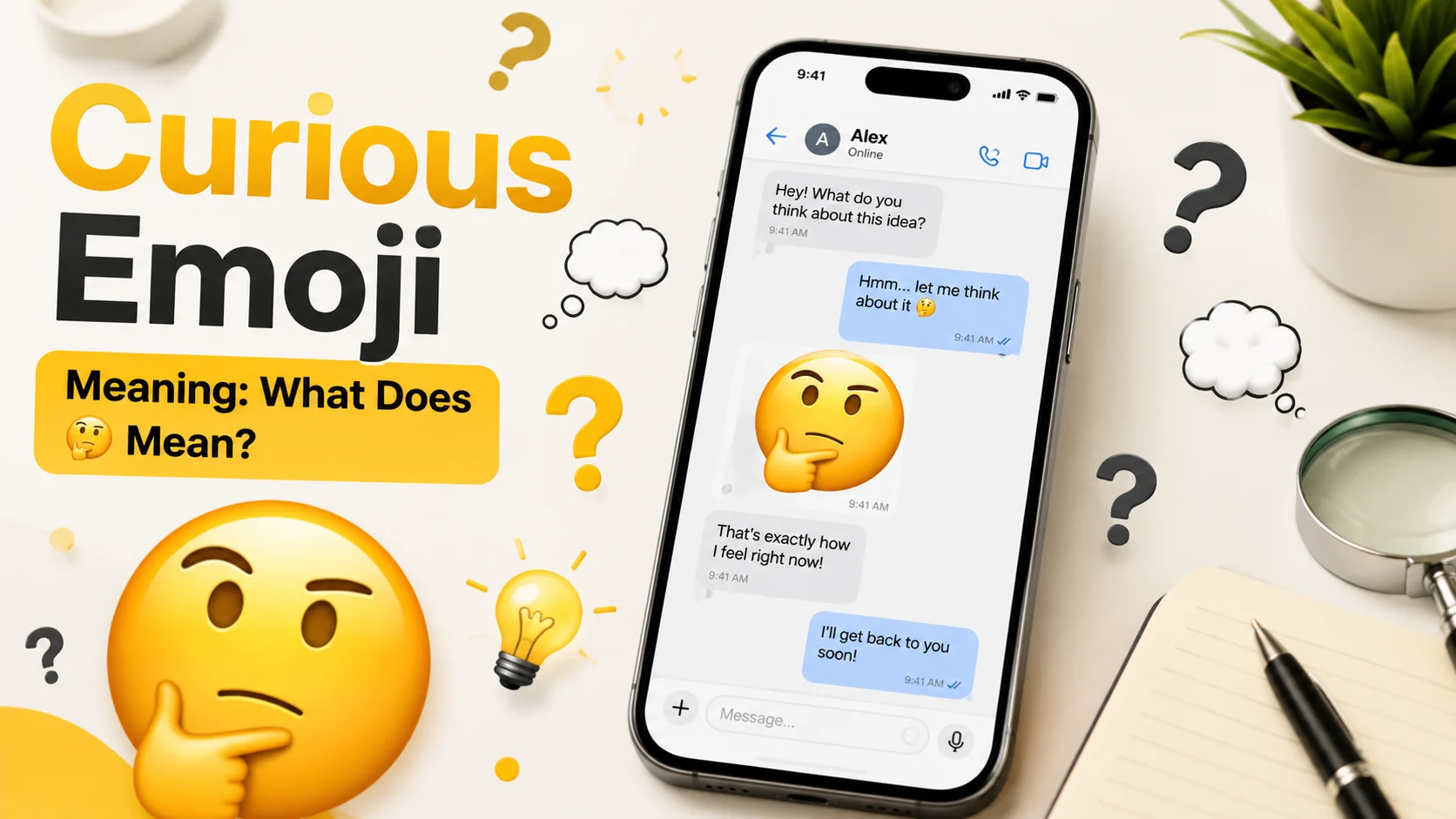
The 🤔 Thinking Face is one of the most commonly used emojis to express curiosity, thinking, wondering, questioning, or uncertainty. It can mean “I’m thinking about it,” “Hmm, I wonder,” or “I’m not sure about that.”
Its tone can be serious, playful, skeptical, or even mildly teasing depending on the message around it. Unicode officially names 🤔 Thinking Face, so “curious emoji” is a common description of how people use it rather than its official name.
When someone sends 🤔, they may be showing that something has caught their attention and they are thinking about it. The emoji’s raised-looking brows, upward gaze, and hand-on-chin pose visually suggest a person considering an idea. That makes it a natural choice for messages about questions, decisions, possibilities, and curiosity.
The phrase curious emoji often refers to 🤔 because people use the Thinking Face to show that they are wondering about something. However, curiosity is only one possible interpretation. The same emoji can express doubt, skepticism, puzzlement, or a playful “Hmm…” depending on the conversation.
The best way to understand 🤔 is to read it together with the words around it. “What do you mean? 🤔” sounds genuinely inquisitive, while “You really believe that? 🤔” may sound skeptical. The emoji adds tone, but it does not have one fixed meaning in every conversation.
What Is the Curious Emoji?
The emoji most commonly associated with curiosity is 🤔 Thinking Face.
Unicode’s official short name is thinking face, and its Unicode code point is U+1F914. Unicode’s associated keywords include ideas such as “consider,” “hmm,” “ponder,” and “wondering,” which help explain why the emoji is often described as a curious or questioning emoji.
Visually, 🤔 shows a yellow face looking upward with a hand resting under the chin. Emojipedia describes it as an expression of pondering or deep thought. It can also be used to question or challenge something, with the tone ranging from earnest and puzzled to playful, skeptical, or mocking.
What Does 🤔 Mean in Texting?
In texting, 🤔 commonly means:
- “I’m thinking.”
- “I’m wondering.”
- “Hmm, I’m not sure.”
- “Let me consider that.”
- “That’s interesting.”
- “I’m curious about this.”
- “I have a question.”
- “I’m not convinced.”
For example:
“What do you think we should do? 🤔”
Here, 🤔 reinforces genuine thought or uncertainty.
Another example:
“Wait… how did you know that? 🤔”
This sounds curious and slightly surprised.
The same emoji can take on a different tone when paired with skeptical wording:
“You said you finished it already? 🤔”
Here, it may suggest doubt rather than simple curiosity.
🤔 Curious vs. Thinking Meaning
Curiosity and thinking are closely related, but they are not exactly the same.
When 🤔 is used for curiosity, the sender may want to know more:
“I wonder what’s inside that box 🤔”
When it is used for thinking, the sender may be considering a choice:
“I need to think about it 🤔”
When it expresses doubt, it can mean:
“That doesn’t sound right 🤔”
The emoji itself does not change. The words and situation create the difference.
Is 🤔 a Questioning Emoji?
Yes, 🤔 can function as a questioning emoji even though its official name is Thinking Face.
It can communicate a silent “Hmm?” or signal that the sender wants more information.
For example:
“So where did you hear that? 🤔”
The emoji adds a questioning, curious tone.
It can also appear without a question mark:
“You were there too 🤔”
In that situation, it may imply that the sender is wondering about or reconsidering something.
Is 🤔 Skeptical or Suspicious?
Sometimes.
A message such as:
“You expect me to believe that? 🤔”
uses the emoji to add skepticism.
That is different from:
“I wonder how this works 🤔”
The first suggests doubt, while the second expresses curiosity.
If the message seems accusatory, 🤔 can make the sender’s skepticism more noticeable. But it does not automatically mean the person is suspicious or distrustful.
Can 🤔 Be Playful or Sarcastic?
Yes. Context can make the Thinking Face playful or sarcastic.
For example:
“Interesting choice of outfit 🤔”
Depending on the relationship and conversation, this could be genuine curiosity or a playful tease.
Another example:
“You totally didn’t eat the last cookie 🤔”
Here, 🤔 can create a jokingly skeptical tone.
It is better to look at the full message than assume that 🤔 always signals sarcasm.
What Does 🤔 Mean From Someone?
When someone sends 🤔 to you, it often means they are considering something you said or asking themselves a question about it.
Consider:
“I might go tomorrow 🤔”
This may mean the person is undecided.
“How did you figure that out? 🤔”
This suggests curiosity.
“Hmm, I’m not sure about that 🤔”
This communicates uncertainty or doubt.
A single 🤔 cannot tell you exactly what the sender feels. The surrounding words provide the strongest clue.
Does 🤔 Mean Someone Is Confused?
It can, but confusion is not its main official meaning.
🤔 may suggest uncertainty or puzzlement when someone does not understand something.
For example:
“I don’t understand how that happened 🤔”
However, if the person is clearly confused, 😕 Confused Face may communicate that feeling more directly. Emojipedia describes 😕 as conveying uncertainty and notes that it can also express slight sadness, disappointment, or frustration.
So:
- 🤔 = thinking, wondering, questioning
- 😕 = confusion or uncertainty
The difference is subtle but useful.
Curious Emoji Examples in Text Messages
Example 1: Genuine curiosity
“What happens if you press that button? 🤔”
Likely meaning: The sender wants to know what will happen.
Example 2: Thinking about a decision
“I might come with you 🤔”
Likely meaning: The person is considering the idea but has not decided.
Example 3: Questioning information
“Are you sure that’s the right answer? 🤔”
Likely meaning: The sender is uncertain or mildly skeptical.
Example 4: Playful teasing
“You said you weren’t hungry 🤔”
Likely meaning: The sender is jokingly pointing out a contradiction.
Example 5: Genuine interest
“Wait, tell me more about that 🤔”
Likely meaning: The sender is interested and wants more information.
These examples are hypothetical illustrations. The same emoji can have a different tone in another conversation.
Related Emojis for Curiosity and Thinking
| Emoji | Official Name | Common Meaning | Tone | Where or When It Is Used |
|---|---|---|---|---|
| 🤔 | Thinking Face | Thinking, wondering, questioning | Curious, thoughtful, skeptical | Questions, decisions, uncertain replies |
| 🧐 | Face with Monocle | Close examination or scrutiny | Curious, analytical, skeptical | Investigating details or examining a claim |
| 🤨 | Face with Raised Eyebrow | Doubt, skepticism, disbelief | Suspicious, questioning | Questioning something that seems questionable |
| 😕 | Confused Face | Confusion or uncertainty | Puzzled, unsure | When something does not make sense |
| 😯 | Hushed Face | Surprise, concern, mild excitement | Surprised, cautious | Unexpected information or reactions |
| 😳 | Flushed Face | Embarrassment, surprise, excitement | Awkward, surprised, emotional | Unexpected or embarrassing situations |
| 🧐 | Face with Monocle | Examination or inspection | Investigative, observant | Looking closely at information |
| ❓ | Red Question Mark | Direct question or uncertainty | Clear, inquisitive | Asking a question or highlighting uncertainty |
The most important distinction is between 🤔, 🧐, and 🤨. 🤔 usually centers on thinking or wondering. 🧐 has a more investigative or examining feel, while 🤨 often adds skepticism or doubt. Emojipedia describes 🤨 as conveying sentiments including suspicion, skepticism, concern, consideration, disbelief, and disapproval.
😕 is another common point of confusion. It usually communicates that something is unclear or confusing, while 🤔 can simply mean the sender is taking time to think.
🤔 vs. 🧐: What’s the Difference?
Both emojis can suggest curiosity, but they create different impressions.
🤔 Thinking Face feels like:
“Hmm, I’m thinking about this.”
🧐 Face with Monocle feels more like:
“Let me examine this carefully.”
Use 🤔 when you are considering an idea or wondering about something. Use 🧐 when you want to emphasize close examination, investigation, or scrutiny.
🤔 vs. 🤨: What’s the Difference?
These two emojis can both question something, but their emotional tones differ.
🤔 usually sounds more open-minded:
“I wonder if that’s true 🤔”
🤨 can sound more doubtful:
“You really expect me to believe that? 🤨”
If you are genuinely curious, 🤔 is usually the softer choice. If you are questioning someone’s claim, 🤨 may feel stronger.
How to Respond to 🤔
Your response can depend on what the sender seems to be asking.
If they seem curious:
“Yeah, I was wondering about that too.”
If they seem unsure:
“Take your time and think about it.”
If they seem skeptical:
“Fair question. Here’s what happened…”
If they are teasing:
“Haha, what? 🤔”
If you cannot tell what the person means, a simple clarification works:
“What are you thinking? 😂”
That keeps the conversation natural without assuming their intention.
Is 🤔 a Flirty Emoji?
🤔 is not inherently a flirty emoji.
It can appear in a playful or flirtatious conversation, but the emoji itself primarily communicates thinking, wondering, questioning, or skepticism. Emojipedia describes its tone as varying from earnest and playful to puzzled, skeptical, and mocking.
For example:
“So… are you saying you want to hang out? 🤔”
The surrounding words could make the exchange playful or suggestive, but 🤔 alone does not prove romantic interest.
Can 🤔 Be Rude?
Usually, 🤔 is not automatically rude. However, it can sound dismissive or skeptical in certain messages.
For example:
“That’s your excuse? 🤔”
may sound judgmental.
But:
“Hmm, let me think 🤔”
is generally neutral.
Tone comes from the combination of the emoji, wording, punctuation, and relationship between the people communicating.
Official Name and Unicode Details
The official Unicode name for 🤔 is Thinking Face.
- Emoji: 🤔
- Official name: Thinking Face
- Unicode code point: U+1F914
- Unicode category: Smileys & Emotion
- Emoji version: Emoji 1.0
- Unicode version: Unicode 8.0
Unicode lists “consider,” “hmm,” “ponder,” “pondering,” and “thinking” among the associated keywords for this character.
The character was approved in Unicode 8.0 in 2015 and added to Emoji 1.0 in 2015.
Does 🤔 Look the Same on Every Device?
Not exactly.
Apple, Google, Samsung, Microsoft, WhatsApp, and other platforms can render the same Unicode emoji with slightly different artwork. The basic concept remains recognizable, but details such as facial shape, eyes, colors, and hand position may vary.
These visual differences usually do not change the basic meaning of 🤔, but they can slightly affect how expressive the emoji feels.
Common Misunderstandings About the Curious Emoji
The biggest misunderstanding is assuming that 🤔 always means “confused.”
It can mean confusion, but it can also show curiosity, careful thought, uncertainty, skepticism, or playful questioning.
Another mistake is assuming that 🤔 always means the sender disagrees with you. A person may simply be thinking about your message.
It is also easy to treat one emoji as a hidden relationship signal. 🤔 does not automatically indicate flirting, attraction, annoyance, or rejection.
Look at the complete message before assigning a strong emotional meaning.
FAQs
What is the curious emoji?
There is no official emoji named “Curious Face.” 🤔 is officially called Thinking Face, but it is commonly used to express curiosity, wondering, and questioning.
What does 🤔 mean in texting?
🤔 commonly means “I’m thinking,” “I’m wondering,” “Hmm,” or “I’m not sure.” It can also communicate skepticism or playful questioning.
Is 🤔 the thinking emoji?
Yes. Its official Unicode name is Thinking Face, making “thinking emoji” a more precise description than “curious emoji.”
Does 🤔 mean curiosity?
It can. The emoji is frequently used when someone is wondering about something or wants to consider an idea.
Does 🤔 mean confused?
Sometimes, but not always. 🤔 usually focuses more on thinking or wondering, while 😕 is more directly associated with confusion or uncertainty.
What is the difference between 🤔 and 🧐?
🤔 suggests thinking or wondering, while 🧐 often suggests closer examination, investigation, or scrutiny.
Conclusion
The curious emoji 🤔 is officially called Thinking Face, and its core idea is thought, wondering, and consideration. In everyday texting, it can also express curiosity, uncertainty, skepticism, or playful questioning.
The key is context. “I wonder how that works 🤔” sounds curious, while “You really believe that? 🤔” sounds skeptical. Instead of treating 🤔 as a fixed code, read it alongside the sender’s words and communication style.
