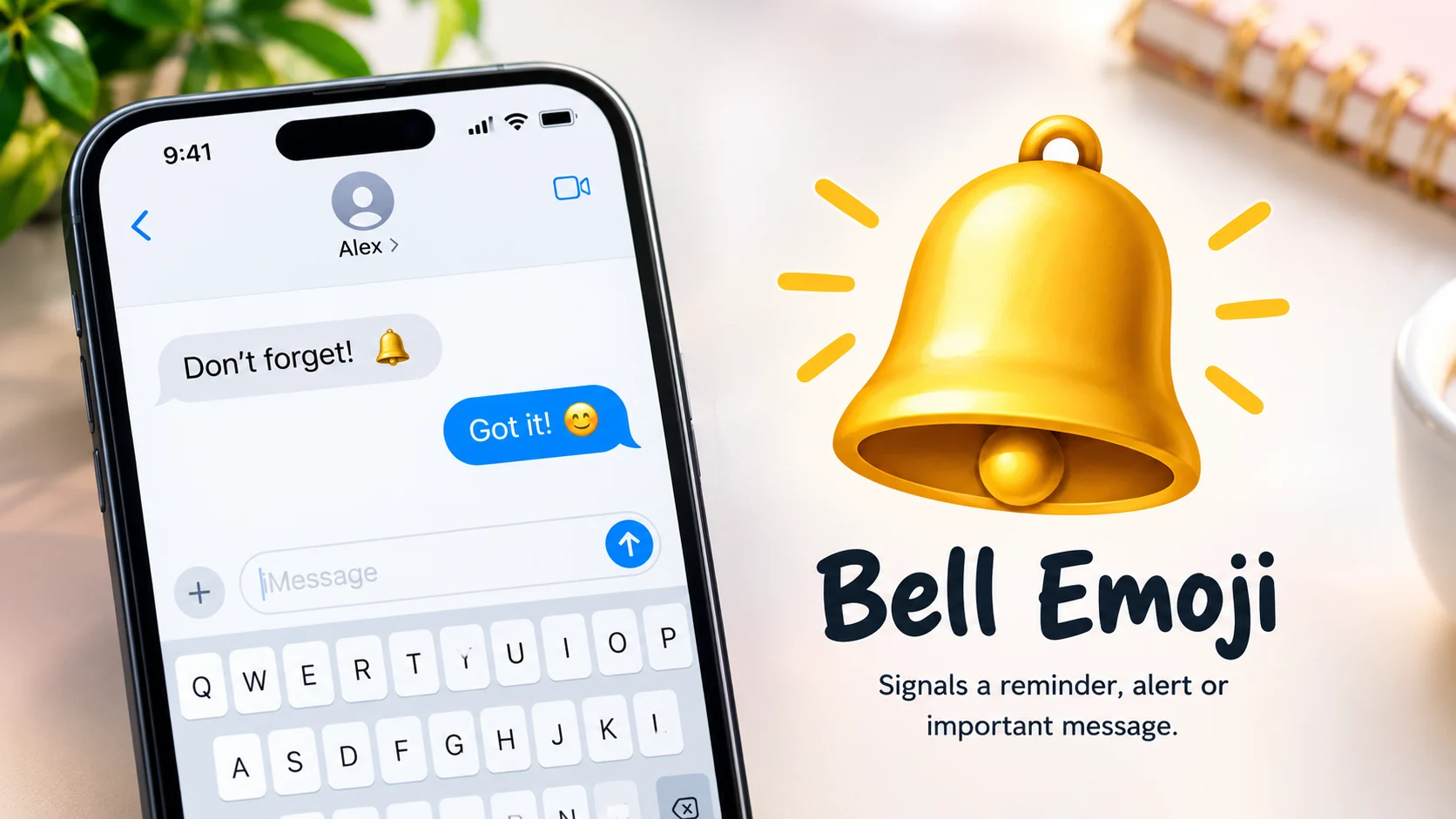
Quick Answer
The bell emoji 🔔 commonly represents a bell ringing, a notification, or a reminder. Its tone is usually neutral and attention-grabbing, but it can also feel cheerful, playful, or urgent. In texting, it may mean “pay attention,” “remember this,” “someone is at the door,” or “the event is starting.”
The 🔔 bell emoji is a simple symbol of sound, attention, and reminders. It shows a bell that people may associate with a notification, a school bell, a doorbell, or a signal that something is about to happen. Unicode officially identifies it as BELL, making it a useful choice when you want to represent ringing or a sound that calls attention.
In text messages, the bell emoji can have several meanings without changing its appearance. Someone might send it to remind you about an appointment, celebrate an announcement, or tell you that the doorbell is ringing. A message such as “🔔 Don’t forget your meeting” feels practical, while “Ding ding 🔔” sounds playful.
The emoji can also be confused with 🔕, the bell with slash, which represents a muted or silenced bell. Understanding the difference helps you choose the right symbol when talking about notifications, reminders, or turning sounds off.
What Does the Bell Emoji 🔔 Usually Mean?
The most common meaning of 🔔 is a bell or a ringing sound. It can represent something that makes a noise to get attention, such as a doorbell, school bell, alarm bell, or notification.
People use it for several related ideas:
- A bell ringing
- A notification
- A reminder
- An announcement
- Getting someone’s attention
- A signal that something is starting
- A cheerful or celebratory sound
The emoji itself does not guarantee that a real bell is ringing. In casual conversation, it may simply be a visual way to say “ding,” “listen up,” or “remember this.”
For example:
“🔔 Your appointment is tomorrow.”
This uses the bell as a reminder.
“Ding ding 🔔 We have a winner!”
This uses the bell as a playful celebration.
What Does 🔔 Mean in Texting?
In texting, 🔔 often works as a visual alert. It can be used to highlight information, remind someone of a task, or signal that an announcement is coming.
Reminder
“🔔 Don’t forget to bring your notebook.”
The emoji adds attention to the reminder.
Notification
“I just got a new message 🔔.”
Here, the bell represents a notification sound.
Announcement
“🔔 Important update: The meeting starts at 3.”
The emoji makes the announcement stand out.
Attention
“🔔 Hey, listen to this!”
This is a casual way to tell someone to pay attention.
Doorbell
“Someone’s at the door 🔔.”
The emoji can represent a doorbell ringing.
These uses are common interpretations, not fixed meanings that apply to every message.
Bell Emoji Meaning in Different Situations
In a Friendly Conversation
A friend may use 🔔 to remind you about something or get your attention.
“🔔 Don’t forget we’re meeting after school.”
The tone is practical and friendly.
In a Group Chat
The emoji can help draw attention to an announcement.
“🔔 Everyone, the plans have changed.”
It signals that the message deserves attention.
In a Work or School Message
🔔 can represent a reminder, schedule, or start time.
“🔔 The presentation begins in ten minutes.”
This is a neutral use.
In a Celebration
The bell can represent a cheerful sound or a signal that something good has happened.
“Ding ding 🔔 We finished the project!”
The tone is excited and playful.
In a Joke
Someone may use the emoji to imitate a bell or exaggerate an announcement.
“🔔 Class is officially dismissed.”
The meaning depends on the joke and the conversation.
Is the Bell Emoji 🔔 a Notification?
Yes, 🔔 is commonly used to represent a notification or alert. Many people associate a bell symbol with being notified about new activity, reminders, or updates.
However, the emoji itself does not activate notifications or change any app settings. It simply represents the idea of a bell or alert in a message.
For example:
“🔔 Check your notifications.”
This uses the bell as a visual reminder.
“Turn on notifications 🔔.”
This is a request related to alerts, but the emoji alone does not mean that notifications are enabled.
Does 🔔 Mean “Pay Attention”?
It can. When placed before a message, the bell emoji often suggests that the reader should notice what follows.
“🔔 Important announcement!”
This means the sender wants attention.
“🔔 Wait, I have something to tell you.”
This uses the bell as a playful signal to listen.
The tone may be serious or casual. A bell in a school announcement, for example, feels different from a bell used in a funny group chat message.
Bell Emoji Meaning in Relationships
The 🔔 emoji does not have a fixed romantic meaning. In a relationship or a conversation with someone you like, it might represent a reminder, a message alert, or a playful way to get attention.
For example:
“🔔 Don’t forget our plans tonight.”
This is a reminder.
“Ding ding 🔔 I have news for you.”
This is playful and conversational.
The emoji alone does not prove attraction, affection, or romantic interest. The surrounding words and the existing relationship matter more.
Is the Bell Emoji Flirty?
🔔 is not inherently a flirting emoji. It can appear in a playful conversation, but it does not automatically mean someone is flirting.
For example:
“🔔 You have a message from your favorite person.”
This may sound teasing, but the romantic meaning comes from the wording and context rather than the bell itself.
If someone sends only 🔔, it is usually more reasonable to interpret it as a bell, alert, or attention signal than as a hidden romantic message.
Can 🔔 Be Sarcastic?
Yes. The bell emoji can be used sarcastically when someone wants to exaggerate an announcement or act as though something deserves a formal signal.
For example:
“🔔 Breaking news: You finally cleaned your room.”
The humor comes from treating an ordinary event like a major announcement.
Another example:
“🔔 Attention, everyone. I have arrived.”
This may be playful or sarcastic depending on the conversation.
Emotional Tone of the Bell Emoji
The bell emoji usually has a neutral or cheerful tone, but its emotional effect depends on the message.
Neutral
“🔔 Your reminder is set.”
This is informational.
Cheerful
“Ding ding 🔔 We finished!”
This sounds celebratory.
Urgent
“🔔 Please check this message.”
The emoji draws attention and may make the message feel more important.
Playful
“🔔 Class is in session.”
This can be a joke or a dramatic announcement.
Supportive
“🔔 Just a reminder that you can do this.”
Here, the bell highlights an encouraging message.
Bell Emoji Compared With Similar Emojis
| Emoji | Official Name | Common Meaning | Tone | Where or When It Is Used |
|---|---|---|---|---|
| 🔔 | Bell | Bell ringing, notification, or reminder | Neutral, cheerful, or alert | Reminders, announcements, messages, celebrations |
| 🔕 | Bell with Slash | Notifications or bell sounds are muted | Neutral | Talking about silencing alerts or quiet mode |
| 📣 | Megaphone | Public announcement or loud call for attention | Loud, emphatic | Group messages, announcements, public notices |
| 📢 | Loudspeaker | Broadcasting information or making an announcement | Direct, attention-grabbing | Alerts, announcements, public messages |
| ⏰ | Alarm Clock | Wake-up alarm, time, or reminder | Practical, urgent | Schedules, waking up, deadlines |
| 🔊 | Speaker High Volume | Loud sound or high volume | Energetic, emphatic | Music, sound, volume, loud reactions |
| 🔉 | Speaker Medium Volume | Moderate sound or volume | Neutral | Audio settings, sound levels |
| 🔇 | Muted Speaker | No sound or muted audio | Neutral or cautionary | Silence, muted devices, turning sound off |
| 🛎️ | Bellhop Bell | Service bell or a bell used to call someone | Practical, playful | Hotels, service requests, door or counter bells |
The closest comparison is 🔕 because it is the muted version of the bell. 🔔 represents a bell or alert, while 🔕 suggests that the sound or notification is turned off.
📣 and 📢 are more focused on broadcasting or making an announcement. ⏰ is more closely connected to time and alarms. The speaker emojis, such as 🔊 and 🔇, represent audio volume rather than a bell specifically.
Bell Emoji Examples in Text Messages
Reminder
“🔔 Don’t forget your appointment tomorrow.”
Likely meaning: The sender is reminding you about an event.
Notification
“I got a notification 🔔.”
Likely meaning: The bell represents an alert or new activity.
Attention
“🔔 Everyone, please listen.”
Likely meaning: The sender wants the group to pay attention.
Doorbell
“🔔 Someone is at the door.”
Likely meaning: A doorbell is ringing or someone has arrived.
Celebration
“Ding ding 🔔 We did it!”
Likely meaning: The bell adds a cheerful, celebratory sound.
Playful Announcement
“🔔 Today’s announcement: I am hungry.”
Likely meaning: A funny or exaggerated announcement.
School or Work
“🔔 The meeting starts now.”
Likely meaning: The bell highlights the start of an event.
Common Misunderstandings About 🔔
One common misunderstanding is that 🔔 always means a phone notification. Although that is a frequent interpretation, it can also represent a real bell, a reminder, an announcement, or a playful sound.
Another misunderstanding is that the emoji means someone is angry or demanding attention. The bell can draw attention without sounding rude. A message such as “🔔 Please remember your homework” is different from a message that uses harsh words.
It is also easy to confuse 🔔 with 🔕. The first represents a bell or alert, while the second represents a bell with the sound crossed out or muted.
When the context is unclear, read the words around the emoji before deciding what the sender means.
How to Respond to the Bell Emoji
Your response depends on what the sender is communicating.
If They Are Giving a Reminder
“Thanks for reminding me!”
If They Are Making an Announcement
“Got it, thanks for the update.”
If They Are Trying to Get Your Attention
“What’s up?”
If They Are Being Playful
“Ding ding 😂”
If You Are Unsure
“Is that a reminder or an announcement?”
These responses keep the conversation natural without assuming a hidden meaning.
When Should You Use 🔔?
Use the bell emoji when you want to represent a sound, reminder, alert, or attention signal.
It works well for:
- Reminding someone about an event
- Announcing something
- Drawing attention to a message
- Representing a doorbell
- Talking about notifications
- Celebrating an achievement
- Making a playful announcement
- Talking about school bells or meeting signals
If you want to show that notifications are muted, 🔕 is a better choice. If you want to represent a loud public announcement, 📣 or 📢 may fit better.
Copy and Paste Bell Emoji
🔔
You can copy and paste the bell emoji into texts, captions, comments, reminders, or announcements.
Common combinations include:
- 🔔📢
- 🔔⏰
- 🔔😂
- 🔔📣
- 🔔🎉
The surrounding emojis can help show whether the message is about a reminder, announcement, joke, or celebration.
Official Name and Unicode Details
The bell emoji is officially named BELL by Unicode. Its code point is U+1F514. The Unicode CLDR short name is also “bell.”
The emoji represents a bell and is commonly associated with ringing, sound, and alerts. Its appearance can vary slightly across devices and operating systems, but the main concept remains the same.
The related emoji 🔕 is officially named BELL WITH SLASH, which represents a muted or silenced bell.
FAQs
What does the bell emoji 🔔 mean?
The bell emoji usually means a bell, notification, reminder, or alert. It can also represent an announcement or a playful “ding.”
What does 🔔 mean in texting?
In texting, 🔔 often means “pay attention,” “remember this,” “there is a notification,” or “something is starting.” The exact meaning depends on the message.
Does 🔔 mean someone is calling me?
Not necessarily. It can represent a notification or alert, but the emoji alone does not specifically mean someone is calling.
What is the difference between 🔔 and 🔕?
🔔 represents a bell or ringing alert. 🔕 represents a bell with a slash, commonly used to show that notifications or sounds are muted.
Is the bell emoji flirty?
Not by itself. It can be used in a playful or affectionate conversation, but it does not automatically indicate flirting or romantic interest.
Conclusion
The 🔔 bell emoji usually represents a bell, notification, reminder, or signal that something deserves attention. In texts, it can be practical, cheerful, playful, or slightly urgent depending on the surrounding words. It may refer to a doorbell, school bell, phone alert, announcement, or a simple “ding ding” reaction.
The best way to understand the bell emoji is to read it with the complete message. It does not automatically mean flirting, anger, or any other specific feeling. If you want to show a muted notification, use 🔕. If you want to represent a public announcement, 📣 or 📢 may be more suitable.
Discover More Related Articles:
